Ex parte property 2025

Get Form
ex parte property Preview on Page 1

Here's how it works

01. Edit your ex parte property online
Type text, add images, blackout confidential details, add comments, highlights and more.

02. Sign it in a few clicks
Draw your signature, type it, upload its image, or use your mobile device as a signature pad.

03. Share your form with others
Send petition approval property via email, link, or fax. You can also download it, export it or print it out.

How to use or fill out ex parte property with our platform

Form edit decoration
9.5
Ease of Setup
DocHub User Ratings on G2
9.0
Ease of Use
DocHub User Ratings on G2
  1. Click ‘Get Form’ to open the ex parte property document in the editor.
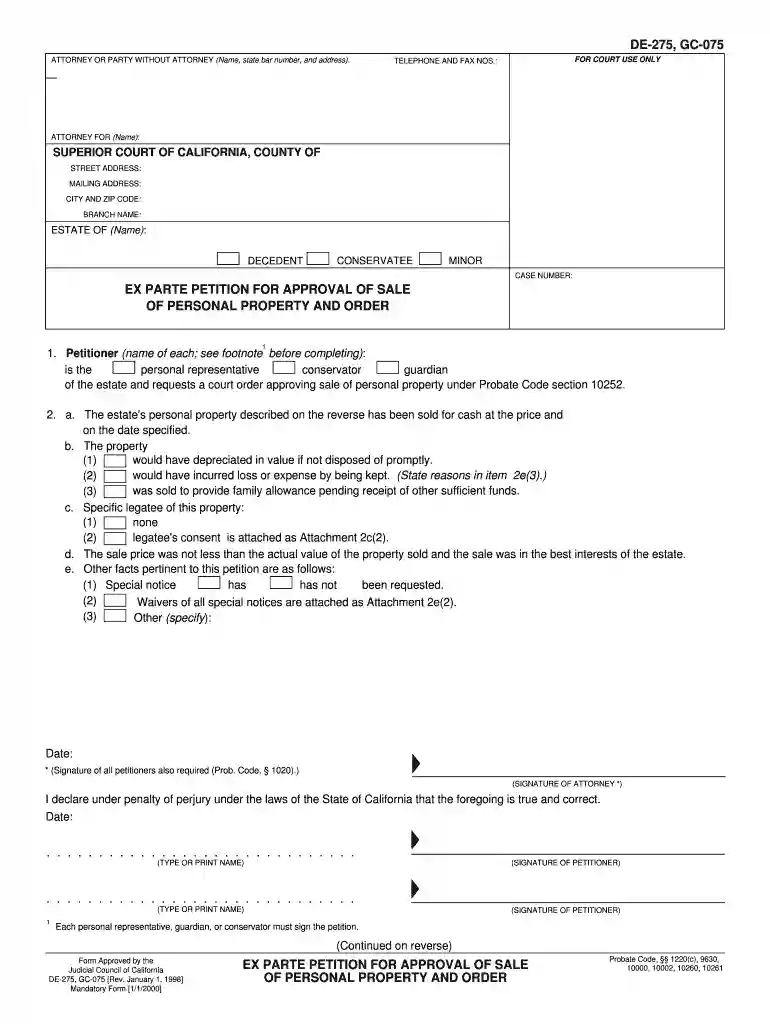
  2. Begin by entering your name, state bar number, and address in the 'ATTORNEY OR PARTY WITHOUT ATTORNEY' section. This identifies you as the petitioner.
  3. Fill in the 'FOR COURT USE ONLY' section with relevant court details including case number and estate information.
  4. In Section 1, specify the names of all petitioners and their roles (personal representative, conservator, guardian).
  5. Complete Section 2 by detailing the personal property sold, including sale price and reasons for sale. Ensure to attach any necessary consents or waivers.
  6. Sign and date the form where indicated. All petitioners must provide their signatures for validation.

Start using our platform today to streamline your ex parte property form completion for free!

See more ex parte property versions

We've got more versions of the ex parte property form. Select the right ex parte property version from the list and start editing it straight away!
Versions Form popularity Fillable & printable
1998 4.8 Satisfied (146 Votes)
be ready to get more

Complete this form in 5 minutes or less

Get form

Got questions?

We have answers to the most popular questions from our customers. If you can't find an answer to your question, please contact us.
Contact us
Once notified of the order, the other party has the right to request a hearing and contest the judges decision. At this hearing, the other party (or the other partys lawyer) presents evidence and arguments, after which the judge can decide whether to maintain, modify, or dissolve the temporary order.
thirty days to set aside a decree passed ex parte or to rehear an appeal decreed or heard ex parte, and the starting point of limitation given is the date of the decree or, where the summons or notice was not duly served, when the applicant had knowledge of the decree.
Examples of situations where the court may approve an ex parte order include, but are not limited to: Writ of possession for property that was stolen. Temporary restraining order where there is immediate danger that property may become unavailable for levy. Correcting a clerical error in a pleading.
What are the Disadvantages of Ex Parte? Lack of Representation: Since ex parte orders are issued without the other party being present, the accused parent doesnt have a chance to defend themselves initially. Temporary Nature: Ex parte orders are usually temporary and meant to provide immediate protection.
An ex parte hearing is a legal proceeding where one party asks the court to issue temporary orders on an urgent matter. Unlike regular hearings, which require formal notice and typically take several weeks to schedule, an ex parte hearing allows the requesting party to appear before a judge on short notice.

People also ask

An ex parte communication undermines the fairness of a judicial proceeding by introducing new information to the decision-maker (the judge or jury) without giving the other party an opportunity to explain or respond. Not all ex parte communications result in due process violations.

Related links