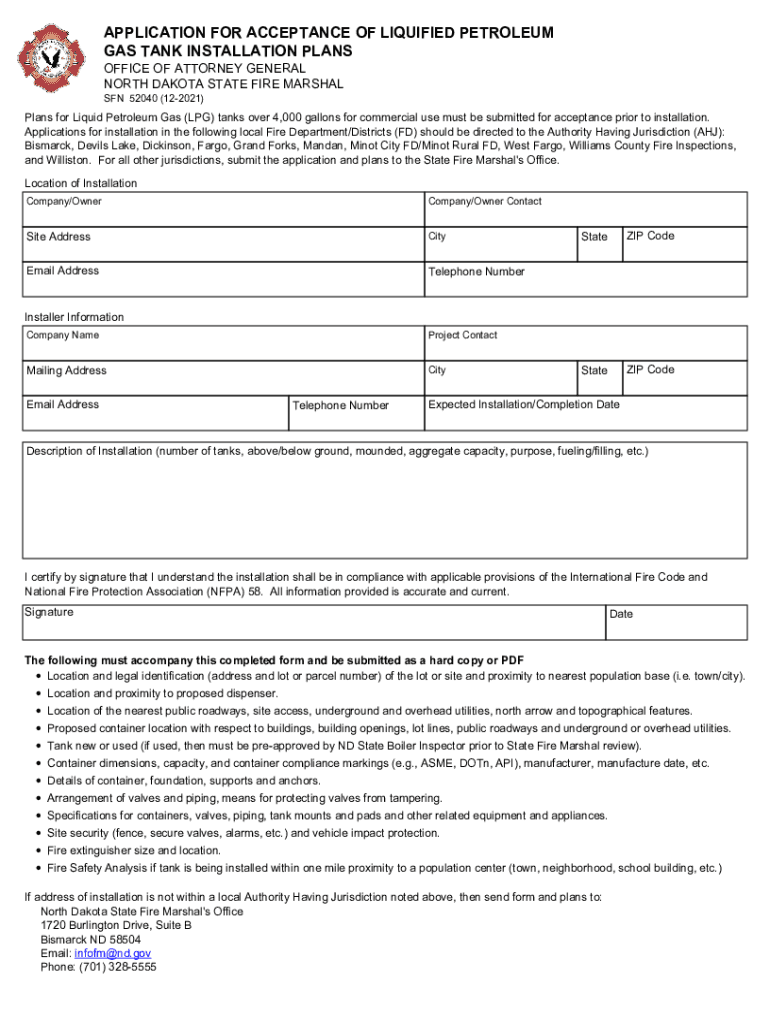
Application for acceptance of liquified petroleum gas tank installation 2026

Get Form
application for acceptance of liquified petroleum gas tank installation Preview on Page 1

Here's how it works

01. Edit your form online
Type text, add images, blackout confidential details, add comments, highlights and more.
02. Sign it in a few clicks
Draw your signature, type it, upload its image, or use your mobile device as a signature pad.
03. Share your form with others
Send it via email, link, or fax. You can also download it, export it or print it out.

How to use or fill out application for acceptance of liquified petroleum gas tank installation with DocHub

Form edit decoration
9.5
Ease of Setup
DocHub User Ratings on G2
9.0
Ease of Use
DocHub User Ratings on G2
  1. Click ‘Get Form’ to open the application for acceptance of liquified petroleum gas tank installation in our editor.
  2. Begin by filling in the 'Location of Installation' section, including the company/owner name, contact details, and site address. Ensure all information is accurate to avoid delays.
  3. In the 'Installer Information' section, provide the installer’s company name and project contact details. Specify the expected installation/completion date and a detailed description of the installation, including tank specifications.
  4. Review the certification statement at the bottom of the form. You will need to sign and date this section to confirm compliance with relevant codes.
  5. Attach any required documents as specified in the instructions, such as site plans and safety analyses. Use our platform's upload feature for convenience.

Start your application process today using our platform for free!

See more application for acceptance of liquified petroleum gas tank installation versions

We've got more versions of the application for acceptance of liquified petroleum gas tank installation form. Select the right application for acceptance of liquified petroleum gas tank installation version from the list and start editing it straight away!
Versions Form popularity Fillable & printable
2021 4.8 Satisfied (80 Votes)
be ready to get more

Complete this form in 5 minutes or less

Get form

Got questions?

We have answers to the most popular questions from our customers. If you can't find an answer to your question, please contact us.
Contact us
Propane tanks are generally set on a concrete pad for proper support. If the concrete is limited to small pads under the feet of the tank, you should surround the rest of the tank with barrier and crushed rock or gravel. Keep combustible materials away from propane tanks.
The average propane tank costs $1,400. Depending on the tank size and location, most homeowners spend between $600 and $2,500 on propane tank installation. A propane pro can estimate your total costs. Tank size and installation location are the most docHub cost factors.
Safety Guidelines for Propane Tank Installation Most regulations for homeowners require above-ground propane tanks to be at least 10 feet away from your home, property line, or any exterior source of ignition that could cause a fire, such as window AC units and central AC compressors.
Due to NFPA regulations, most propane tanks must be at least 10 feet from your home. However, this minimum distance applies to tanks starting at 500 gallons. This distance also includes underground tanks that can hold 2,000 gallons. Other sizes will have more specific regulations.
Many homeowners feel comfortable hanging a lighting fixture, mounting a new television or switching out a bathroom faucet. But anything involving a gas line needs to be handled by a licensed professional. Attempting to a propane tank yourself is dangerous and often illegal.

Security and compliance

At DocHub, your data security is our priority. We follow HIPAA, SOC2, GDPR, and other standards, so you can work on your documents with confidence.

Learn more

People also ask

The AmeriGas service crew will lift and place the tank on its concrete pad or in its hole. After the tank has been set and leveled, we will run the propane gas lines and test the system for leaks.
NFPA 58, Liquefied Petroleum Gas Code, contains the requirements pertaining to the placement of liquefied petroleum gas (LP-Gas) containers.

Related links