




01. Edit your mtm distance verification form online
Type text, add images, blackout confidential details, add comments, highlights and more.

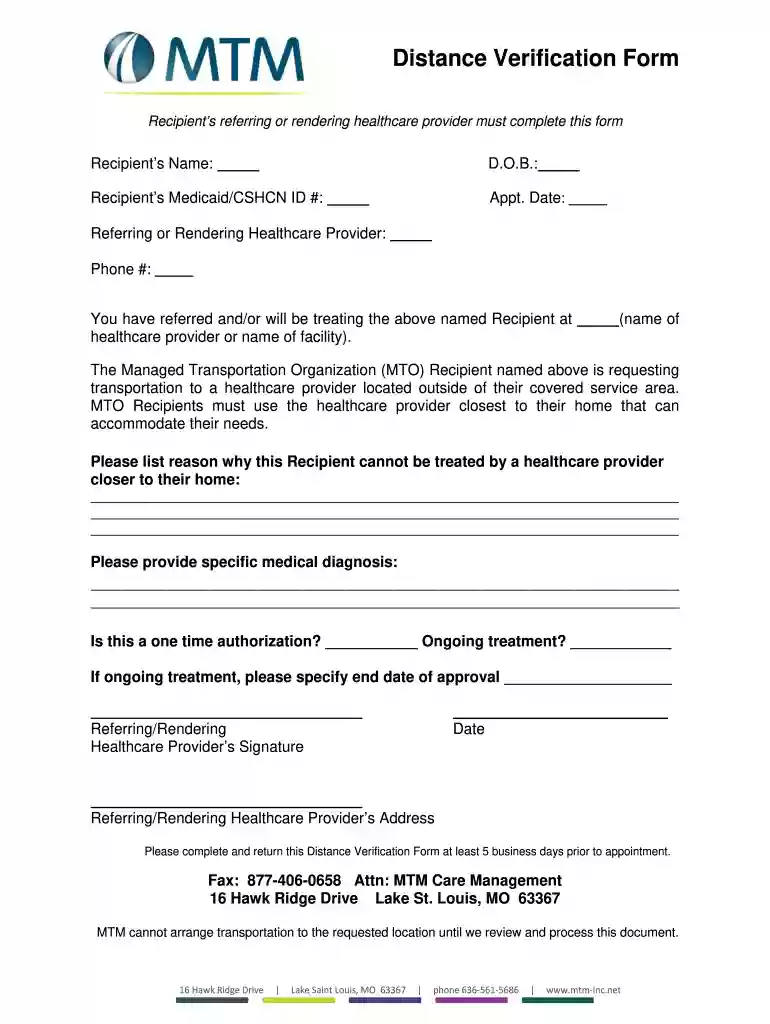
Type text, add images, blackout confidential details, add comments, highlights and more.

Draw your signature, type it, upload its image, or use your mobile device as a signature pad.

Send distance verification form mtm via email, link, or fax. You can also download it, export it or print it out.
Distance verification is a crucial process that ensures recipients of transportation services, particularly in healthcare, meet the necessary criteria for mileage reimbursement. This term generally relates to forms and protocols used for verifying the distance between a recipient’s residence and medical facilities for eligible transportation covered under Medicaid or other medical transportation programs.
The distance verification form often requires careful documentation that includes:
Accurate distance verification is essential for ensuring that the reimbursement complies with Medicaid guidelines and supports the effective allocation of transportation resources.
Completing the distance verification form involves several important steps. This process must be followed meticulously to avoid delays in transportation and reimbursement.
Collect Necessary Information:
Measure the Distance:
Document Medical Necessity:
Complete the Form Accurately:
Submit the Form:
By following these detailed steps, the chances of prompt processing and approval increase, facilitating timely access to necessary medical transportation services.
The distance verification form is primarily utilized by various stakeholders in the healthcare and transportation sectors. Understanding the typical users can help clarify the purpose and application of the form.
Healthcare Providers: Doctors, hospitals, and clinics often complete these forms to request transportation for patients needing to attend medical appointments outside their service area.
Patients and Recipients: Individuals who are eligible for non-emergency medical transportation (NEMT) services may be directly involved in filling out parts of the form or providing necessary information, especially if they are self-managing their transportation needs.
Transportation Services: Organizations and companies that provide NEMT services for Medicaid recipients utilize this documentation to schedule rides and ensure compliance with all regulatory requirements.
Medicaid Administrators: Individuals working within the state Medicaid offices regularly review these forms to verify eligibility for transportation reimbursements and manage service provisions efficiently.
By recognizing these users, the process of distance verification can be streamlined, ensuring that all parties understand their roles in facilitating medical transportation.


Familiarity with key terms associated with the distance verification process is essential for effective communication and understanding of the requirements involved. Below are crucial terms often encountered:
Medicaid Mileage Reimbursement: This refers to the compensation provided to Medicaid beneficiaries for travel to medical appointments, calculated based on the distance verified via the form.
NEMT (Non-Emergency Medical Transportation): It is a service designed to help eligible individuals access healthcare appointments when they do not have other means of transportation.
MTM (Medical Transportation Management): A company that coordinates transportation services for Medicaid recipients, ensuring compliance with state and federal regulations.
Medical Necessity: A term used to justify the need for transportation based on a patient's medical condition, requiring documentation for approval.
Provider Network: A group of healthcare providers and transportation services recognized by Medicaid that satisfy specific regulatory criteria for providing services to recipients.
Understanding these terms enhances the clarity and accuracy of the documentation and processes involved in distance verification and medical transportation services.
The distance verification form serves numerous legal purposes in the context of healthcare and transportation. Its proper use is essential to comply with the regulations governing Medicaid and related transportation services.
Compliance With Medicaid Regulations: The form acts as evidence that recipients qualify for transportation assistance, adhering to the criteria set forth by federal and state Medicaid programs.
Documentation for Reimbursement Claims: It provides necessary documentation for reimbursing transportation providers, establishing a clear record of valid services rendered based on verified distances.
Prevention of Fraud: Legally, accurate distance verification helps to reduce fraud in Medicaid transportation claims, ensuring that transportation services are requested and provided only when genuinely needed.
Health and Safety Compliance: Legal guidelines and safety standards dictate that the transportation of patients must meet certain requirements; hence, this form helps illustrate compliance with those standards.
Using the distance verification form legally safeguards all parties involved, ensuring that resources are appropriately allocated and that beneficiaries receive the transportation they need to access healthcare.
We've got more versions of the mtm distance verification form form. Select the right mtm distance verification form version from the list and start editing it straight away!
At DocHub, your data security is our priority. We follow HIPAA, SOC2, GDPR, and other standards, so you can work on your documents with confidence.
Jan 14, 2025 All credit‐bearing courses and programs offered through distance education methods must verify that the student who registers for a distanceRead more
Distances within Vanadiel are measured in terms of units of distance called Yalms (roughly analogous to yards), commonly indicated with a prime () symbol.Read more
Distance Verification Form. All requests for a CRH distance verification must be submitted in person. A fee of $441.60 Plus 15% city surcharge fee (NORead more


