Type text, add images, blackout confidential details, add comments, highlights and more.
02. Sign it in a few clicks
Draw your signature, type it, upload its image, or use your mobile device as a signature pad.
03. Share your form with others
Send it via email, link, or fax. You can also download it, export it or print it out.
How to use or fill out CC377 Petition for Personal Protection Order (Nondomestic)(6 19) with Our Platform
Ease of Setup
DocHub User Ratings on G2
Ease of Use
DocHub User Ratings on G2
Click ‘Get Form’ to open the CC377 Petition in the editor.
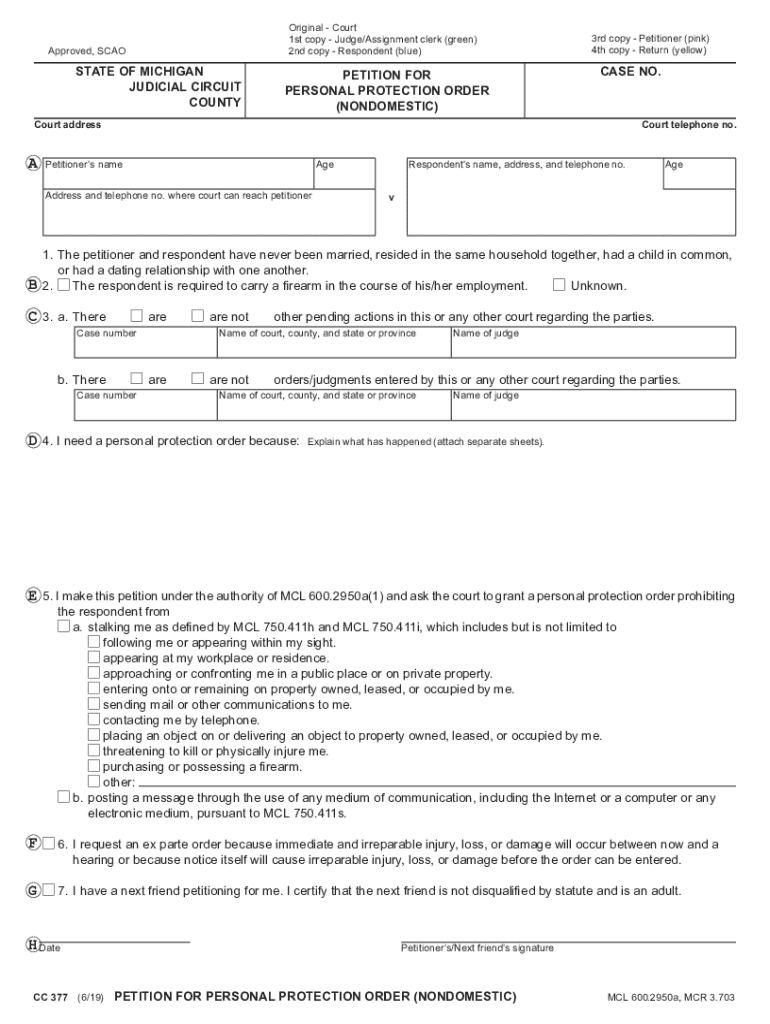
In section A, enter your name, address, and telephone number in the 'Petitioner' box. If you are under 18, include your age. Fill in the respondent's details as well.
For section B, check if the respondent is required to carry a firearm at work. If unsure, select 'unknown'.
In section C, indicate if there are any pending actions or court orders between you and the respondent. Provide necessary case details.
Section D requires a detailed explanation of why you seek a personal protection order. Attach additional sheets if necessary.
In section E, check only those boxes that apply to your situation regarding stalking or harassment.
If applicable, check for an 'ex parte order' in section F to expedite your request without prior notice to the respondent.
Complete sections G and H by signing and dating the form before submitting it to the county clerk.
Start using our platform today for free to complete your CC377 Petition efficiently!
Fill out CC377Petition for Personal Protection Order (Nondomestic)(6 19) online It's free
See more CC377Petition for Personal Protection Order (Nondomestic)(6 19) versions
We've got more versions of the CC377Petition for Personal Protection Order (Nondomestic)(6 19) form. Select the right CC377Petition for Personal Protection Order (Nondomestic)(6 19) version from the list and start editing it straight away!
Personal protection order scaoNondomestic PPOPersonal protection order michiganHow to apply for a Personal Protection OrderGenesee County Personal Protection OrderMotion to terminate ppo michiganMichigan legal help ppoSCAO ppo Forms
Security and compliance
At DocHub, your data security is our priority. We follow HIPAA, SOC2, GDPR, and other standards, so you can work on your documents with confidence.
I need a personal protection order because: Explain what has happened (attach separate sheets). 5. I make this petition under the authority of MCL 600.2950a(1)Read more
Cookie consent notice
This site uses cookies to enhance site navigation and personalize your experience.
By using this site you agree to our use of cookies as described in our Privacy Notice.
You can modify your selections by visiting our Cookie and Advertising Notice.