Findings and Conclusions about De Facto Parentage 2026

Get Form
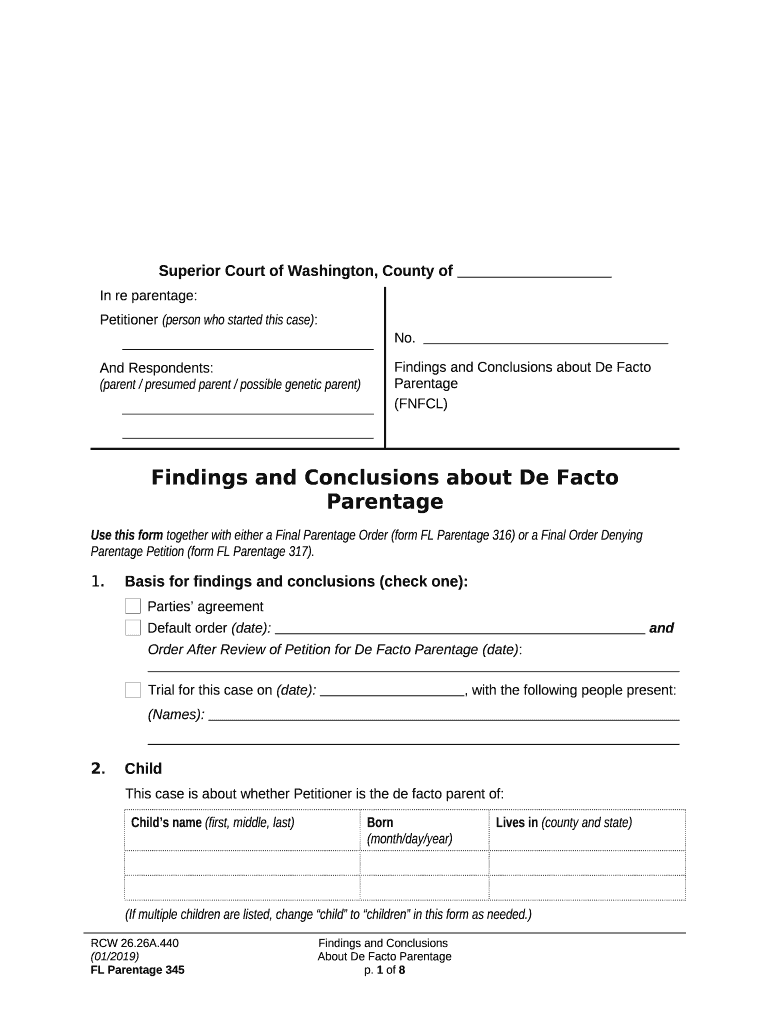
Findings and Conclusions about De Facto Parentage Preview on Page 1

Here's how it works

01. Edit your form online
Type text, add images, blackout confidential details, add comments, highlights and more.
02. Sign it in a few clicks
Draw your signature, type it, upload its image, or use your mobile device as a signature pad.
03. Share your form with others
Send it via email, link, or fax. You can also download it, export it or print it out.

How to use or fill out Findings and Conclusions about De Facto Parentage

Form edit decoration
9.5
Ease of Setup
DocHub User Ratings on G2
9.0
Ease of Use
DocHub User Ratings on G2
  1. Click ‘Get Form’ to open it in the editor.
  2. Begin by selecting the basis for findings and conclusions. Check either 'Parties’ agreement' or 'Default order' and provide the relevant dates.
  3. Fill in the child's name, date of birth, and residence details. If there are multiple children, ensure to adjust the wording accordingly.
  4. Indicate whether a Guardian ad Litem was appointed. If so, provide their name and check applicable areas regarding their report.
  5. Complete the personal jurisdiction section by checking all relevant boxes that apply to the respondents.
  6. Address each question from 5 to 11 regarding de facto parentage by selecting 'Yes' or 'No' and providing supporting facts as necessary.
  7. Finalize any additional requests such as changes to the child's name or birth record, ensuring all sections are completed before submission.

Start using our platform today for free to streamline your document editing and completion process!

be ready to get more

Complete this form in 5 minutes or less

Get form

Got questions?

We have answers to the most popular questions from our customers. If you can't find an answer to your question, please contact us.
Contact us
Who is a de facto parent? that the biological or adoptive parent(s) consented to, and fostered, the formation and establishment of your parent-like relationship with the child; that you and the child lived together in the same household;
A de facto parent is a person who is the current or recent caretaker of a child and who has been found by the court to have assumed, on a day-to-day basis, the role of a parent to the child.
Parental alienation is a term used to describe a process by which one parent tries to cause the child to reject, fear, or avoid contact with the other parent. Read on to learn about how to fight back.
A de facto parent is someone the court treats like a parent, due to the persons relationship with the child. De facto parents have a right to seek custody or visitation of a child, even if that child is not biologically their child. Maryland has adopted a four-factor test to determine de facto parent status.
These are some mistakes youre going to want to be mindful to avoid. PREVENTING THE OTHER PARENTS ACCESS TO THE CHILDREN. LYING ABOUT DRUG AND ALCOHOL USE. NOT PREPARING FOR COURT SPECIALISTS. INVOLVING YOUR CHILDREN IN LEGAL PROCEEDINGS. WORKING TOO MUCH. NOT PUTTING YOUR KIDS BEST INTERESTS FIRST.

Security and compliance

At DocHub, your data security is our priority. We follow HIPAA, SOC2, GDPR, and other standards, so you can work on your documents with confidence.

Learn more
ccpa2
pci-dss
gdpr-compliance
hipaa
soc-compliance

People also ask

A de facto parent claim typically requires evidence of a parental relationship, including living with the child and acting as a parent. Simply being close to the child without cohabitation or a caregiving role may not meet legal standards.

Related links