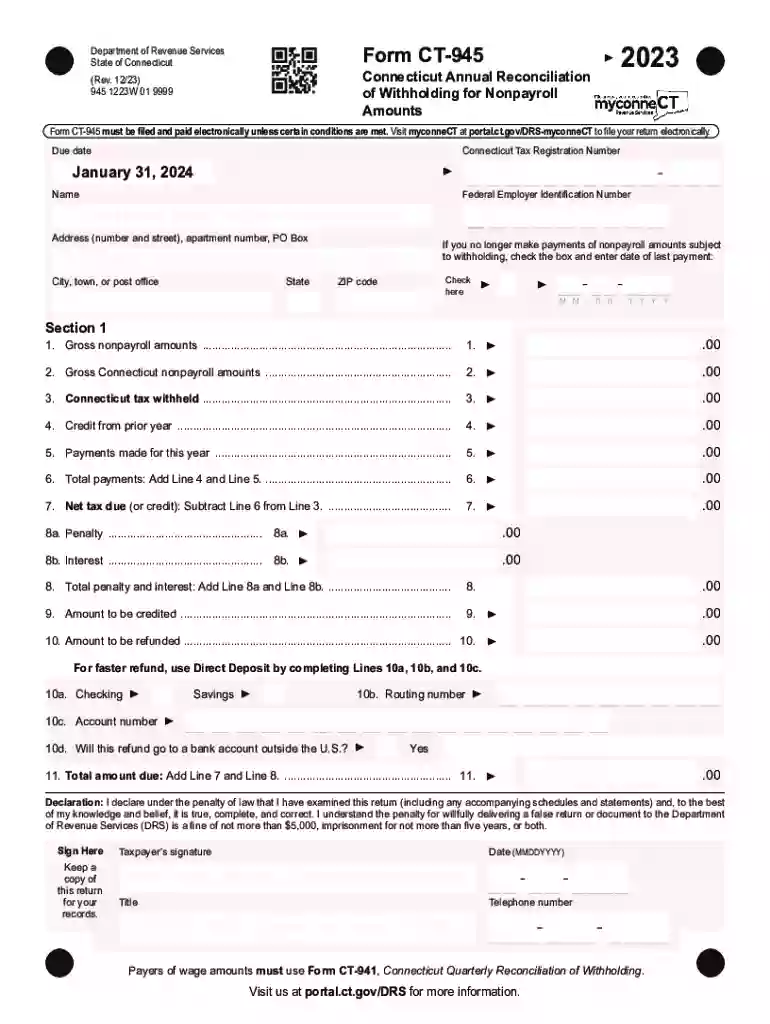
State of Connecticut 2023 Withholding Tables (Effective-2026

Get Form
State of Connecticut 2023 Withholding Tables (Effective Preview on Page 1

Here's how it works

01. Edit your form online
Type text, add images, blackout confidential details, add comments, highlights and more.

02. Sign it in a few clicks
Draw your signature, type it, upload its image, or use your mobile device as a signature pad.

03. Share your form with others
Send it via email, link, or fax. You can also download it, export it or print it out.

Definition & Meaning

The "State of Connecticut 2023 Withholding Tables (Effective" are guidelines provided by the Connecticut Department of Revenue Services to help employers and other relevant parties determine the correct amount of state tax to withhold from employees' wages. These tables are essential for ensuring accurate tax withholdings, minimizing the need for tax adjustments later. Designed to reflect current tax laws and rates, these tables serve as a key resource for accurate payroll processing.

How to Use the State of Connecticut 2023 Withholding Tables

To use the State of Connecticut 2023 Withholding Tables, employers need to match each employee's earnings with the appropriate withholding category in the tables. This requires knowing the employee’s filing status, number of allowances, and payroll period. Employers should:

  1. Identify the employee’s filing status and payroll frequency.
  2. Use the withholding tables to find the corresponding row for the employee's wage range.
  3. Apply the withholding rate to determine the amount to withhold for state taxes.

This ensures compliance with state tax obligations and helps employees meet their tax liabilities.

How to Obtain the State of Connecticut 2023 Withholding Tables

The Connecticut Department of Revenue Services typically publishes the withholding tables annually. Employers and tax professionals can access these tables through:

  • The official website of the Connecticut Department of Revenue Services, where they are available for download as a PDF.
  • Subscription to tax bulletin newsletters that provide updates on new releases.
  • Through authorized payroll service providers who integrate these tables into their systems.

Having the latest version ensures compliance with current tax requirements.

Steps to Complete the State of Connecticut 2023 Withholding Tables

Employers should follow these steps to ensure accurate tax withholding:

  1. Obtain the most recent version of the State of Connecticut 2023 Withholding Tables.
  2. Identify employee details such as filing status and allowances.
  3. Match earnings with the corresponding row in the withholding table.
  4. Record and implement the indicated withholding amount.
  5. Regularly review and update information to address any changes in employee status or Connecticut tax laws.

Consistent application of these steps ensures accuracy and compliance.

Key Elements of the State of Connecticut 2023 Withholding Tables

The withholding tables include several critical components:

  • Filing statuses: Includes categories like single, married, or head of household.
  • Allowance configurations: Adjusts the withholding amount based on the number of allowances claimed by the employee.
  • Payroll periods: Various payroll frequencies such as weekly, bi-weekly, semi-monthly, and monthly.
  • Wage brackets: Specifies income ranges with corresponding withholding rates.

Understanding these elements ensures precise withholdings and simplifies payroll processes.

State-Specific Rules for the State of Connecticut 2023 Withholding Tables

Connecticut has unique tax considerations reflected in the withholding tables:

  • Progressive tax rates: Vary based on income levels and filing status, necessitating careful attention to detail.
  • Periodic updates: Tables undergo revisions; staying informed of changes helps avoid under or over-withholding.
  • Special condition rules: Such as additional withholding requirements under specific circumstances.

Adhering to these rules is crucial for maintaining compliance with state tax regulations.

Penalties for Non-Compliance

Non-compliance with the withholding table instructions can lead to penalties:

  • Monetary fines: Employers may face fines for incorrect withholding submissions.
  • Interest on unpaid taxes: Accrues if insufficient tax is withheld and not re-mediated in a timely manner.
  • Administrative sanctions: Repeated non-compliance can result in additional inspections or penalties.

Employers must ensure that their payroll processes align with the state's requirements to avoid these penalties.

Examples of Using the State of Connecticut 2023 Withholding Tables

To contextualize the use of the withholding tables, consider these scenarios:

  • Scenario 1: A single employee earning $1,500 weekly with one allowance will have a specific amount withheld as outlined in the tables.
  • Scenario 2: A married employee with two allowances earning $3,000 bi-weekly will have a different withholding amount, demonstrating variability based on earnings and filing status.

These examples highlight the practical application of the tables across different employment situations.

be ready to get more

Complete this form in 5 minutes or less

Get form

Got questions?

We have answers to the most popular questions from our customers. If you can't find an answer to your question, please contact us.
Contact us
SDI Rate. The SDI withholding rate for 2023 is 0.9 percent. The taxable wage limit is $153,164 for each employee per calendar year. The maximum to withhold for each employee is $1,378.48.
For tax year 2023 and beyond, the tax rate for Arizona taxable income is 2.5%.
Its a progressive income tax that ranges from 3% to 6.99%. Connecticut does not have any local city taxes, so all of your employees will pay only the state income tax.
If you are a resident of Connecticut and receive a lump sum distribution that brings your account balance to zero, the 6.99% tax must be withheld without exception. However, Connecticut mandatory withholding does not apply to payments to estates, trusts or other entities.
Withholding Formula (Effective Pay Period 03, 2024) Net Taxable Income:Amount of Tax: $10,600 but not over $15,100 3.00% minus $211.97 $15,100 but not over $25,000 3.40% minus $272.37 $25,000 but not over $89,601 4.40% minus $522.36 $89,601 but not over $89,701 4.40% minus $506.4041 more rows Mar 19, 2024

Security and compliance

At DocHub, your data security is our priority. We follow HIPAA, SOC2, GDPR, and other standards, so you can work on your documents with confidence.
Learn more
ccpa2
pci-dss
gdpr-compliance
hipaa
soc-compliance
be ready to get more

Complete this form in 5 minutes or less

Get form

People also ask

Georgia Payroll Tax Rates Georgia has a flat income tax of 5.19%, meaning all residents pay the same tax percentage regardless of their income levels. Starting January 1, 2026, that rate will decrease 0.10% every year until it docHubes 4.99%.
How to Calculate State Withholding Tax from Your Paycheck Compute the employees gross pay for the current pay period. Subtract voluntary pre-tax contributions (e.g. 401(k), health insurance). Using your states tax guide, deduct the appropriate percentage from the newly adjusted total.

Related links