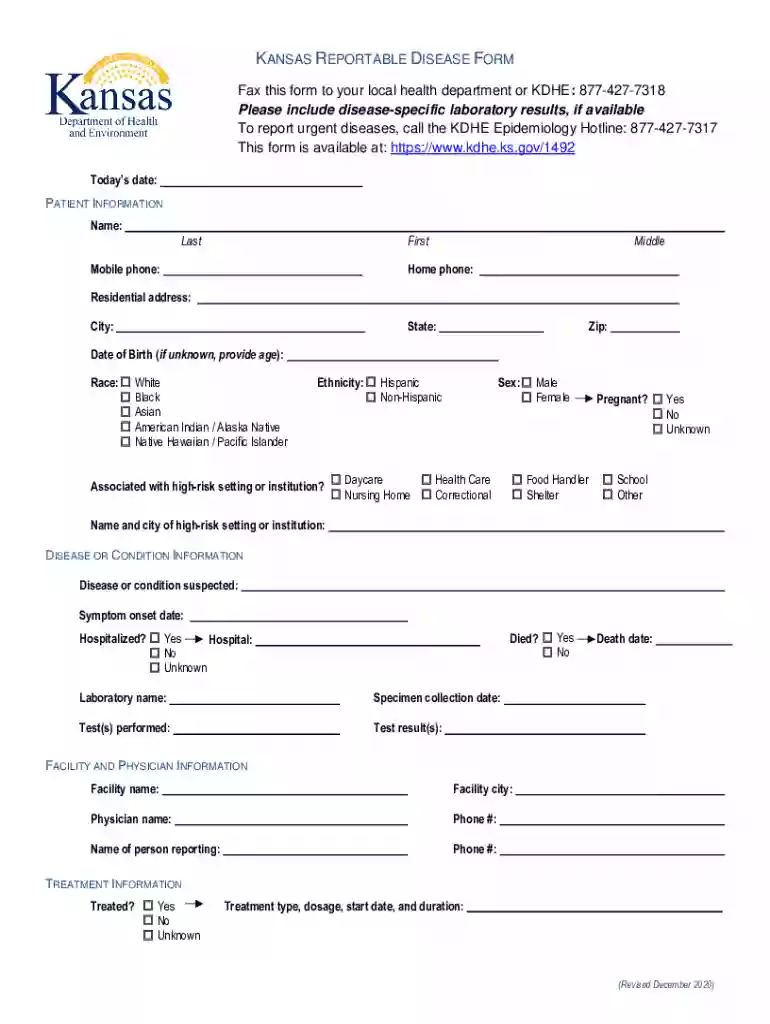
Kansas Reportable Disease Form - Fill Out and Sign 2026

Get Form
kansas reportable disease form Preview on Page 1

Here's how it works

01. Edit your kansas reportable disease form online
Type text, add images, blackout confidential details, add comments, highlights and more.

02. Sign it in a few clicks
Draw your signature, type it, upload its image, or use your mobile device as a signature pad.

03. Share your form with others
Send kdhe reportable disease form via email, link, or fax. You can also download it, export it or print it out.

How to use or fill out Kansas Reportable Disease Form - Fill Out and Sign with DocHub

Form edit decoration
9.5
Ease of Setup
DocHub User Ratings on G2
9.0
Ease of Use
DocHub User Ratings on G2
  1. Click ‘Get Form’ to open the Kansas Reportable Disease Form in our editor.
  2. Begin by entering today’s date at the top of the form. This is essential for record-keeping.
  3. In the 'Patient Information' section, fill in the patient's name, mobile phone, home phone, and residential address. Ensure accuracy for effective communication.
  4. Provide the patient's date of birth or age if unknown. Select their race and ethnicity from the provided options.
  5. Indicate the patient's sex and whether they are associated with a high-risk setting by checking the appropriate boxes.
  6. In the 'Disease or Condition Information' section, specify the suspected disease or condition, symptom onset date, and hospitalization status.
  7. Complete the 'Facility and Physician Information' section with relevant details about the facility and physician involved in patient care.
  8. Finally, provide treatment information if applicable, including treatment type and duration before saving your completed form.

Start using our platform today to fill out your Kansas Reportable Disease Form quickly and efficiently!

See more Kansas Reportable Disease Form - Fill Out and Sign versions

We've got more versions of the Kansas Reportable Disease Form - Fill Out and Sign form. Select the right Kansas Reportable Disease Form - Fill Out and Sign version from the list and start editing it straight away!
Versions Form popularity Fillable & printable
2020 4.8 Satisfied (58 Votes)
2014 4.6 Satisfied (48 Votes)
2008 4 Satisfied (21 Votes)
be ready to get more

Complete this form in 5 minutes or less

Get form

Got questions?

We have answers to the most popular questions from our customers. If you can't find an answer to your question, please contact us.
Contact us
Diseases reportable to the CDC include: Anthrax. Arboviral diseases (diseases caused by viruses spread by mosquitoes, sandflies, ticks, etc.) such as West Nile virus, eastern and western equine encephalitis. Babesiosis. Botulism. Brucellosis. Campylobacteriosis. Cancer. Candida auris, clinical.
The PD-23 is the general disease reporting form and should be used if other specialized forms are not available. PD-23 forms may either be faxed to 860-920-3131 or submitted by hospital IPs directly into CTEDSS (where applicable).
The focus is on the 5 x 5 NCD agenda which includes the main NCDs (cardiovascular diseases, cancer, diabetes, and chronic respiratory diseases), and mental health (suicide); as well as the main NCD risk factors (tobacco use, harmful use of alcohol, unhealthy diet, insufficient physical activity), along with air
Details of Notifiable Diseases Source Of Infection And Prevention Whooping Cough (Pertusis) Plague Polio Rabies Small Pox Scarlet Fever Tetanus Tuberculosis Typhoid Fever Viral Encephalitis Mal Nutrition Vitamin A Deficiency5 more rows
AND call the KDHE Epidemiology Hotline at 877-427-7317.

Security and compliance

At DocHub, your data security is our priority. We follow HIPAA, SOC2, GDPR, and other standards, so you can work on your documents with confidence.

Learn more
ccpa2
pci-dss
gdpr-compliance
hipaa
soc-compliance
be ready to get more

Complete this form in 5 minutes or less

Get form

People also ask

There are four main types of disease: infectious diseases, deficiency diseases, hereditary diseases (including both genetic and non-genetic hereditary diseases), and physiological diseases. Diseases can also be classified in other ways, such as communicable versus non-communicable diseases.

Related links