01. Edit your insulation certificate template online
Type text, add images, blackout confidential details, add comments, highlights and more.

02. Sign it in a few clicks
Draw your signature, type it, upload its image, or use your mobile device as a signature pad.

03. Share your form with others
Send insulation certificate pdf via email, link, or fax. You can also download it, export it or print it out.

How to use or fill out insulation certificate for residential new construction with DocHub
Ease of Setup
DocHub User Ratings on G2
Ease of Use
DocHub User Ratings on G2
Click ‘Get Form’ to open the insulation certificate in our editor.
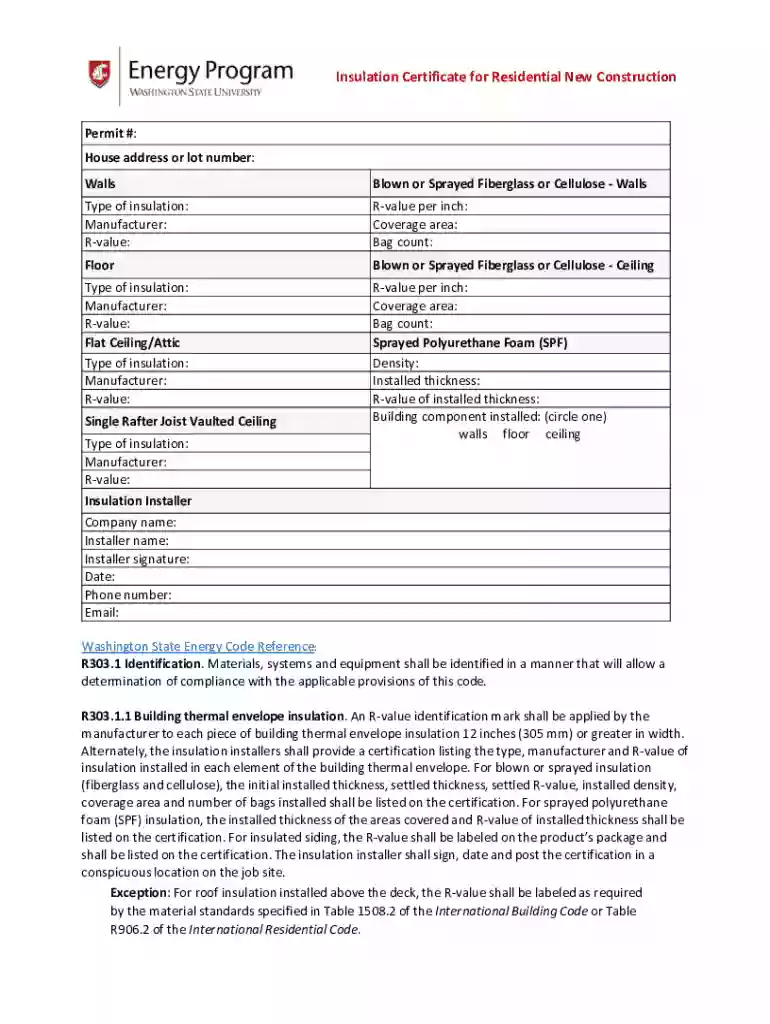
Begin by entering the Permit # and House address or lot number at the top of the form. This information is crucial for identifying the project.
In the 'Walls' section, specify the type of insulation used (Blown or Sprayed Fiberglass or Cellulose). Fill in details such as Manufacturer, R-value, R-value per inch, Coverage area, and Bag count.
Proceed to the 'Floor' section and repeat similar steps for Ceiling insulation. Ensure you include all relevant details like type, manufacturer, and R-values.
For Sprayed Polyurethane Foam (SPF), provide Density, Installed thickness, and R-value of installed thickness. Circle the appropriate building component installed: walls, floor, or ceiling.
Complete the Insulation Installer section with Company name, Installer name, signature, date, phone number, and email. This certifies that installation meets code requirements.
Finally, review all entries for accuracy before saving your completed form. Utilize our platform’s features to easily share or print your document.
Start using our editor today to fill out your insulation certificate for free!
Fill out insulation certificate for residential new construction online It's free
See more insulation certificate for residential new construction versions
We've got more versions of the insulation certificate for residential new construction form. Select the right insulation certificate for residential new construction version from the list and start editing it straight away!
When did insulation become a requirement in new home construction?
Texas changed their insulation codes in 1980, California in 1978. Per EERE: Air leakage can account for a high percentage of heating and cooling bills in an especially leaky house, and homes built before 1980 often have little or no wall insulation.
When did houses start being built with insulation?
Most of the houses built in the 1970s have insulation although we have found houses in Southern California with no insulation through 1974. They typically have R-19 or about 4 inches of insulation.
Who provides an insulation certificate?
Download your certificate below. NAIMA (North American Insulation Manufacturers Association) is dedicated to concentrating all efforts into promoting energy efficiency and environmental preservation through the use of fiberglass and mineral wool insulation.
What is the code for insulation in Kentucky?
402.2. The minimum ceiling insulation R-values shall be R-19 in Zones 1 through 4 and R-24 in Zones 5 through 8. The minimum wall R-value shall be R-13 in all zones. New wall(s) separating a sunroom from conditioned space shall meet the building thermal envelope requirements.
What is the recommended R-value for new construction?
Typical recommendations for exterior walls are R-13 to R-23, while R-30, R-38 and R-49 are common for ceilings and attic spaces.
insulation certificate form
Insulation certificate for residential new construction templateInsulation certificate for residential new construction texasInsulation certificate for residential new construction pdfInsulation certificate for residential new construction onlineFree insulation certificate for residential new constructionInsulation certificate templateBuilding code insulation requirements Texastexas wall insulation r-value
Security and compliance
At DocHub, your data security is our priority. We follow HIPAA, SOC2, GDPR, and other standards, so you can work on your documents with confidence.
A hipot test measures the ability of a product to withstand a high voltage applied between the circuits of a product and ground. An insulation resistance test
Insulation Certificate for Residential New Construction
An R-value identification mark shall be applied by the manufacturer to each piece of building thermal envelope insulation 12 inches (305 mm) or greater in width
Cookie consent notice
This site uses cookies to enhance site navigation and personalize your experience.
By using this site you agree to our use of cookies as described in our Privacy Notice.
You can modify your selections by visiting our Cookie and Advertising Notice.