




Here's how it works

01. Edit your florida volunteer application online
Type text, add images, blackout confidential details, add comments, highlights and more.

02. Sign it in a few clicks
Draw your signature, type it, upload its image, or use your mobile device as a signature pad.

03. Share your form with others
Send florida volunteer registration via email, link, or fax. You can also download it, export it or print it out.
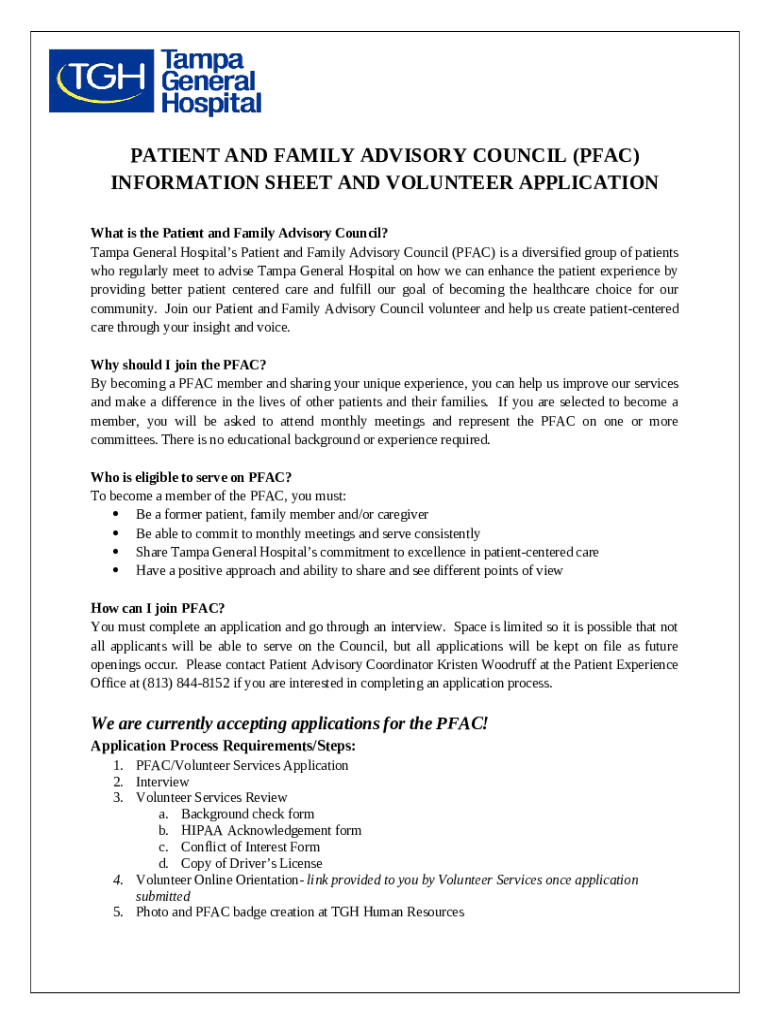
How to use or fill out Patient and Family Advisory Council (PFAC) Application

- Click ‘Get Form’ to open the PFAC Application in our editor.
- Begin by filling in your personal information clearly, including your name, address, and contact numbers. Ensure that you indicate your preferred method of contact.
- Next, provide details about your relationship to Tampa General Hospital. Check the appropriate boxes indicating whether you are a patient, caregiver, or other.
- In the section regarding criminal history, answer truthfully and provide any necessary details if applicable. This information is crucial for the volunteer review process.
- Complete the sections on your interests in PFAC activities and any relevant committee experience. This helps us understand how you can contribute effectively.
- Finally, review all entries for accuracy before signing and dating the application at the bottom. Once completed, submit it via email or mail as instructed.
Start your journey with us today by filling out the PFAC Application online for free!
Fill out Patient and Family Advisory Council (PFAC) Application online
It's free
It's free
See more Patient and Family Advisory Council (PFAC) Application versions
We've got more versions of the Patient and Family Advisory Council (PFAC) Application form. Select the right Patient and Family Advisory Council (PFAC) Application version from the list and start editing it straight away!
| Versions | Form popularity | Fillable & printable |
|---|---|---|
| 2021 | 4.6 Satisfied (38 Votes) |
Got questions?
We have answers to the most popular questions from our customers. If you can't find an answer to your question, please contact us.
Contact us
What is the role of the Pfac?
Patient and Family Advisory councils (PFACs) are an excellent way to help health care institutions and providers better understand the perspective of patients and families while also helping caregivers better identify the needs of their patient population and bring patient and clinicians views closer together.
How to create a patient advisory council?
Just follow these four steps from the Creating a Patient and Family Advisory Council: A Toolkit for Pediatric Practices. Step One: Assess Practice Readiness. Step Two: Recruit Members. Step Three: Engage and Involve. Step Four: Sustain, Evaluate and Improve.
What does a patient advisory board do?
A patient advisory council, also known as a patient advisory board or a patient and family advisory council, is a representative group of patients and caregivers who meet regularly with clinic staff to help improve clinic performance.
What is the role of the advisory council?
An advisory council is a group of experts or industry professionals who provide specialized knowledge and strategic advice to a board of directors. Unlike the board, which has formal governance responsibilities, an advisory council serves in a non-binding, consultative role.
What does a patient and family advisory council do?
Provide insight from the patient and family perspective about policies, care practices, and patient education materials. Identify patient and family needs and concerns. Serve on subcommittees and workgroups to help bring the patient and family perspective to these efforts.
Security and compliance
At DocHub, your data security is our priority. We follow HIPAA, SOC2, GDPR, and other standards, so you can work on your documents with confidence.
Learn more


People also ask
What are the benefits of a Pfac?
The Purpose and Responsibilities of a PFAC Increase understanding and cooperation between patients, families, and staff. Transform the culture towards patient- and family-centered care. Improve quality, patient safety, and patient health outcomes.