




01. Edit your vl17 form online
Type text, add images, blackout confidential details, add comments, highlights and more.

Type text, add images, blackout confidential details, add comments, highlights and more.

Draw your signature, type it, upload its image, or use your mobile device as a signature pad.

Send vl17 via email, link, or fax. You can also download it, export it or print it out.
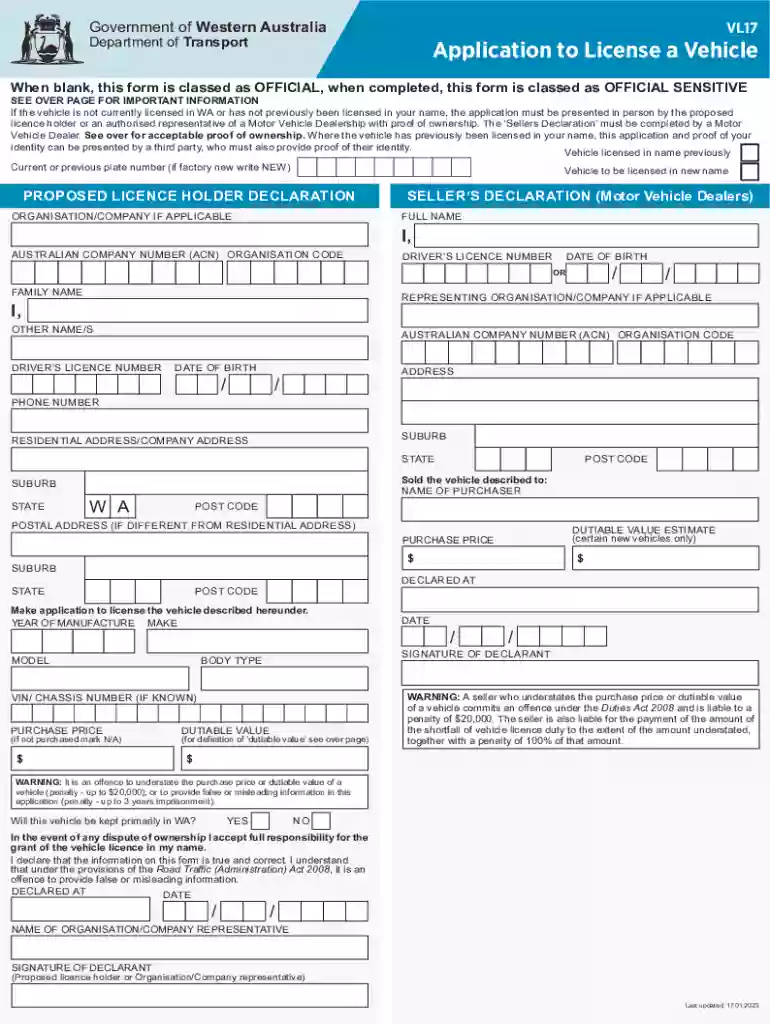
The Application to License a Vehicle (Form VL17) is a crucial document used primarily in the United States for individuals and businesses applying to register their vehicles with the relevant state department of motor vehicles (DMV). This form serves as an official request for a vehicle license, which is necessary for legal operation on public roads. It captures essential information about the vehicle, such as make, model, year, and identification numbers, along with the applicant's details—ensuring compliance with state automotive regulations.
The purpose of the VL17 form includes:
Filling out the VL17 form requires careful attention to detail to prevent delays in processing. The following steps outline the completion process:
Several documents are often required to accompany the Application to License a Vehicle (Form VL17). Proper documentation is crucial for a smooth application process. The standard documents include:
Familiarity with key terms is beneficial to navigate the application process effectively. Important terms include:
There are generally multiple methods to submit the VL17 form depending on state regulations and individual preferences. Common submission methods include:
Using the appropriate submission method can expedite processing and reduce risks of errors in the application.
We've got more versions of the vl17 form form. Select the right vl17 form version from the list and start editing it straight away!
Upload your vl 17 form to DocHub (once you’ve set up an account for this). If you need to complete fields in it, use appropriate tools from the upper pane. For example, drop Signature Fields, assign each to specific person, and click on Sign → Request signatures from others. Customize your message for your recipients and click Send Request. You can also send your form by fax or as a Signing link instead of using email (you’ll find these options by navigating to the Menu → Send)
If you are using Chrome, there are two easy methods to modify your form vl17 online. First, go to the DocHub site, add your file, and modify it utilizing our toolbar. You can also set up our Chrome extension and modify any document by dragging and dropping it in your browser tab.
At DocHub, your data security is our priority. We follow HIPAA, SOC2, GDPR, and other standards, so you can work on your documents with confidence.
The proceedings contain 73 papers. The special focus in this conference is on Computer Science, Engineering and Information Technology.
The vehicle is clear of encumbrances except as shown. Any required sales tax has been collected. Choose one. 1 - Automobile. 2 - Truck. 3 - Motorcycle.Read more
TM VL 17 hard drives contain all necessary mechanical and electronic parts to interpret control signals and commands from an AT-compatible host computer.


