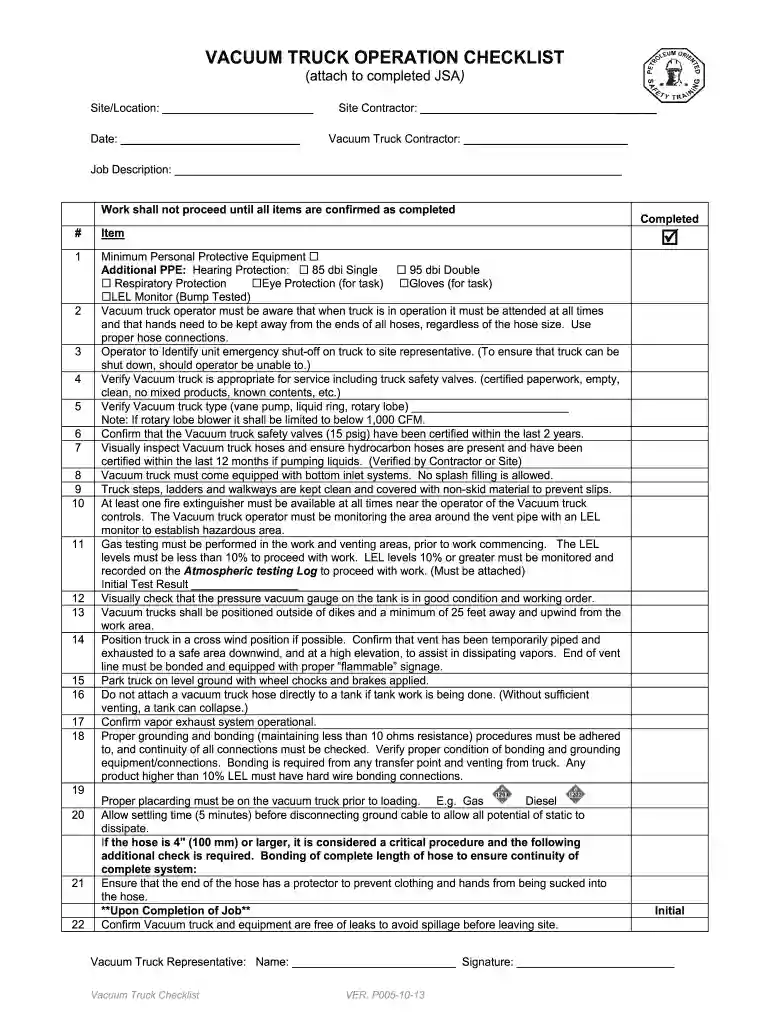
vacuum truck safety checklist Preview on Page 1

Vacuum truck inspection checklist 2026

Here's how it works

  • 01. Edit your vacuum truck safety checklist online

    Type text, add images, blackout confidential details, add comments, highlights and more.

  • 02. Sign it in a few clicks

    Draw your signature, type it, upload its image, or use your mobile device as a signature pad.

  • 03. Share your form with others

    Send vacuum truck inspection checklist via email, link, or fax. You can also download it, export it or print it out.

How to use or fill out vacuum truck inspection checklist with our platform

Form edit decoration
9.5
Ease of Setup
DocHub User Ratings on G2
9.0
Ease of Use
DocHub User Ratings on G2
  1. Click ‘Get Form’ to open the vacuum truck inspection checklist in the editor.
  2. Begin by entering the site/location and date at the top of the form. This information is crucial for record-keeping.
  3. Fill in the Site Contractor and Vacuum Truck Contractor details to ensure accountability.
  4. In the Job Description section, provide a brief overview of the task at hand, ensuring clarity for all involved parties.
  5. Proceed through each item on the checklist, marking off completed personal protective equipment (PPE) requirements and confirming that safety protocols are followed.
  6. For each operational check, such as verifying vacuum truck type and inspecting hoses, ensure you document any findings or certifications required.
  7. Once all items are checked and initialed, have the Vacuum Truck Representative sign at the bottom to confirm completion of inspections.

Start using our platform today to streamline your vacuum truck inspection process for free!

See more vacuum truck safety checklist versions

We've got more versions of the vacuum truck safety checklist form. Select the right vacuum truck safety checklist version from the list and start editing it straight away!

VersionsForm popularityFillable & printable
20134.8 Satisfied (268 Votes)

be ready to get more

Complete this form in 5 minutes or less

Got questions?

We have answers to the most popular questions from our customers. If you can't find an answer to your question, please contact us.

To become a vacuum truck driver, you must be at least 18 years old and have a valid commercial drivers license (CDL). You may also be required to pass a background check and drug test.
A critical piece of vacuum truck operation safety is wearing personal protection equipment (PPE). We recommend wearing gloves, eye protection, hard hats, ear plugs, reflective clothing, steel toe boots, and respirators or face masks.
Vac Truck Driver Salary Annual SalaryHourly Wage Top Earners $100,000 $48 75th Percentile $90,000 $43 Average $79,239 $38 25th Percentile $61,500 $30
A properly built vacuum truck tank in good condition (see articles HERE and HERE for internal tank inspections) can handle full vacuum and, unless a certified pressure vessel is legally limited to 14.9 PSI, we recommend limiting your tank to no more than 8-9 PSI.
= 6.9735479 x 10²³ molecules in a cubic foot of gas at room temperature DescriptionPressure (Torr)Pressure (Pa) Low (Rough) Vacuum 25 to 760 3 kPa - 100 kPa Medium Vacuum 1 x 10⁻³ - 25 100 mPa - 3 kPa High Vacuum 1 x 10⁻⁹ - 1 x 10⁻³ 100 nPa - 100 mPa Ultra-High Vacuum (UHV) 1 x 10-12 - 1 x 10⁻⁹ 100 pPa - 100 nPa3 more rows

Security and compliance

At DocHub, your data security is our priority. We follow HIPAA, SOC2, GDPR, and other standards, so you can work on your documents with confidence.

People also ask

Vacuum Truck Capabilities They utilize high-pressure water (approximately 2,0004,000 PSI) to break down soil, while a powerful vacuum pump removes the loosened material into an onboard holding tank, ensuring minimal mess and disruption on-site.
The set pressure shall be 100kPa or less. The total capacity of the safety relief valve shall be sufficient to ensure a rise in vessel pressure of not more than 10% above the set pressure. A vacuum relief arrangement is also required.

vacuum truck checklist

T20 Daily Checklist

Confirm the recovery tank is drained and clean. □ Check the right solution tank cover seal for damage and wear. □ Check the vacuum hoses for debris or blockage.Read more

Learn more
If you believe that this page should be taken down, please follow our DMCA take down process here