
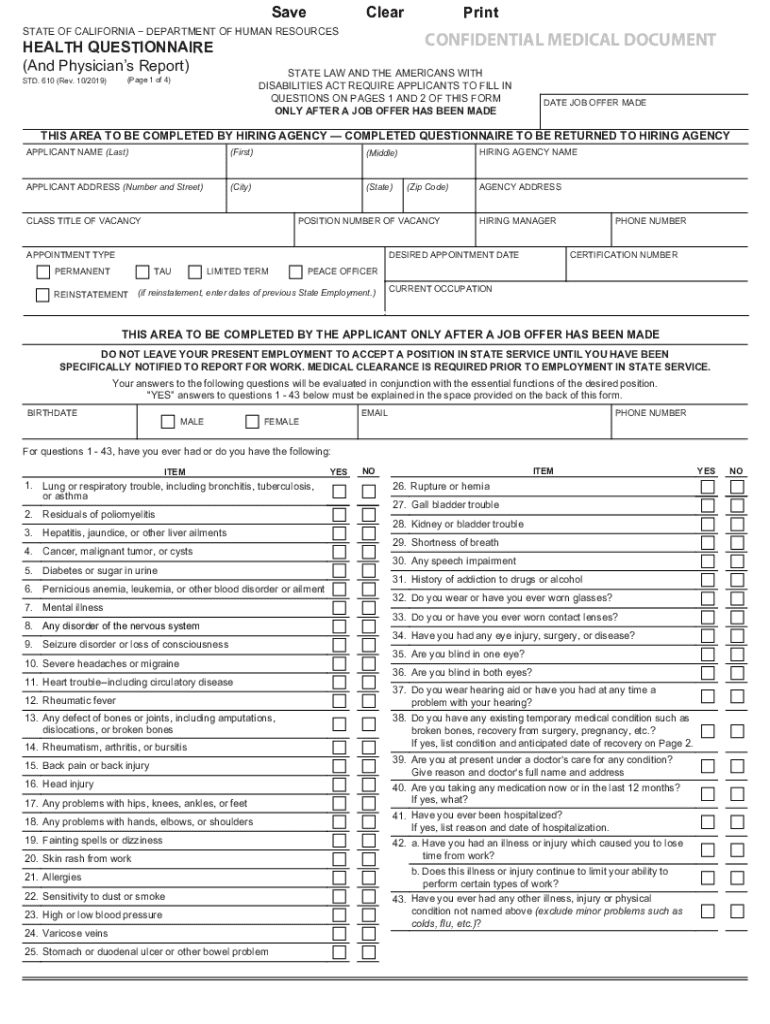







Definition and Meaning of the Health Questionnaire
A health questionnaire is a document designed to gather information about an individual's medical history and current health status. It is often used in employment settings, particularly after a conditional job offer, to ensure that potential hires meet specific health criteria relevant to their job roles. In the context of the State of California, these questionnaires comply with regulations from the Department of Human Resources while aligning with the Americans with Disabilities Act to protect applicants' privacy and ensure fair treatment. The questionnaire typically includes queries about past medical conditions, ongoing treatments, and any health-related accommodations that may be necessary for the applicant's role.
How to Use the Health Questionnaire
Using a health questionnaire effectively involves understanding its purpose and structure. Upon receiving the document, applicants should carefully read each question, as accurate responses are crucial for legal compliance and employment considerations. Respondents should:
- Gather relevant medical records.
- Answer each question truthfully.
- Highlight any health conditions that may require workplace accommodations.
Employers use the completed questionnaire to assess whether the applicant can perform essential job functions. It is essential that both parties follow outlined privacy policies to ensure information is used ethically and legally.
Steps to Complete the Health Questionnaire
Completing a health questionnaire involves several key steps to ensure accuracy and compliance:
-
Review Instructions: Begin by reading all instructions to understand what information is required and why.
-
Collect Medical Information: Gather recent health records, including any relevant test results or doctor's notes, to support your responses.
-
Answer Honestly: Provide truthful answers to each question. If a question is not applicable, mark it accordingly.
-
Detail Current Health Status: Clearly outline any ongoing medical treatments or conditions.
-
Include Physician's Evaluation: In cases where a physician's input is required, schedule an appointment and ensure your doctor completes their section accurately.
Completing the questionnaire thoroughly reduces potential misunderstandings and ensures compliance with employment standards.
Key Elements of the Health Questionnaire
Understanding the key components of a health questionnaire ensures that applicants provide complete and compliant information. Typically, the questionnaire includes:
- Personal Information: Identifying details like name, contact information, and date of birth.
- Medical History: Information about past illnesses or surgeries, allergies, and family medical history.
- Current Health Status: Details on current medications, chronic conditions, or treatments.
- Work-Related Accommodations: Any physical or mental accommodations needed for job performance.
- Physician's Evaluation: An optional or required section for a medical professional to provide their assessment.
Each element is essential for employers to evaluate the applicant's medical fitness for the role while maintaining compliance with privacy laws.
State-Specific Rules for the Health Questionnaire
Health questionnaires are guided by specific state regulations, affecting their design and implementation. For example, California law mandates that such questionnaires:
- Be conducted only after a conditional job offer is made.
- Ensure compliance with the Americans with Disabilities Act.
- Protect applicant confidentiality by restricting who can access health information.
Businesses must tailor their questionnaires to align with state guidelines, ensuring that they are both legally compliant and sensitive to individuals' privacy rights.
Legal Use of the Health Questionnaire
The legal framework governing health questionnaires ensures protection for both applicants and employers. Critical components include:
- Confidentiality Agreements: Restrict access to medical information to authorized personnel only.
- Compliance with ADA: Ensure that questions do not discriminate based on health status.
- Informed Consent: Applicants must be informed about the purpose of health data collection and its use.
These legal checks and balances ensure ethical use of health data and protect applicants from discrimination based on their health histories.
Required Documents for the Health Questionnaire
Before completing a health questionnaire, applicants may need to prepare supporting documents:
- Medical Records: Recent health evaluations, treatment summaries, and test results.
- Identification: Government-issued ID for identity verification.
- Physician's Statement: If required, a formal evaluation or diagnosis from a medical professional.
Assemble these documents in advance to streamline the completion process and verify the information provided in the questionnaire.
Examples of Using the Health Questionnaire
Health questionnaires are employed in various scenarios to assess medical fitness effectively:
- Pre-Employment Screening: Ensure candidates meet health criteria for physically demanding jobs.
- Periodic Employee Health Checks: Monitor ongoing health status for employees in high-risk positions.
- Accommodations Assessment: Determine reasonable adjustments for employees returning to work post-illness.
Each example illustrates the practical application of the health questionnaire in maintaining workplace safety and compliance.




