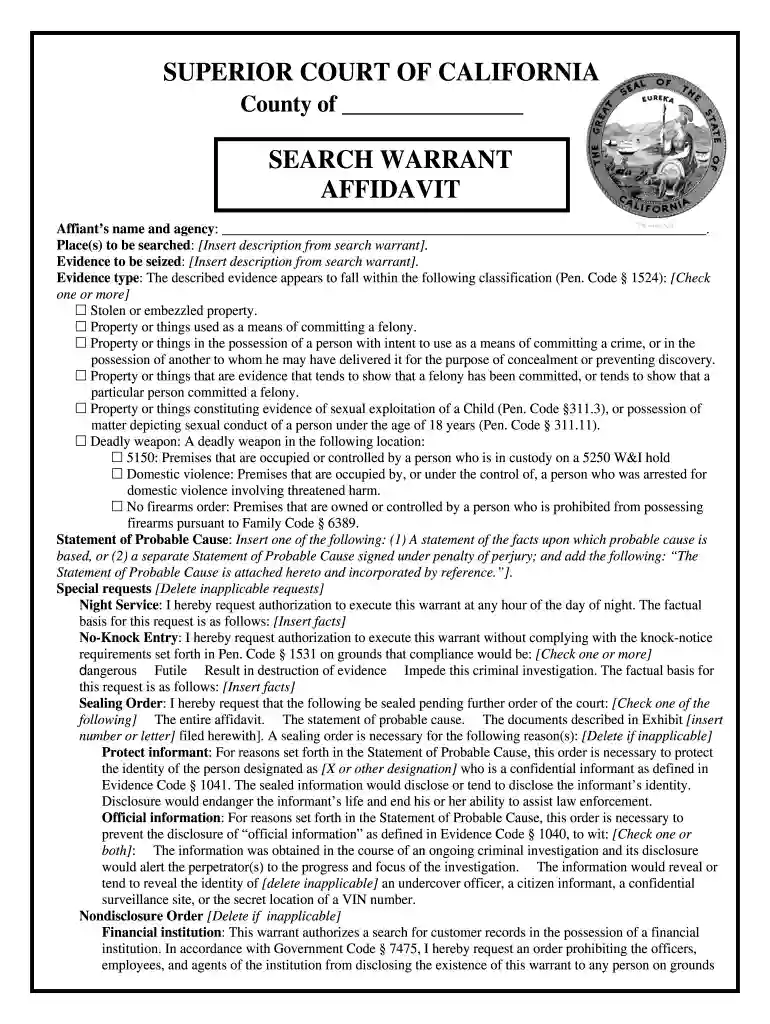
Warrant template 2026

Get Form
search warrant template Preview on Page 1

Here's how it works

01. Edit your search warrant template online
Type text, add images, blackout confidential details, add comments, highlights and more.

02. Sign it in a few clicks
Draw your signature, type it, upload its image, or use your mobile device as a signature pad.

03. Share your form with others
Send what does a search warrant look like via email, link, or fax. You can also download it, export it or print it out.

Definition and Meaning of Warrant Template

A warrant template is a formal document that authorizes law enforcement officers to conduct a search of a specific location or to arrest an individual. It typically outlines the details of what is being searched for, the premises that may be searched, and the legal justifications for the request. In the context of legal documents, warrants can be divided into various categories, such as search warrants, arrest warrants, and warrants of possession.

Types of Warrants

  • Search Warrant: Authorizes the search of a specified location for evidence of a crime.
  • Arrest Warrant: Penetrates a person’s liberty by permitting law enforcement to apprehend an accused individual.
  • Warrant of Possession: Often used in civil cases, allowing the reclaiming of property after a court order.

Understanding the nuances between these types is essential for proper legal compliance and procedure.

How to Use the Warrant Template

Utilizing a warrant template effectively involves several steps that adhere to legal standards and procedural requirements. Here’s how to go about it:

  1. Identify the Purpose: Determine whether you need a search warrant, arrest warrant, or another type.
  2. Fill in Necessary Details: Input information such as the subject's name, address, and a detailed description of the item or evidence being sought.
  3. Justification Section: Provide substantial evidence or reasoning supporting why the warrant should be granted. This may include witness statements, prior criminal history, or surveillance evidence.

As a rule, ensuring accuracy is critical, as any errors can lead to the rejection of the warrant or possible legal repercussions.

Components of the Warrant Document

  • Title: Clearly label the document as a "Warrant" with the specific type indicated.
  • Affidavit: Include a sworn statement detailing the facts supporting the need for the warrant.
  • Signature and Seal: Required for the document's validity to show it has been issued by a legal authority.

Steps to Complete the Warrant Template

Completing a warrant template necessitates attention to detail and compliance with legal standards. The following steps should be followed:

  1. Download the Template: Ensure you have the correct version pertinent to your jurisdiction, such as a California search warrant template.
  2. Detailed Input: Fill out areas requiring specific information, including:
    • Location to be searched: Clearly specify the address or premises.
    • Items to be searched: Itemize the evidence or items expected to be found.
  3. Attach Evidence: Include any supporting materials that justify the issuance of the warrant.

Common Mistakes to Avoid

  • Failing to cite correct legal statutes that provide the authority for the warrant.
  • Inaccuracies in describing the premises or items to be seized can lead to complications.

Legal Use of the Warrant Template

The legal use of a warrant template is governed by specific laws that vary from state to state. In the U.S., warrants must comply with the Fourth Amendment, which protects against unreasonable searches and seizures.

Adherence to Local Laws

  • Federal vs. State Laws: Ensure compliance with both levels, as some jurisdictions may have additional requirements.
  • Judicial Oversight: Typically requires a judge’s approval based on the sufficiency of the evidence presented.

Key Elements of the Warrant Template

Certain fundamental elements must be incorporated into every warrant template to ensure its legal validity:

  • Clear Identification: Names of the individuals involved, including the issuer, target, and law enforcement officers.
  • Precise Description of Place: The location should be described with enough detail to avoid ambiguity.
  • Specificity in Evidence: Clearly outline what is being sought to prevent overreach in the search.

Importance of Each Element

Correctly detailing each component ensures not just legality but also protects the rights of those involved. A poorly constructed warrant can undermine a case or violate constitutional rights.

Examples of Using the Warrant Template

Several scenarios illustrate the application of a warrant template in practice:

  • Case of Suspicion of Theft: Law enforcement has received credible tips regarding stolen property at a residence. A search warrant template is completed to allow officers to inspect the home for specific stolen items.
  • Drug-related Investigation: When investigating suspected drug trafficking, an officer utilizes a warrant template to outline the areas to be searched and types of evidence needed, such as narcotics or related paraphernalia.

By employing warrant templates effectively, law enforcement can navigate complex legal frameworks while ensuring adherence to protocol.

Important Terms Related to Warrant Template

Understanding key terminology associated with warrant templates is essential for those working with legal documents. Some of the most important terms include:

  • Affidavit: A written statement confirmed by oath, used as evidence.
  • Probable Cause: The reasonable belief that a person has committed a crime or that evidence of a crime exists in a specified location.
  • Exclusionary Rule: A legal principle that excludes evidence collected in violation of a defendant’s constitutional rights.

Contextual Relevance

These terms not only clarify the language of legal documentation but also reinforce the responsibilities of law enforcement when executing searches and arrests.

See more warrant template versions

We've got more versions of the warrant template form. Select the right warrant template version from the list and start editing it straight away!
Versions Form popularity Fillable & printable
2012 4.9 Satisfied (50 Votes)
be ready to get more

Complete this form in 5 minutes or less

Get form

Got questions?

We have answers to the most popular questions from our customers. If you can't find an answer to your question, please contact us.
Contact us
A good warrant will be a reasonable interpretation of facts. A good warrant will not make illogical interpretive leaps. A good warrant will not assume more than the evidence supports. A good warrant may consider and respond to possible counter-arguments.
A good warrant should: Be a reasonable interpretation of the facts. Not make illogical leaps of interpretation. Not assume more than the evidence supports. Consider and prepare to respond to possible counterarguments.
The legal system uses many different types of warrants in the administration of justice and during investigations. The most common types of warrants include arrest warrants, bench warrants, search warrants, fugitive warrants and alias warrants.
A valid search warrant must meet four requirements: (1) the warrant must be filed in good faith by a law enforcement officer; (2) the warrant must be based on reliable information showing probable cause to search; (3) the warrant must be issued by a neutral and detached magistrate; and (4) the warrant must state
The paperwork should include the law(s) suspected to have been violated, a detailed description of the person or place to be searched, a description of what items are anticipated to be found during the search, and a summary from the officer indicating background information about the investigation and probable cause.

Security and compliance

At DocHub, your data security is our priority. We follow HIPAA, SOC2, GDPR, and other standards, so you can work on your documents with confidence.

Learn more
ccpa2
pci-dss
gdpr-compliance
hipaa
soc-compliance
be ready to get more

Complete this form in 5 minutes or less

Get form

People also ask

In California, arrest warrants can be issued by a judge. They have the authority to issue warrants based on probable cause.

what does a warrant look like