Definition & Meaning
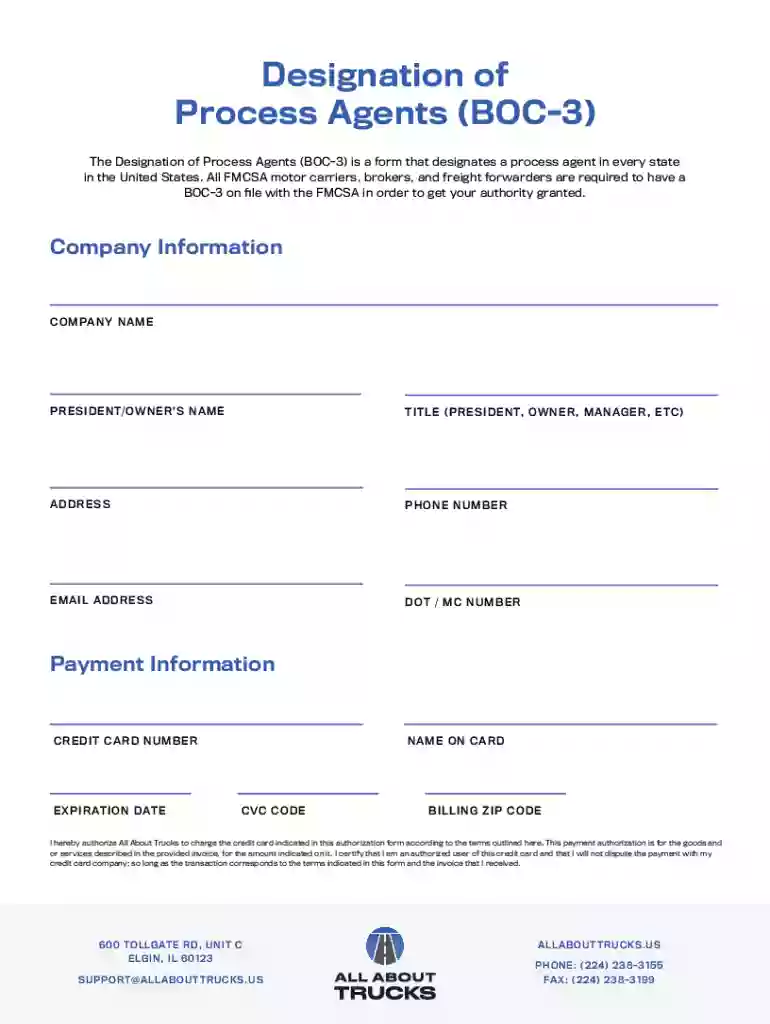
The BOC-3 Form Filing FMCSA Processing Agent is a critical component in the regulatory framework that governs the operations of motor carriers, brokers, and freight forwarders in the United States. This form is officially titled as "Designation of Process Agents" and is mandated by the Federal Motor Carrier Safety Administration (FMCSA). The BOC-3 form requires these entities to designate a process agent in every U.S. state where they operate. A process agent is responsible for receiving legal documents on behalf of the company, ensuring that they are legally compliant with state and federal obligations. The primary role of the BOC-3 form is to facilitate legal communications and engagements, providing a reliable point of contact for the service of process.
Key Elements of the BOC-3 Form Filing FMCSA Processing Agent
Several essential components must be included in the BOC-3 form to ensure it meets the FMCSA requirements. Each element plays a pivotal role in the effective functioning of the process:
- Company Information: Detailed information about the entity filing the form is required, such as name, address, DOT number, and operating authority.
- Designation of Agents: A list of appointed process agents in each state where the company operates. Each agent's contact details, including their address, must be clearly stated.
- Payment Authorization: Information authorizing the payment of fees related to the designation of process agents. This typically includes payment methods and authorization details.
These elements collectively ensure that the form is comprehensive and complies with FMCSA regulations, safeguarding the company's legal operations across state lines.
How to Obtain the BOC-3 Form Filing FMCSA Processing Agent
To acquire the BOC-3 Form, companies must go through specific channels to ensure proper filing:
- Consult a Processing Agent Service: Engage with a certified processing agent service that is authorized to file BOC-3 forms on behalf of motor carriers and brokers.
- Visit the FMCSA Website: The official form can be accessed and downloaded from the Federal Motor Carrier Safety Administration's website.
- Complete the Application: Fill out the required sections of the form with accurate and complete information before submission.
- Submit Electronically or Via Mail: Depending on the processing agent's instructions, the form can be submitted electronically or through traditional mail.
Choosing an authorized processing agent service simplifies the process, ensuring all regulatory requirements are met efficiently.
Steps to Complete the BOC-3 Form Filing FMCSA Processing Agent
Filing the BOC-3 form involves several steps that must be meticulously followed to avoid delays or rejections:
- Gather Necessary Information: Collect all essential details regarding your company and its operations, including legal names and operational jurisdictions.
- Identify Process Agents: Choose process agents in each state where your company is authorized to operate. Verify their credentials and validity.
- Fill Out the Form: Enter the gathered data into the BOC-3 form. Ensure all spelling and numerical entries are accurate.
- Double-Check for Accuracy: Review the completed form for any errors or omissions. Verify that all information is accurate and current.
- Submit the Form: Follow the chosen submission method, either electronically through an authorized agent's portal or via mail to the FMCSA.
These steps ensure that the form is completed accurately, reducing the likelihood of processing errors.
Legal Use of the BOC-3 Form Filing FMCSA Processing Agent
The BOC-3 form holds significant legal implications:
- Service of Process: Designated agents serve as the legal point of contact in each state, receiving all legal documents and ensuring compliance with local laws.
- Regulatory Compliance: Filing the BOC-3 form is necessary for obtaining operating authority from the FMCSA, legally permitting the company to conduct interstate commerce.
- Legal Protection: Having designated agents protects the company from legal issues arising from failure to receive legal notices promptly.
This form is a legal requirement for ensuring that all transportation-related businesses maintain transparent and lawful operations across the United States.
State-Specific Rules for the BOC-3 Form Filing FMCSA Processing Agent
While the BOC-3 form is federally mandated, there can be state-specific rules or variations:
- Agent Designation: Some states may impose additional requirements regarding who can be appointed as a process agent.
- Filing Fees: Various states might have different filing fees associated with the designation and processing of agents.
- Compliance Standards: Certain states require additional compliance checks or documentation to support the BOC-3 filing.
It's crucial for companies to understand state-specific nuances to ensure comprehensive compliance and avoid legal pitfalls.
Penalties for Non-Compliance
Non-compliance with the BOC-3 form filing requirements can lead to significant penalties:
- Revocation of Operating Authority: The FMCSA may suspend or entirely revoke a company's authority to operate if the BOC-3 form is not filed or maintained properly.
- Legal Consequences: Companies might face legal action due to failure in receiving legal documents, resulting in costly lawsuits or judgments.
- Financial Fines: Both federal and state authorities can impose fines for non-compliance, impacting the company's financial health.
Understanding and adhering to BOC-3 form requirements is critical to avoid these serious ramifications.
Business Types That Benefit Most from BOC-3 Form Filing FMCSA Processing Agent
Certain businesses gain particular advantages from properly filing BOC-3 forms:
- Interstate Motor Carriers: Companies engaged in the transport of goods between states require BOC-3 filings for legal compliance.
- Freight Brokers: Those who arrange transportation of goods between shippers and carriers must have process agents designated through the BOC-3 form.
- Freight Forwarders: Businesses arranging the transport of goods, including insurance and documentation, rely heavily on BOC-3 compliance to maintain seamless operations.
Businesses involved in transportation benefit by ensuring their operations adhere to FMCSA regulations, protecting them from legal and operational issues.
Digital vs. Paper Version of the BOC-3 Form Filing FMCSA Processing Agent
Choosing between digital and paper BOC-3 form submissions has distinct considerations:
- Digital Submissions: Faster processing times and easier management of filing records are benefits of choosing electronic submissions. They offer real-time tracking and more streamlined updates.
- Paper Submissions: Traditional mail can be preferable for businesses requiring physical documentation for record-keeping. However, it typically involves longer processing times.
Selecting the appropriate submission method should align with the company's operational needs and preferences for record management.