




01. Edit your canada last will testament online
Type text, add images, blackout confidential details, add comments, highlights and more.

Type text, add images, blackout confidential details, add comments, highlights and more.

Draw your signature, type it, upload its image, or use your mobile device as a signature pad.

Send canada last will testament template via email, link, or fax. You can also download it, export it or print it out.
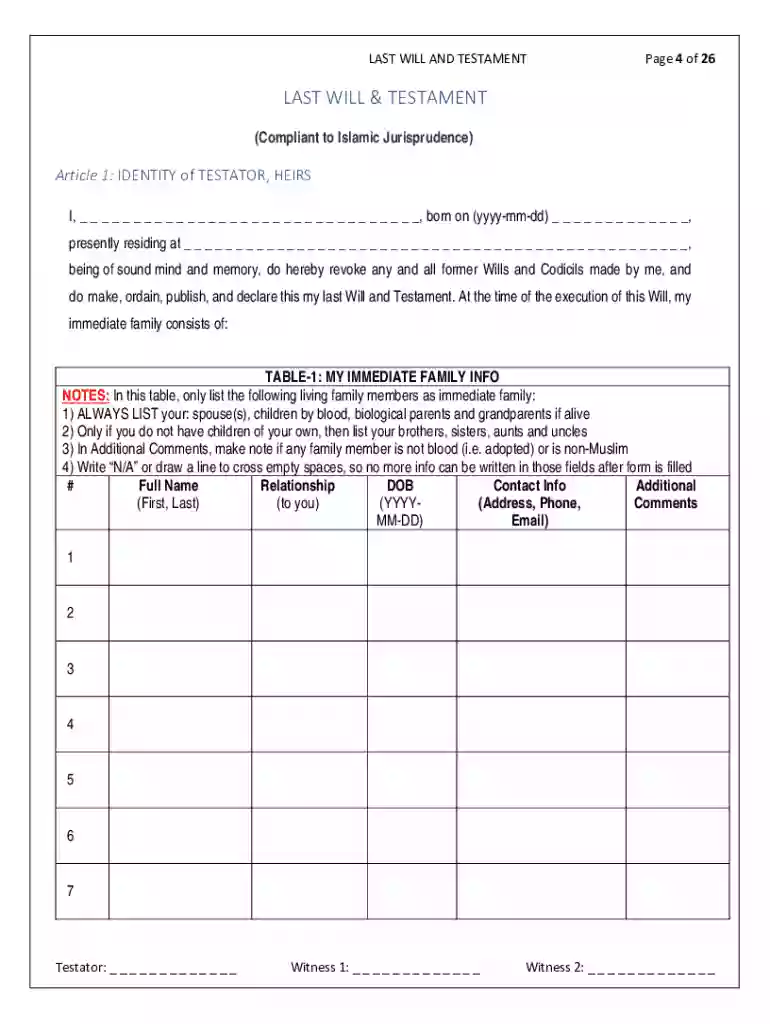
The WIA-Islamic-Will-Template-v2020-04-02 docx serves as a comprehensive guide for Muslims preparing their last will and testament, or Wasiyyah, in accordance with Islamic law. This particular template ensures that all actions and divisions within the will adhere to the principles outlined in the Quran and Sunnah. The document covers key areas such as the identification of the testator, the execution of funeral rites, guardianship arrangements for minors, and the detailed allocation of assets and debts among heirs. It is foundational for Muslims wishing to ensure that their final wishes align with their religious obligations.
This template includes numerous critical components necessary for creating a legally and religiously compliant Islamic will:
In the U.S., this template can be used to create a legally binding document provided that it conforms to both Islamic laws and the legal requirements of the state where it is executed. It serves not only as a testament to one's faith but also as a lawful declaration of how one's estate should be managed. It is crucial to verify state-specific estate laws to ensure compliance.
Different states in the U.S. have varying laws regarding wills. While this Islamic will template focuses on compliance with religious standards:
The template is typically available through legal service providers, Islamic community organizations, or online platforms offering legal document templates. Accessing a reliable version of this template ensures that your will adheres to closely aligned religious and legal standards.
Consider a case where a Muslim parent wishes to leave a legacy that aligns with both their state laws and religious duties. Using this template, they can clearly specify guardianship for their children, delineate estate division per Islamic law, and include charitable donations to align with their spiritual values. Another example could involve a Muslim entrepreneur specifying particular business successions and charitable allocations as part of their will to ensure their business remains in accordance with their faith.
We've got more versions of the canada last will testament form. Select the right canada last will testament version from the list and start editing it straight away!
| Versions | Form popularity | Fillable & printable |
|---|---|---|
| 2020 | 4.6 Satisfied (56 Votes) |
Electronic document signing requires a software solution that complies with data security and eSignature laws. DocHub is a perfect tool for that, since it meets all the aforementioned requirements. Whatever method you like to sign your islamic last will testament template in DocHub, your electronic signature will be legally binding and court-admissible.
When you choose analog ways of completing your WIA-Islamic-Will-Template-v2020-04-02 docx, it is simple to download your file for printing. Search DocHub’s Forms & Templates catalog to find the exact document template you need and open it for editing or download it on your gadget in the format of your liking. It is easy to complete your form electronically and place your handwritten signature on it right after printing or eSign your document with DocHub.
At DocHub, your data security is our priority. We follow HIPAA, SOC2, GDPR, and other standards, so you can work on your documents with confidence.


