




01. Edit your form online
Type text, add images, blackout confidential details, add comments, highlights and more.

Type text, add images, blackout confidential details, add comments, highlights and more.

Draw your signature, type it, upload its image, or use your mobile device as a signature pad.

Send it via email, link, or fax. You can also download it, export it or print it out.
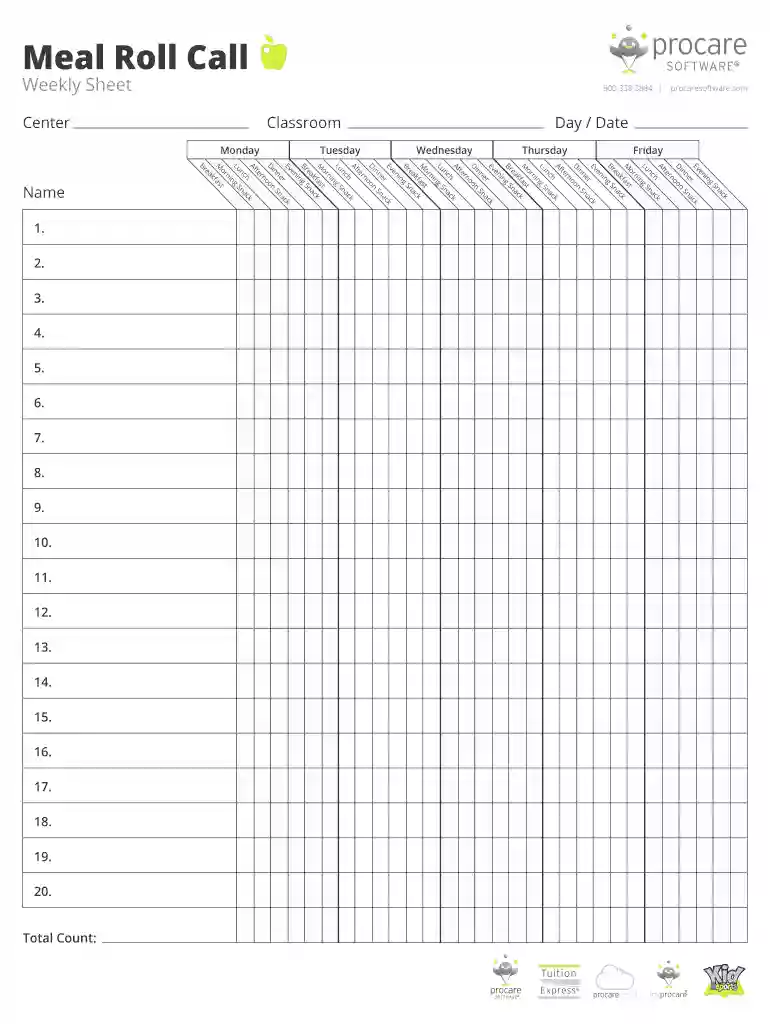
The "child-care-formsweekly-meal-roll-call-sheet" is an essential document designed to organize and track meal attendance in child care settings. This form typically functions as a weekly log used by caretakers or administrators to record the participation of children in meal programs. It ensures all mealtime participation is documented accurately, allowing for efficient meal planning and resource allocation.
The primary purpose of this sheet is to facilitate the smooth operation of meal programs by keeping a detailed account of who participates in each meal. These records can aid in identifying patterns such as regular absentees, which could indicate potential issues with child attendance or meal preferences. Additionally, having accurate records is crucial for compliance with regulatory and funding bodies that require documentation of service usage.
Using the weekly meal roll call sheet involves several key steps to ensure accuracy and completeness.
Detailed guidance on completing the form effectively can streamline processes and improve accuracy.
The form contains several critical sections, each serving a specific purpose.
The primary users of this form are individuals and entities involved directly in child care.


The benefits of utilizing this structured approach to meal tracking are manifold.
Ensuring legal compliance is crucial when implementing the use of this form.
Practical applications and scenarios where this form proves useful.
A small daycare uses the form each day to track which children partake in breakfast and lunch, allowing for clear reporting to catering services and parents.
After unexpected closures, staff can use accumulated data from these forms to adjust meal orders and budgets for the remainder of the month accurately.
The collected data assists administrators in assessing the success and reach of subsidized meal programs within their centers.
By covering these aspects, the content provides comprehensive insights and practical guidance aligned with the intended use of the child-care forms weekly meal roll call sheet.
We've got more versions of the child-care-formsweekly-meal-roll-call-sheet form. Select the right child-care-formsweekly-meal-roll-call-sheet version from the list and start editing it straight away!
According to eSignature regulations, forms signed electronically have the same validity as those approved with pen and paper. You can electronically sign almost any business and personal documentation. Four types of paperwork still require wet signatures only - wills and testamentary trusts, court orders and other court papers, state statutes regulating divorce, adoption, or other family law, and notice of cancellation of utility services. If you adhere to the regulations and utilize a reliable and compliant software solution, like DocHub, you can eSign your child-care-formsweekly-meal-roll-call-sheet without printing it.
If you choose analog methods of completing your child-care-formsweekly-meal-roll-call-sheet, you can easily download your file for printing. Search DocHub’s Forms & Templates catalog to find the exact file template you need and open it for editing or download it on your device in the format of your choice. It is possible to complete your form electronically and place your handwritten signature on it right after printing or eSign your file with DocHub.
At DocHub, your data security is our priority. We follow HIPAA, SOC2, GDPR, and other standards, so you can work on your documents with confidence.
Prepare attendance records or verify staff have prepared complete records. ☐ Complete. Post weekly menu. ☐ Complete. Medications: appropriate storage, out ofRead more
Manually prepared Time sheets and Overtime Forms, for those departments and staff that are NOT YET on the online TAS, can be scanned and submitted via emailRead more
Illness Specimen Contact Sheet for BC Womens and Childrens Hospital (BCWCH); other forms can be obtained from your selected laboratory. Please ensure thatRead more


