




01. Edit your nc fuel sticker application online
Type text, add images, blackout confidential details, add comments, highlights and more.

Type text, add images, blackout confidential details, add comments, highlights and more.

Draw your signature, type it, upload its image, or use your mobile device as a signature pad.

Send nc gas 1274 via email, link, or fax. You can also download it, export it or print it out.
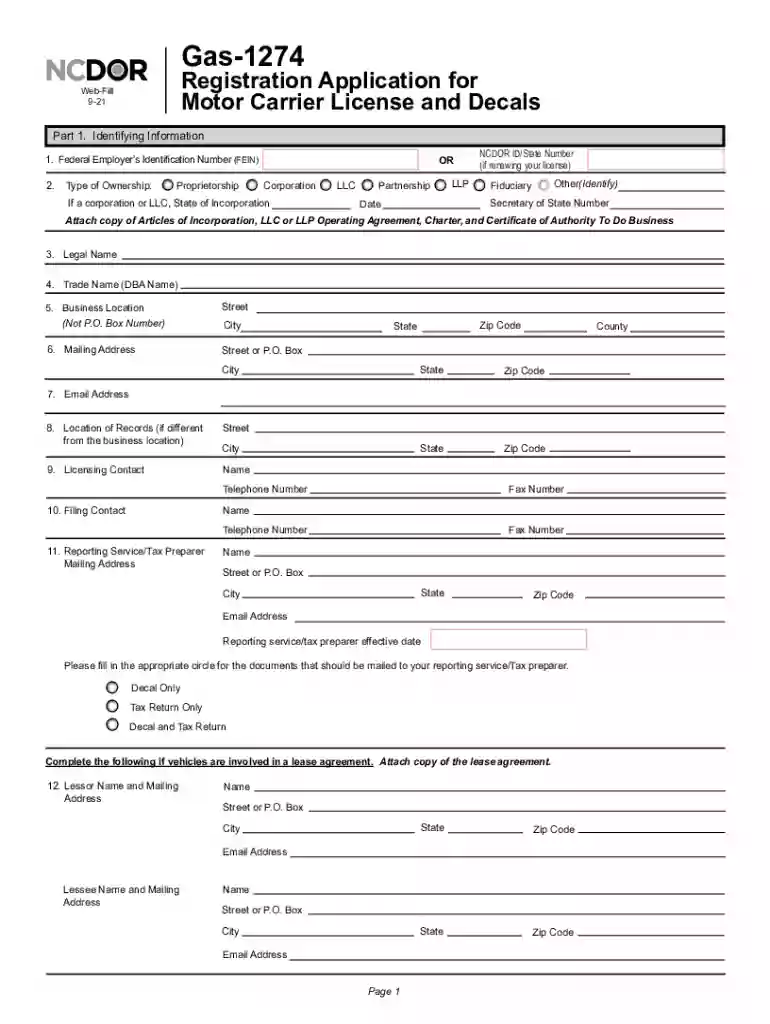
The Gas-1274 Registration Application is a crucial document used by motor carriers operating within the United States, specifically in North Carolina, to apply for a Motor Carrier License and Decals. This application ensures compliance with the International Fuel Tax Agreement (IFTA) and helps in managing fuel tax reporting obligations. Motor carriers must provide extensive information about their operations, including their business structure, vehicle details, and operational jurisdiction, to obtain approval.
Completing the Gas-1274 form requires careful attention to detail and accurate input of the necessary information. Here’s a step-by-step guide to help applicants through the process:
The proper completion and submission of the Gas-1274 form ensure compliance with state and federal regulations. Non-compliance can lead to penalties, including fines or revocation of the motor carrier license.
While the Gas-1274 is primarily a North Carolina-specific application, other states may have similar requirements with slight variations. Motor carriers operating in multiple states should be aware of these differences:
The form is predominantly used by:


Consider a medium-sized trucking company based in North Carolina, planning to expand its operations to several neighboring states. By using the Gas-1274 Registration Application, the company ensures full compliance with both state and cross-border fuel tax requirements, facilitating smooth uninterrupted operations.
Motor carriers have the flexibility to submit their Gas-1274 application through various channels to suit their needs:
Familiarity with related forms or predecessor documents might be necessary for applicants who have previously registered and need to update or amend their current operations.
Different business entities, such as LLCs or corporations, may have specific requirements concerning the submission of the Gas-1274 application, necessitating legal consultations or additional paperwork to ensure correctness.
By understanding the detailed mechanics of the Gas-1274 Registration Application process, businesses can better navigate the complexities of motor carrier licensing, ensuring compliance and the smooth operation of their business activities.
We've got more versions of the nc fuel sticker application form. Select the right nc fuel sticker application version from the list and start editing it straight away!
At DocHub, your data security is our priority. We follow HIPAA, SOC2, GDPR, and other standards, so you can work on your documents with confidence.
To obtain an annual parking decal, current vehicle registration and a valid Pace I.D. must be presented to Safety and Security Department.
This application must be completed by any business operating as an intrastate or interstate motor carrier with a gross vehicle weight exceeding 26,000 lbs.Read more


