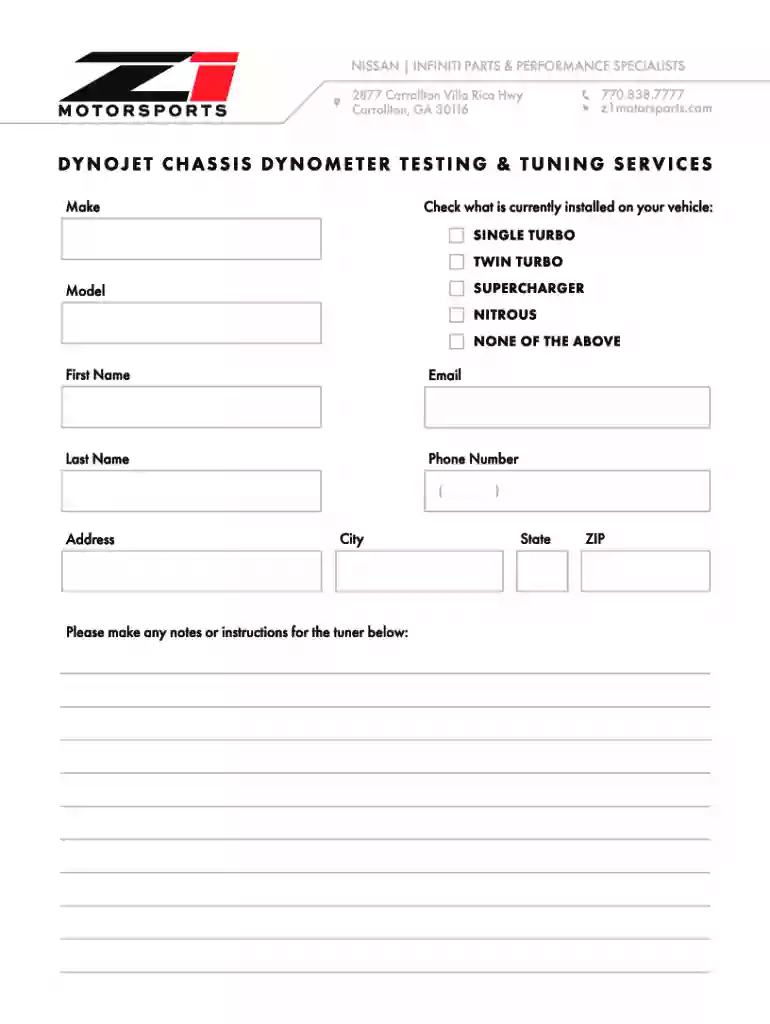
Dyno Waiver 2020-2026

Get Form
Dyno Waiver 2020 Preview on Page 1

Here's how it works

01. Edit your form online
Type text, add images, blackout confidential details, add comments, highlights and more.

02. Sign it in a few clicks
Draw your signature, type it, upload its image, or use your mobile device as a signature pad.

03. Share your form with others
Send it via email, link, or fax. You can also download it, export it or print it out.

Definition & Meaning

The "Dyno Waiver 2020" is a document often used in automotive contexts, specifically within the United States. It primarily serves as a release form, detailing the terms and conditions related to the operation of dyno equipment, which is typically used for measuring the power output of vehicles. This document ensures that both parties—the service provider and the vehicle owner—are aware of the responsibilities, risks, and liabilities involved in using the dyno equipment.

The waiver offers a legal framework that protects the service provider from potential liabilities arising from damages or injuries that may occur during the dyno testing process. It typically includes clauses that specify the limitations of liability, the scope of permitted use of the equipment, and the acknowledgement of assumed risk by the vehicle owner.

Key Elements of the Dyno Waiver 2020

The Dyno Waiver 2020 includes several critical components that define its scope and enforceability:

  • Assumption of Risk: This section requires the vehicle owner to acknowledge the inherent risks associated with dyno testing, including potential damage to the vehicle.
  • Limitation of Liability: The waiver limits the service provider's liability for any damages incurred during the dyno test beyond cases of gross negligence or willful misconduct.
  • Indemnification Clause: The vehicle owner agrees to indemnify and hold the service provider harmless against any claims arising from the use of dyno services.
  • Vehicle Condition: An affirmation that the vehicle is in proper working order and suitable for dyno testing, shifting responsibility onto the owner for any pre-existing conditions that may cause damage.

Steps to Complete the Dyno Waiver 2020

Completing the Dyno Waiver 2020 involves several systematic steps to ensure all parties are adequately informed and protected:

  1. Read the Document Thoroughly: Understand all clauses, especially those regarding liability and risk assumption.
  2. Fill Out Personal Information: Include name, contact details, and vehicle identification information.
  3. Review Risk Acknowledgement: Ensure there is an understanding of the risks outlined, and agree to assume them.
  4. Sign and Date the Waiver: Provide a signature confirming agreement to the terms and conditions.
  5. Submit the Document: Return the completed waiver to the service provider, preferably before the scheduled dyno session to avoid any delays.

Legal Use of the Dyno Waiver 2020

The legal use of a Dyno Waiver 2020 requires adherence to specific standards to ensure its enforceability:

  • Clear Language: The waiver must use clear and understandable language to avoid any ambiguity regarding its terms.
  • Voluntary Agreement: The vehicle owner must sign the waiver voluntarily. It should not be executed under duress or coercion.
  • Legal Capacity: Both parties must have the legal capacity to enter into a binding agreement.
  • Jurisdiction Compliance: The waiver should comply with applicable state laws, which can affect its validity and enforceability.

State-Specific Rules for the Dyno Waiver 2020

Different states in the U.S. may impose specific regulations that impact the Dyno Waiver 2020:

  • Liability Waivers: While generally enforceable, some states have stricter rules on waivers and may dictate specific wording or disclaimer requirements.
  • Consumer Protection Laws: States may have consumer protection laws that influence the terms and conditions permissible in such waivers.
  • Statutory Limits: Certain states impose statutory limits that affect the amount or scope of liability that can be waived.

Examples of Using the Dyno Waiver 2020

Using the Dyno Waiver 2020 involves practical scenarios where it serves as a protective measure for both service providers and customers:

  • Performance Tuning Shops: These businesses frequently use the waiver before conducting dyno sessions to enhance vehicle performance, ensuring that customers understand potential risks.
  • Automotive Events: At events featuring dyno exhibitions, organizers may require participants to sign the waiver to participate in dyno testing activities.
  • Research and Development: Companies conducting engine tests or performance evaluations on prototypes typically use the waiver to protect against unintended liabilities.

Digital vs. Paper Version

The choice between digital and paper versions of the Dyno Waiver 2020 can affect the document's accessibility and convenience:

  • Digital Signing: Using platforms like DocHub, users can sign the waiver electronically, facilitating easy distribution, storage, and access across devices.
  • Paper Copies: While still common, paper documents require manual processing and storage, potentially leading to inefficiencies.
  • Security Concerns: Digital versions often benefit from enhanced security features such as encryption, ensuring confidentiality and tamper prevention.

Eligibility Criteria

Understanding the eligibility criteria for the Dyno Waiver 2020 can help ensure the appropriate issuance and execution of the waiver:


  • Age Requirement: Most states require vehicle owners or authorized representatives to be at least 18 years old to sign the waiver legally.
  • Vehicle Ownership: The party signing should have legal ownership or a valid authorization to present the vehicle for dyno testing.
  • Proper Identification: Typically, valid identification may be required to verify the signer's identity, reducing the risk of fraudulent claims.
decoration image ratings of Dochub

See more Dyno Waiver 2020 versions

We've got more versions of the Dyno Waiver 2020 form. Select the right Dyno Waiver 2020 version from the list and start editing it straight away!
Versions Form popularity Fillable & printable
2021 4.8 Satisfied (117 Votes)
2020 4.4 Satisfied (46 Votes)
2013 4 Satisfied (57 Votes)
be ready to get more

Complete this form in 5 minutes or less

Get form

Got questions?

We have answers to the most popular questions from our customers. If you can't find an answer to your question, please contact us.
Contact us

Log in to your DocHub account and add your Dyno Waiver 2020 to our editor using one of its upload methods - from your device, cloud storage, protected URL, or your DocHub folders if you have already processed your document before. Open our editor, click the Sign button in the top toolbar, and decide on your signing method. You can use an image of your handwritten signature, draw it, type in your name, or utilize a QR code as an alternative.

You may quickly complete, edit, and even eSign your Dyno Waiver 2020 utilizing DocHub. Create a new account and begin your free trial. After that, you may add the document with the form and simply make all the required edits. No need to print on paper or use a third-party application to sign it, as you can put your electronic signature on your document faster via DocHub.

A Dyno tune will optimize the performance of your vehicle. Its a great choice if you need more acceleration or want to tune your car for the track. You can tweak and boost horsepower, torque, and fuel efficiency to your cars capable parameters.
Tuning Dyno Rates Dyno cost per hour while tuning: $125.00. Strap Setup fee: $50.00. Restrap fee: $25.00.
Dyno tuning is a quick procedure and shouldnt take long to complete. Therefore, it should take between one and five hours for complete engine optimization. However, the sweet spot is usually between four and five hours for a job well done.

Security and compliance

At DocHub, your data security is our priority. We follow HIPAA, SOC2, GDPR, and other standards, so you can work on your documents with confidence.

Learn more
ccpa2
pci-dss
gdpr-compliance
hipaa
soc-compliance

People also ask

Belts and hoses: Dyno tuning sessions can be hard on the engine, so any weak or old belts and hoses could be at risk for tearing or bursting. Be sure yours are in good shape. Tires: Your cars tires run directly on rollers during a dyno pull, so youll want to be sure theyre in good condition and have proper traction.
A dyno tune commonly provides for maximum power, better drivability, good fuel economy and a smoother ride. It increases the horse power of your vehicle and returns the vehicle to stock fuel economy. It also prevents or minimizes backfire. Dyno tuning can also save you from costly repairs in the future.
Dyno tuning is definitely the more consistent way to tune, but one of the major drawbacks here is that the best dyno tune in the world is not worth the time if the car cant make it around the corner from the shop because the tuner could not replicate a condition the vehicle actually encounters on the street, such as a
A Dyno tune will optimize the performance of your vehicle. Its a great choice if you need more acceleration or want to tune your car for the track. You can tweak and boost horsepower, torque, and fuel efficiency to your cars capable parameters.
Dyno tuning is a quick procedure and shouldnt take long to complete. Therefore, it should take between one and five hours for complete engine optimization. However, the sweet spot is usually between four and five hours for a job well done.

Related links