




01. Edit your motsepe foundation funding application forms for churches online
Type text, add images, blackout confidential details, add comments, highlights and more.

Type text, add images, blackout confidential details, add comments, highlights and more.

Draw your signature, type it, upload its image, or use your mobile device as a signature pad.

Send motsepe foundation funding application forms for churches via email, link, or fax. You can also download it, export it or print it out.
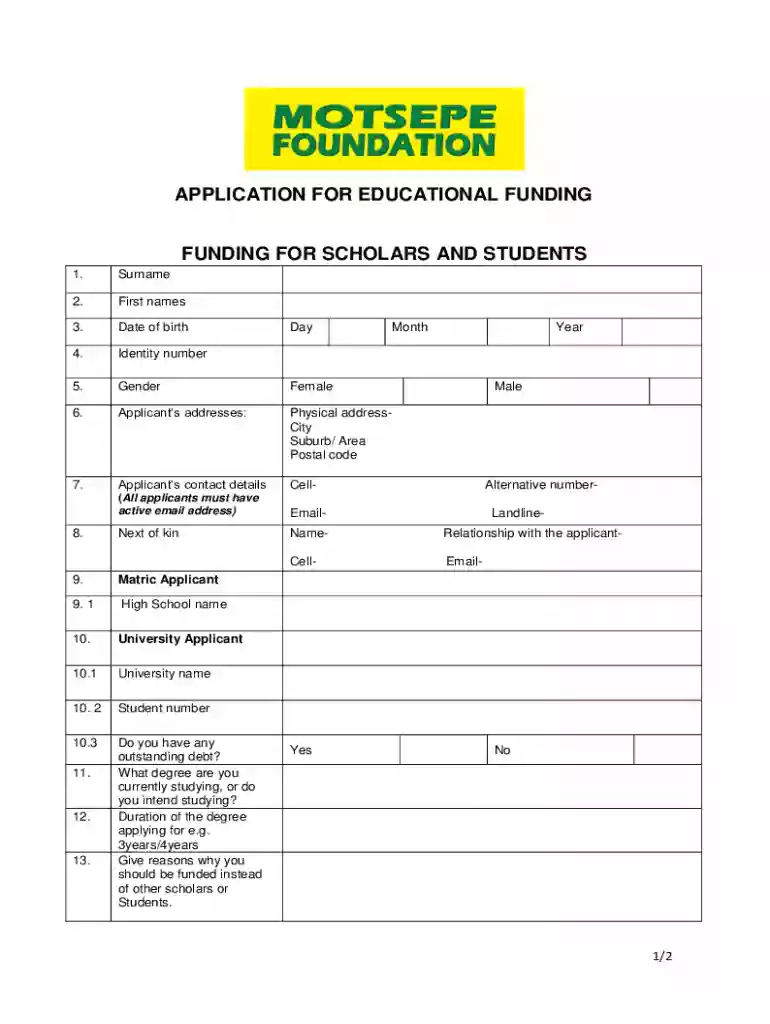
The application for educational funding is a formal document designed to assist students and scholars in obtaining financial support for their academic endeavors. This form is central to identifying those in need of assistance by requiring detailed personal and academic information. It also helps institutions or governmental bodies assess the eligibility of candidates based on the standardized data they provide. Completing this application accurately is pivotal as it plays a decisive role in securing the necessary funds to pursue educational goals.
The application serves multiple purposes, such as gathering comprehensive information about the applicant's educational background and current financial situation. By consolidating this information into a structured format, it enables funding organizations to make informed decisions regarding the allocation of resources to deserving applicants. This process ensures that financial aid is distributed fairly and effectively, allowing students to focus on their studies without the burden of financial stress.
Acquiring the application for educational funding can be done through several channels, depending on the issuing body. Here's how you can typically obtain the form:
Educational Institutions: Most colleges and universities provide their students with access to educational funding applications through their financial aid offices. You can visit the office in person or check the school's website for downloadable forms.
Government Websites: Federal and state government websites often host applications for governmental education grants and funding. These sites usually offer detailed instructions and links to download or fill out the forms online.
Mail Requests: Some funding bodies allow applicants to request the form via mail. This option may require applicants to call or email the institution to send the form to their home address.
Non-Profit Organizations: Educational non-profits sometimes offer forms or assistance in applying for educational funds on their websites or at their offices.
Always ensure that you are accessing the most current version of the application form by checking the issue date or version number, as these forms can often undergo updates to reflect new policies or requirements.
Completing the application for educational funding requires careful attention to detail. Here's how you can effectively fill out the form:
Gather Necessary Documentation: Before you start, collect all required documents such as tax returns, proof of enrollment, and personal identification. Having these on hand will streamline the process.
Read Instructions Carefully: Each funding application comes with specific instructions. Take time to thoroughly read these guidelines to ensure you fill out each section correctly.
Provide Accurate Personal Details: Fill in your name, date of birth, and contact information precisely. Accurate data ensures efficient processing and minimizes the risk of errors.
Detail Educational Background: Include your current level of study, institution details, and any pertinent academic achievements or records. This information supports your eligibility.
Financial Information and Need Analysis: Complete sections detailing your financial status, including income and expenses. This critical part of the application determines the level of need-based assistance you may receive.
Review and Verify: Double-check all entered information. Ensure all documents are attached and in the correct format, as incomplete or incorrect applications can lead to delays or denials.
Submit the Application: Follow submission instructions carefully, whether mailing the form or submitting it online through a secure portal.
Understanding key terminology related to the application can significantly aid in a successful submission:
Grants: Financial awards that do not need to be repaid, typically offered based on need or merit.
Scholarships: Financial aid provided to students based on academic or other achievements, also not requiring repayment.
Financial Aid: A broad term encompassing grants, scholarships, loans, and work-study opportunities that assist students financially.
Need-Based Aid: Assistance provided based on the applicant's financial need, often determined by income and family size.
Merit-Based Aid: Financial support given for outstanding academic performance or unique talents.
Understanding these terms will help applicants effectively communicate with financial aid officers and tailor their applications accordingly.
To complete an application for educational funding, applicants typically need to provide several key documents:
Proof of Identity: A government-issued ID, such as a passport or driver's license.
Academic Records: Transcripts or certificates from current or previous educational institutions.
Financial Documents: Recent tax returns, pay stubs, and any documentation that reflects income and expenses.
Letters of Recommendation: Sometimes required to support claims of academic merit or potential.
Statement of Purpose: A brief essay detailing educational goals and how the funding will contribute to achieving them.
By ensuring all necessary documents are submitted and accurate, applicants can significantly enhance their chances of receiving funding.
The process involves several clear steps which, if followed diligently, can lead to a successful outcome:
Initial Submission: Once the application is filled out, it must be submitted using the preferred method (online or via mail).
Acknowledgment and Review: Upon receipt, most institutions send an acknowledgment message. The application is then reviewed to ensure compliance with submission criteria.
Evaluation Phase: Institutions assess the application based on merit and financial need, this phase may include additional requests for supporting documents.
Notification of Decision: Applicants receive a formal decision letter, informing them whether the application was approved or denied.
The time from submission to notification can vary but typically ranges from several weeks to a couple of months, depending on the institution's processing capabilities.
Ensuring the legal and ethical use of the application is crucial:
Accuracy of Information: Applicants must provide truthful and accurate information. False data can lead to application denial and potential legal action.
Confidentiality: The data provided in the application should be protected and used only for the purpose of funding evaluation.
Compliance: Follow all guidelines and legal requirements set by the issuing body to avoid any form of misconduct.
Understanding and adhering to the legal responsibilities associated with the application is essential for maintaining eligibility and integrity within the educational funding process.
While many aspects of educational funding applications are standardized, state-specific rules can apply:
State Aid Programs: Some states have their own financial aid programs with unique forms and procedures.
Residency Requirements: Eligibility often requires proof of state residency, which can vary in criteria from state to state.
Deadline Variations: States can have differing deadlines for submission, which must be adhered to prevent application rejection.
Being informed about and compliant with state-specific regulations can significantly affect the outcome and availability of funding opportunities. This involves checking with local educational authorities or state education departments for detailed information.
We've got more versions of the motsepe foundation funding application forms for churches form. Select the right motsepe foundation funding application forms for churches version from the list and start editing it straight away!
At DocHub, your data security is our priority. We follow HIPAA, SOC2, GDPR, and other standards, so you can work on your documents with confidence.


