




01. Edit your form online
Type text, add images, blackout confidential details, add comments, highlights and more.

Type text, add images, blackout confidential details, add comments, highlights and more.

Draw your signature, type it, upload its image, or use your mobile device as a signature pad.

Send it via email, link, or fax. You can also download it, export it or print it out.
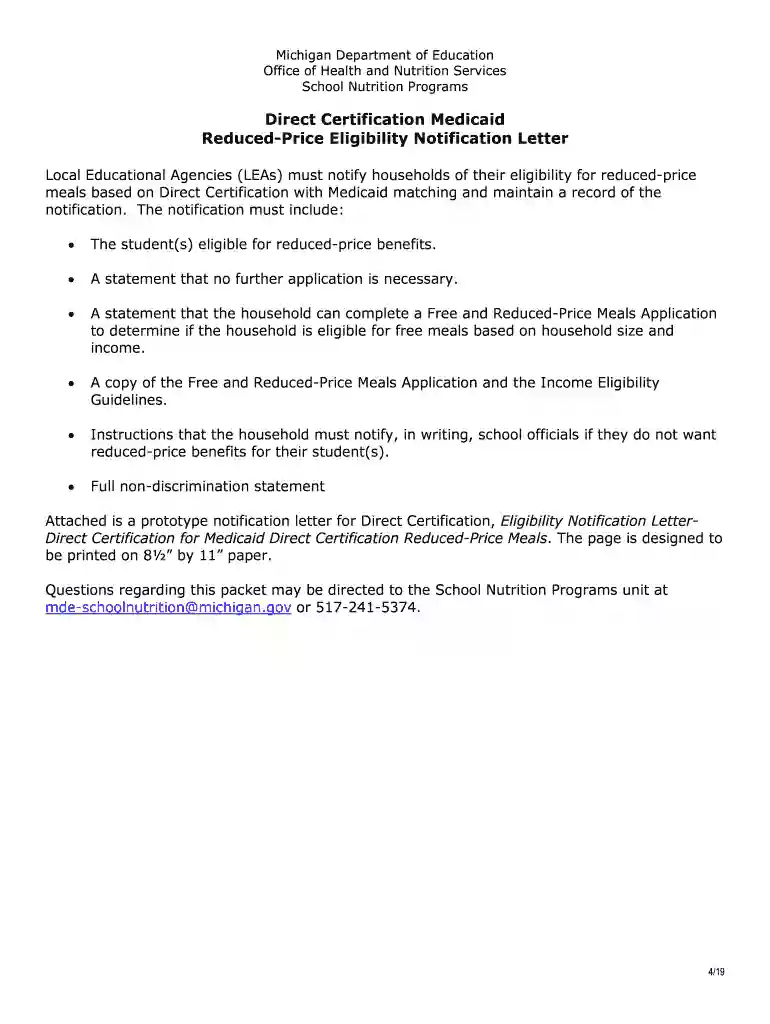
A Sample Eligibility Notification Letter serves as a formal document issued to notify households about their eligibility for certain benefits or services, such as reduced-price meals in educational settings. This form typically provides important details about the eligibility criteria, the benefits offered, and any necessary steps for the recipients to follow if they wish to accept or decline the benefits.
In the context of educational institutions, this letter often pertains to notifications regarding eligibility under programs that provide free or reduced-price meals to students. It plays a crucial role in ensuring that eligible families are aware of the benefits to which they are entitled and can make informed decisions about participating in the program.
The Sample Eligibility Notification Letter can be a critical tool for both issuing organizations and recipients. Understanding its use helps in effectively communicating and processing notifications.
Issuers: Schools or educational agencies typically send out these letters as part of their responsibility to inform eligible families. The letter should clearly outline the eligibility criteria, benefits, and any action required by the recipient.
Recipients: Families receiving this letter should carefully review the information provided. It's essential to understand the benefits being offered and assess whether the listed eligibility aligns with their current situation.
Procedure: If opting in, recipients may need to follow specific instructions, which could include filling out forms or providing additional documentation to confirm their eligibility.
Though the letter itself is primarily informative, there may be components that require action. Below is a typical outline for completing any necessary steps associated with the letter:
Read the Letter Carefully: Begin by thoroughly reading the sample eligibility notification letter to ensure you understand the benefits and requirements.
Verify Eligibility Information: Check the information to confirm that details such as the names of eligible individuals and the benefits are accurate.
Make a Decision: Decide whether to accept the offered benefits. If you choose to opt in, note any deadlines and procedural steps mentioned.
Complete Required Actions: If the letter requires you to submit additional forms or documents, gather these materials promptly.
Submit Responses: Follow the instructions for where and how to submit any required information or forms. This may include online submissions or mailing physical documents.
The effectiveness of the Sample Eligibility Notification Letter is dependent on including certain vital components. The letter must ensure clarity and utility by covering the following key elements:
Eligibility Criteria: Clearly state the standards or requirements that qualify households for the benefits. This could include income thresholds or specific demographic criteria.
Benefit Details: Outline what is being offered, such as reduced-price meal options, to clarify the nature and scope of the benefits provided.
Instructions for Accepting or Declining: Provide explicit instructions on how recipients can opt in or out of the benefits.
Contact Information: Include ways for recipients to reach out for further questions, typically a phone number or email address, and the issuers' contact person or department.
Nondiscrimination Statement: Ensure compliance with legal requirements by including a statement that addresses nondiscrimination policies.
The primary users of a Sample Eligibility Notification Letter are educational institutions and governmental bodies responsible for administering benefit programs:
Local Educational Agencies (LEAs): LEAs often utilize these forms to notify families about entitlements related to student benefits, such as meal programs.
Government Entities: State and federal programs may also issue such letters as part of larger initiatives aimed at supporting eligible individuals or groups.
Families and Households: Those receiving these notifications are generally families with school-aged children who may qualify for subsidized services.


The Sample Eligibility Notification Letter operates under specific legal frameworks that govern its issuance and use:
Compliance with Federal and State Laws: Issuers must ensure that the letter adheres to relevant regulations, such as those under the USDA or other governing bodies related to education and welfare.
Data Privacy: The handling of recipients' sensitive information must comply with privacy standards, ensuring that personal data is protected during the notification process.
Audit and Record-Keeping: Institutions may be required to maintain records of these notifications for auditing purposes, verifying compliance and effectiveness of the benefit programs.
Differences may exist in how these letters are used or governed from one state to another. Factors influencing these discrepancies often include:
State Legislation: Varied state laws may dictate different procedures or criteria for determining eligibility and issuing notifications.
Regional Initiatives: State-specific initiatives may affect the scope of benefits offered, necessitating different notification formats or content.
Administrative Procedures: Differences in administrative practices at the state level can impact how and when these letters are distributed.
Understanding these variations is crucial for both issuers and recipients to ensure compliance with local mandates and optimize the utilization of offered benefits.
To illustrate the practical application of these letters, consider the following scenarios:
A School District in Michigan: Issues eligibility notification letters annually to inform families about reduced-price meal benefits based on direct certification with Medicaid. These letters are a vital communication tool to ensure that families are aware of their options for subsidized meals.
An Urban Educational Agency: Notifies students about their eligibility for a city-funded scholarship program to promote academic achievement in underprivileged communities. The letter outlines scholarship amounts and application procedures, encouraging participation among eligible students.
These examples highlight the diverse use cases of such letters in different settings and underscore their importance in managing and communicating benefit programs effectively.
We've got more versions of the Sample Eligibility Notification Letter form. Select the right Sample Eligibility Notification Letter version from the list and start editing it straight away!
At DocHub, your data security is our priority. We follow HIPAA, SOC2, GDPR, and other standards, so you can work on your documents with confidence.
Parent and Guardian Notification Letters. School Year 2025-26. The parent/guardian letters below apply to school meals for the NSLP and SBP.Read more
We have reviewed your request for leave under the FMLA and supporting documentation you have provided. This letter is intended solely as notice you are eligibleRead more
A sample SF-50 follows below. Employees should pay particular attention to the following items: . Check your name, SSN, DOB for accuracy (Items 1, 2, 3)Read more


