




01. Edit your form online
Type text, add images, blackout confidential details, add comments, highlights and more.

Type text, add images, blackout confidential details, add comments, highlights and more.

Draw your signature, type it, upload its image, or use your mobile device as a signature pad.

Send it via email, link, or fax. You can also download it, export it or print it out.
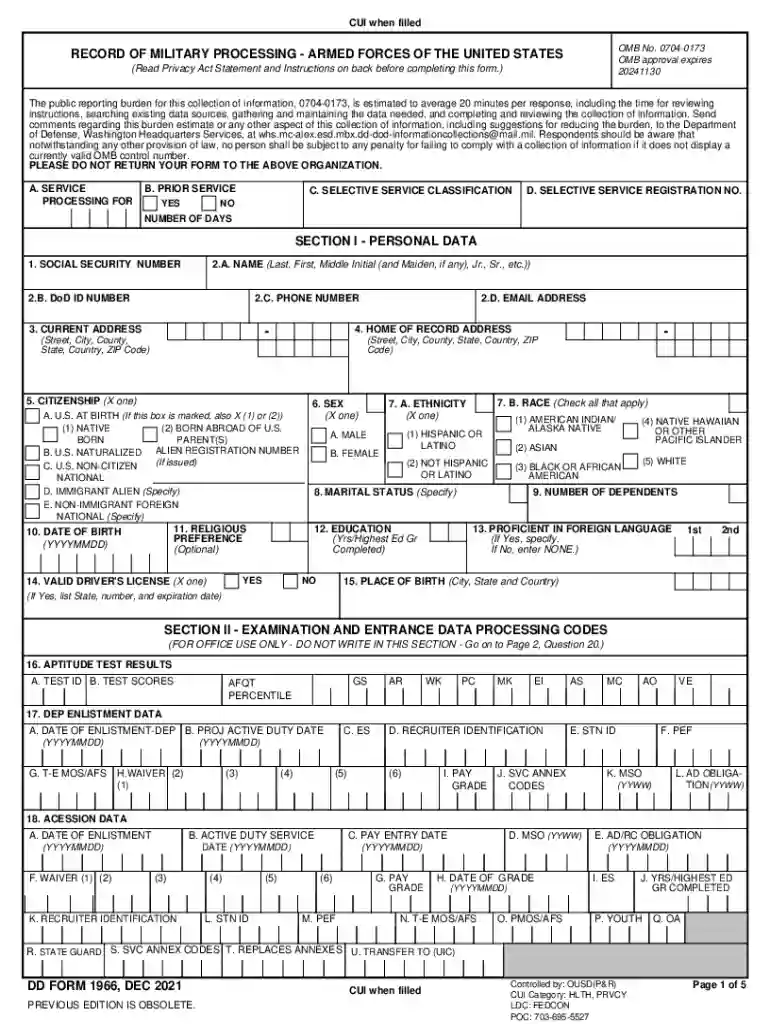
DD Form 1966, known as "Record of Military Processing," is utilized for enlistment in the United States Armed Forces. This form gathers essential information about applicants, including their personal identification, education background, and military history, to determine their eligibility for enlistment. It serves as a comprehensive record that ensures all necessary criteria are met for individuals joining the military. The form complies with privacy laws and emphasizes the importance of providing accurate information to avoid penalties.
The DD Form 1966 is typically provided by a military recruiter during the enlistment process. Individuals interested in joining the armed forces can contact their local recruiting office or visit the official military recruitment website to connect with a recruiter. This form is not publicly available for download, as it must be filled out under the guidance of a recruiting officer to ensure all sections are accurately completed and verified.
Personal Information Section: Begin by filling in basic personal details, including name, date of birth, and social security number. Ensure that all spellings and numbers are accurate.
Education and Employment History: Provide information about your educational background, including schools attended and degrees obtained. List any significant employment history that may enhance your application.
Prior Military Experience: If applicable, include details of any previous military service, including branch, rank, and discharge status.
Examination Results: Complete sections related to physical and aptitude test results. These are typically administered and recorded by the recruiter.
Certification and Signatures: Sign the form to certify that all information is true and accurate to the best of your knowledge. Have the recruiter also certify the form.
Parental Consent: If you are under the age of 18, a parent or guardian must complete and sign the parental consent section.
This form is used by individuals who are aspiring to join the U.S. military. It is relevant for potential recruits from all branches, including the Army, Navy, Air Force, Marine Corps, and Coast Guard. Additionally, DD Form 1966 is handled by military recruiters who guide applicants through the enlistment process and ensure compliance with military entry requirements.
The DD Form 1966 must be used in accordance with various federal regulations that govern the enlistment process. It adheres to privacy laws, ensuring that the personal data of applicants is protected throughout the application process. Any false or misleading information provided on this form is subject to legal penalties, which may include disqualification from military service or other legal actions.
To complete the DD Form 1966, applicants need to provide several supporting documents:
Failing to provide accurate information or omitting required details on the DD Form 1966 can lead to severe consequences. Applicants may face disqualification from serving in the military, and any discovered falsehoods can lead to legal action. It is crucial to be truthful and ensure all information provided is complete and accurate to avoid these penalties.
We've got more versions of the dd 1966 form. Select the right dd 1966 version from the list and start editing it straight away!
At DocHub, your data security is our priority. We follow HIPAA, SOC2, GDPR, and other standards, so you can work on your documents with confidence.
PRINCIPAL PURPOSE(S): DD Form 1966 is the basic form used by all the Military Services and the. Coast Guard for obtaining data used in determiningRead more
The public reporting burden for this collection of information, 0704-0173, is estimated to average 20 minutes per response, including the time for reviewingRead more


