







Definition and Meaning
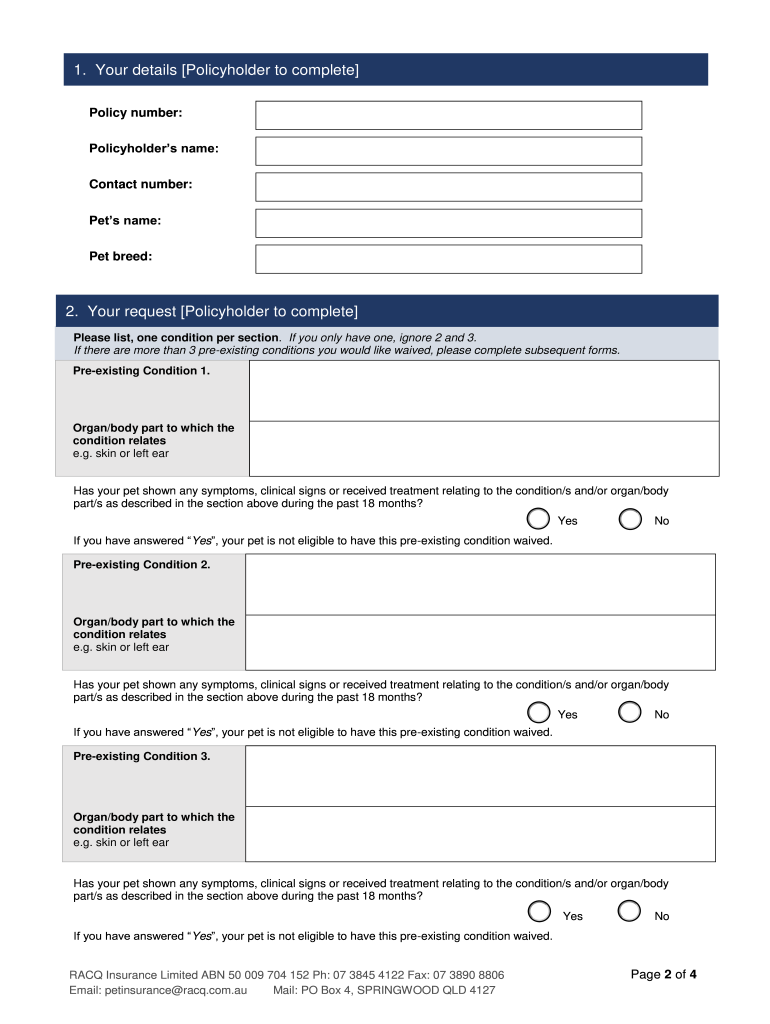
The "Pet Insurance Pre-existing Condition Exclusion Waiver Form" is a crucial document for pet owners seeking coverage for existing medical conditions under their pet insurance policies. This form serves as an official request to waive the typical exclusions that apply to pre-existing conditions, allowing pets to receive insurance benefits for health issues they had prior to securing coverage. By submitting this form, pet owners have an opportunity to extend their insurance benefits to cover ailments that would otherwise be excluded, provided the conditions for a waiver are met.
This document is particularly advantageous for pet owners who want to ensure comprehensive health coverage for their pets, even for issues that existed before the policy took effect. The form acts as a bridge between standard insurance exclusions and the additional coverage sought by pet owners.
Steps to Complete the Pet Insurance Pre-existing Condition Exclusion Waiver Form
-
Gather Required Information: Collect all necessary documentation, including a full veterinary history and recent health assessments of your pet. This will help provide a complete picture of your pet's health status and support your waiver request.
-
Complete Personal and Pet Details: Fill in your own details, such as name and contact information, alongside your pet's details, including breed, age, and any known health conditions.
-
Specify the Pre-existing Condition(s): Clearly identify the pre-existing conditions you wish to have waived from exclusion, providing as much detail as possible.
-
Attach Veterinary Documentation: Include any relevant veterinary reports or assessments that demonstrate your pet's health condition and the history of the pre-existing issue.
-
Sign and Date the Form: Ensure all sections are appropriately filled out, then sign and date the document. This certifies that the information provided is accurate and complete.
-
Submit the Form: Follow the submission instructions provided by your insurer. This might involve mailing the form, submitting it online, or in some cases, delivering it in person.
Eligibility Criteria
Not all pre-existing conditions are eligible for waivers. Insurance providers often have specific criteria that must be met for a waiver to be approved. Typically, the pet must have been free of the condition for a set period, often around 18 months, to qualify for consideration. Below are common eligibility requirements:
-
Condition-Free Period: Pets must not have shown symptoms or needed treatment for the condition in the last 18 months.
-
Comprehensive Medical History: Owners must provide a complete veterinary history, confirming the timelines and treatment details of the pre-existing condition.
-
Insurer Guidelines: Each insurer might have unique terms or additional criteria prescribing what constitutes eligibility for a waiver.
Pet owners should check with their insurer to understand the specific requirements and ensure all criteria are met before submitting the waiver request.


Important Terms Related to the Form
Understanding the terminology associated with the Pet Insurance Pre-existing Condition Exclusion Waiver Form can help pet owners accurately complete the form and communicate effectively with insurers. Here are critical terms:
-
Pre-existing Condition: A medical issue or condition that existed before the pet insurance policy became active.
-
Exclusion: Specific conditions or treatments that are not covered under an insurance policy.
-
Waiver: An agreement by the insurer to cover certain conditions or services that would typically be excluded.
-
Veterinary Assessment: An evaluation by a licensed veterinarian detailing the pet's health status and history.
These terms are essential for understanding the form's purposes and the conditions under which a waiver might be granted.
Key Elements of the Form
When completing the Pet Insurance Pre-existing Condition Exclusion Waiver Form, several elements must be carefully addressed to ensure the form is processed without delay:
-
Owner and Pet Information: Ensure accuracy in personal details and pet data.
-
Detailed Description of Condition: Include comprehensive information on the medical issues, ensuring clarity about what is being requested for waiver.
-
Supporting Documentation: Attach all necessary veterinary records and assessments verifying the condition and its status over time.
-
Declaration and Consent: Affirm that all information is accurate, providing explicit consent for the insurer to obtain further information if required.
These elements must be handled meticulously to facilitate a smooth processing of the form.
Who Uses the Pet Insurance Pre-existing Condition Exclusion Waiver Form
This form is primarily utilized by pet owners who seek to enhance the scope of their insurance coverage. It is particularly beneficial for owners of pets who have previously existing medical conditions and want assurance that future treatments for these conditions will be covered under their insurance plan. The form can also cater to:
-
New Pet Owners: Seeking to protect newly adopted animals that may have unknown pre-existing conditions.
-
Owners of Aging Pets: Ensuring continued coverage as pets grow older and developing conditions become more common.
-
Individuals with Pets Experiencing Recurring Conditions: Ensuring insurance extends to conditions that may resurface over time.
Examples of Using the Form
This form is often used in cases where pet owners have pets that were treated for conditions prior to acquiring the insurance but have since not shown any symptoms. Consider these scenarios:
-
Chronic Conditions: A dog with a history of allergies that has been symptom-free due to effective management.
-
Injury-Related Issues: A cat that had a broken bone, which healed fully before the insurance policy started, could be a candidate for an exclusion waiver.
-
Seasonal Conditions: Pets prone to conditions like hay fever, which didn’t manifest in recent seasons, might also be eligible.
These examples illustrate the broad applicability and potential benefits of using the waiver form.
Form Submission Methods
Understanding how to submit the Pet Insurance Pre-existing Condition Exclusion Waiver Form is critical to ensure timely processing:
-
Online Submission: Most insurers provide digital platforms for submission, where forms can be filled out and uploaded. This is often the quickest method.
-
Mail: For those preferring traditional methods, forms can be printed and mailed to the insurer's address provided in their instructions.
-
In-Person: Visiting an insurance office can ensure direct handover of the document, allowing for immediate receipt verification.
Adhering to the submission process defined by your insurer maximizes the chances of approval and efficient processing of your request.




