




01. Edit your form online
Type text, add images, blackout confidential details, add comments, highlights and more.

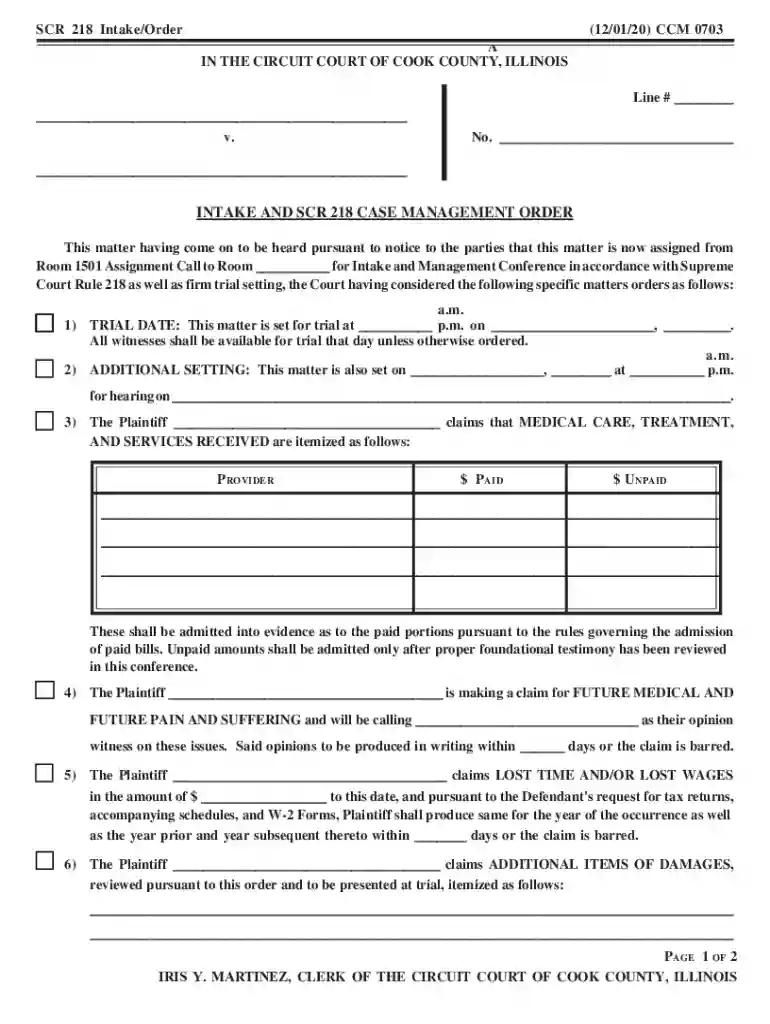
Type text, add images, blackout confidential details, add comments, highlights and more.

Draw your signature, type it, upload its image, or use your mobile device as a signature pad.

Send it via email, link, or fax. You can also download it, export it or print it out.
The "Motion - General Form (This form replaces CCMD-39) 12 01 20," often referred to as the Motion-Gen Form, serves as a standardized document for legal proceedings in the Circuit Court of Cook County, Illinois. It facilitates the submission of motions in court cases, allowing parties involved in litigation to request judicial action or issue a statement under the court's consideration. This form is essential for managing procedural actions, ensuring that all parties adhere to the rules and guidelines established by the court.
This particular iteration of the form replaces the earlier CCMD-39 version, incorporating updates that reflect current legal requirements and procedural adjustments. Understanding this form's purpose is crucial for smooth and efficient court interactions, as it is a vital part of case management within the Illinois legal system.
The Motion-Gen Form is composed of several key sections that need to be filled out accurately:
Including all essential details ensures that the motion is processed without unnecessary delays or complications.
Gather Necessary Information: Before filling out the form, collect all relevant case details, including docket numbers and the parties involved. This will ensure that the information is precise and complete.
Complete the Form Sections:
Review for Accuracy: Double-check all sections for completeness and accuracy. Verify that the motion is clear and that all legal references are correct.
Obtain Necessary Signatures: Secure the required signatures to certify the form. If you have legal representation, your attorney should also review and sign the form.
Submit the Form: Once completed, submit the form as instructed by the court. This may include electronic submission or physical filing, depending on the court's procedures.
The Motion-Gen Form is primarily used in legal settings to:
An understanding of the form's legal application ensures adherence to procedural norms and aids in maintaining the flow of judicial processes.
The primary users of the Motion-Gen Form include:
Familiarity with the form and its proper usage is crucial for anyone involved in initiating or responding to legal motions.


While this form is standardized for use in the Illinois court system, there are state-specific guidelines and procedures that must be adhered to:
Ensuring compliance with these rules is vital for effective legal practice and the timely processing of motions.
The Motion-Gen Form can be obtained through several channels:
Ensuring access to the correct version of the form is critical for compliance and effective legal management.
Understanding terminology associated with the Motion-Gen Form enhances its effective usage:
A solid grasp of these terms aids in accurate completion and submission of the form, contributing to a more effective judicial process.
We've got more versions of the Motion - General Form (This form replaces CCMD-39) 12 01 20 form. Select the right Motion - General Form (This form replaces CCMD-39) 12 01 20 version from the list and start editing it straight away!
Signing documents on a mobile device is fast, straightforward, and doesn’t require software installation when you have an account with DocHub. Sign in from any browser, complete your blank fields with your data, and click on Sign → Create your signature. You can draw your eSignature just as you usually do on paper, add its picture to your Motion - General Form (This form replaces CCMD-39) 12 01 20, or type in your name and stylize its look. Whatever option you choose, your document will be valid.
As a comprehensive document modifying service, DocHub is available on smart phones. Open DocHub in your choice of mobile browser and use our intelligent mobile-friendly toolset to fill out your Motion - General Form (This form replaces CCMD-39) 12 01 20.
At DocHub, your data security is our priority. We follow HIPAA, SOC2, GDPR, and other standards, so you can work on your documents with confidence.
Jan 31, 2026 The successful Bidder will be required to furnish a 100% Performance Bond and a 100% Payment Bond to cover the execution of the Contract whichRead more
Rule 3 Commencement of the Action, Service of the Complaint. 3 01. Commencement of the Action. 3 02. Service of Complaint. Rule 4 Service.
WARNING! Text set off in this manner indicates that failure to follow directions could result in bodily harm or loss of life.Read more


