
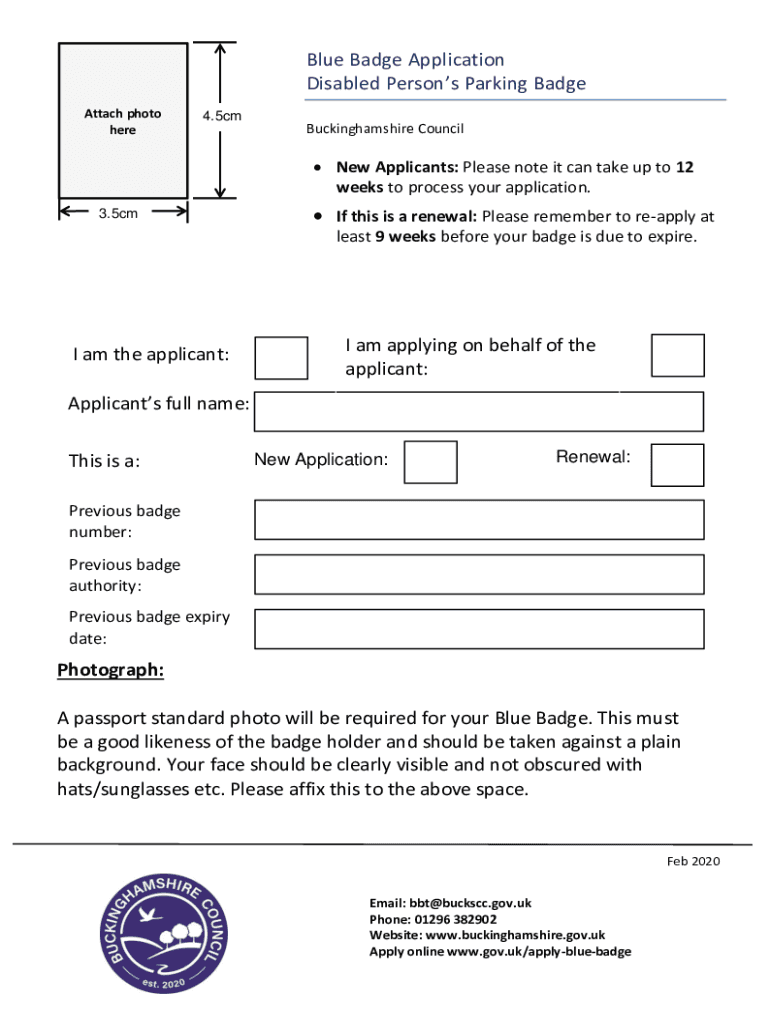







Definition and Purpose of the Blue Badge Application
The Blue Badge application is primarily aimed at individuals who require a disabled parking badge due to mobility challenges. This application facilitates access to designated parking areas, enabling easier access to facilities and services. The Blue Badge program is specifically tailored for disabled persons, allowing them to park closer to their destinations and ensuring greater convenience and independence.
Key Features
- Provides access to reserved parking spaces for disabled individuals.
- Facilitates more manageable access to facilities within communities.
- Serves as a critical tool for individuals with permanent or temporary mobility impairments.
Eligibility Criteria
Eligibility for the Blue Badge application primarily revolves around the mobility challenges faced by the applicant. There are specific categories under which an individual may automatically qualify or require further assessment.


Automatic Qualification Criteria
- Individuals receiving certain disability benefits such as high-rate mobility component of the Disability Living Allowance or Personal Independence Payment (PIP)
- Veterans awarded a particular sum under the Armed Forces Compensation Scheme
- Individuals who are registered blind
Further Assessment Criteria
- Individuals experiencing substantial difficulty while walking
- Those who have a severe disability affecting both arms and are a driver
- People with cognitive impairments who may struggle with a journey and have assistance needs
Required Documents
When completing the Blue Badge application, applicants must be prepared to supply several key documents. These documents provide necessary proof of identity, residence, and disability status.
Essential Documentation
- Proof of identity, such as a passport or driver’s license
- Proof of residency within the issuing state or local authority
- Relevant medical documentation or evidence, proving the mobility-related criteria are met
- Recent passport-sized photograph to be used for the badge
Steps to Complete the Blue Badge Application
Completing the Blue Badge application involves several clear steps, ensuring that all the necessary criteria and documentation are met.
-
Gather Required Documents: Collect all essential documents and information regarding identity, residency, and disability.
-
Complete the Form: Fill in personal details, mobility-related information, and attach necessary documentation as outlined by the local authority.
-
Submit the Application: Applications can be submitted online, via mail, or in person, depending on the issuing authority’s guidelines.
-
Await Decision: The local authority will review the application, and you may be contacted for further information or assessment.
-
Receive and Use Badge: Upon approval, you receive the badge, which you can use immediately in the designated areas.
Form Submission Methods (Online, Mail, In-Person)
Applications for the Blue Badge can be submitted through a variety of methods, ensuring accessibility for all potential applicants.
Online Submission
- Use the local authority’s designated portal or website
- Upload scanned copies of required documents
- Provide digital signatures where necessary
Mail Submission
- Send physical copies of the completed application form with all supporting documentation
- Include the relevant fees, if applicable, as a check or money order
In-Person Submission
- Visit the issuing office or a designated center
- Submit forms and documents over-the-counter
- Pay fees directly and possibly receive assistance with completing the application
Application Process and Approval Time
Understanding the application process and expected approval time is crucial for applicants. The Blue Badge application process is streamlined but requires thorough verification by the issuing authority.
Application Workflow
- Submit completed application with required documentation
- Authority conducts initial review and verifies information
- Applicant may be called for an assessment or interview if further clarification is needed
Approval Timelines
- Typical processing period ranges from a few weeks to a couple of months
- Timelines may vary based on the volume of applications and the need for additional assessments
Legal Use of the Blue Badge
The Blue Badge conveys certain parking benefits, and adherence to legal use is essential to avoid penalties or misuse.
Usage Guidelines
- Use only in designated accessible parking spaces
- Clearly display the badge on the vehicle dashboard, ensuring the badge number and expiration date are visible
- Do not lend your badge to others, even for short durations
Penalties for Non-Compliance
Non-compliance with Blue Badge rules can result in penalties that negatively impact an individual’s ability to use the badge.
Violations and Consequences
- Misuse may result in fines or revocation of the badge
- Using a badge that does not belong to you can lead to confiscation
- Parking in an unauthorized area could attract substantial fines
Examples of Using the Blue Badge Application
Practical examples of how the Blue Badge application process unfolds for different applicants provide insight into its utility.
Example Scenarios
- An elderly individual with a recent mobility impairment applies for a badge after securing documentation from their health provider.
- A veteran applies under the automatic qualification criteria, streamlining their application process.
- A young adult with cognitive impairments submits a comprehensive application that includes assessments from health professionals.
Who Typically Uses the Blue Badge Application
The Blue Badge application caters to a broad range of individuals dealing with various mobility challenges.

Typical Applicants
- Elderly individuals experiencing reduced mobility due to age
- Veterans or serving personnel with related mobility impairments
- Individuals with temporary mobility impairments due to surgery or physical injury
By covering these topics comprehensively, individuals applying for a Blue Badge can navigate the process with clarity and ease. Understanding the eligibility, necessary documentation, and legal guidelines ensures applicants can secure their badges with confidence.




