MI MC 13 2018-2022 - Fill and Sign - US Legal Forms-2026

Get Form
michigan courts Preview on Page 1

Here's how it works

01. Edit your michigan courts online
Type text, add images, blackout confidential details, add comments, highlights and more.

02. Sign it in a few clicks
Draw your signature, type it, upload its image, or use your mobile device as a signature pad.

03. Share your form with others
Send mi courts via email, link, or fax. You can also download it, export it or print it out.

Understanding the MI MC 13 2 Form

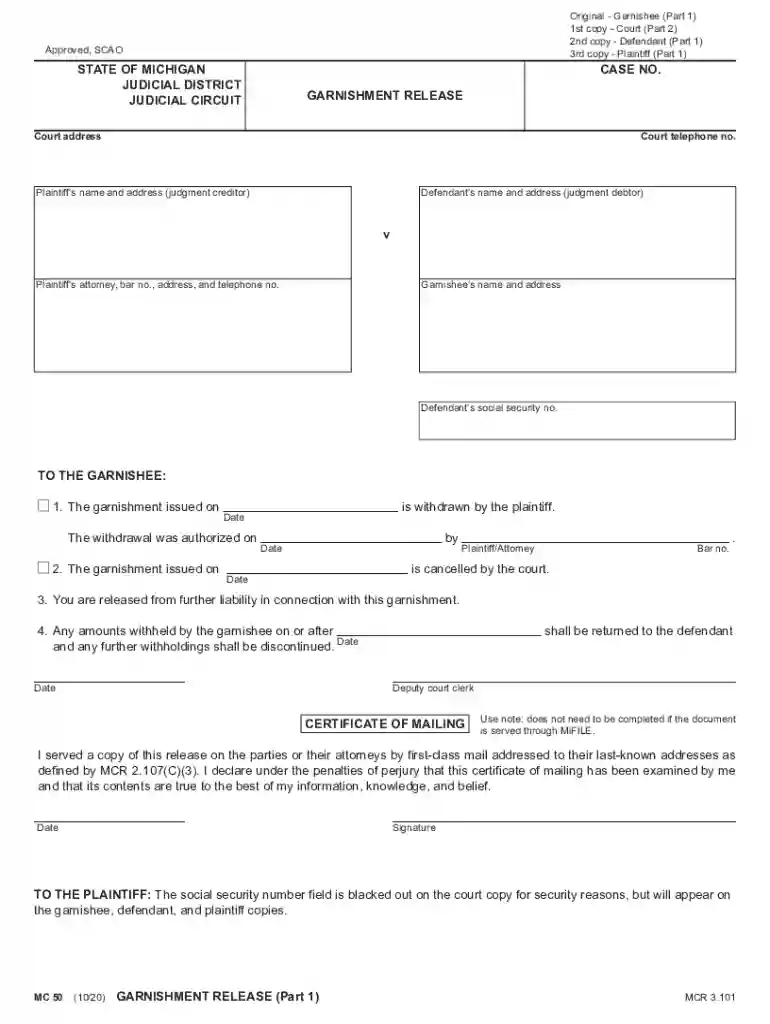
The MI MC 13 2 is a Garnishment Release form utilized in the State of Michigan. It serves to release a garnishment previously imposed on a defendant, following the withdrawal request by the plaintiff and cancellation approval by the court. This document plays a critical role in ensuring that all relevant parties adhere to state regulations surrounding garnishments.


Primary Purpose and Usage

  • Withdrawal of Garnishment: The form confirms the withdrawal of garnishment by the court.
  • Responsibilities of Garnishee: It instructs garnishees to stop withholding funds and details the process for returning withheld amounts to the defendant.
  • Documentation: It ensures all involved parties are informed and provides authentic documentation that garnishment obligations have ceased.

Steps to Complete the MI MC 13 2 Form

  1. Gather Required Information: Collect personal and contact information for the plaintiff, defendant, and garnishee.
  2. Fill Out the Form: Input data into the designated fields, ensuring accuracy to avoid processing delays.
  3. Certification of Mailing: Complete the section confirming the document has been mailed to relevant parties.
  4. Submission to Court: Ensure the completed form is submitted to the appropriate Michigan court for processing.

Key Elements of the MI MC 13 2 Form

Sections to Be Completed

  • Identification of Parties: Includes the names and addresses of the plaintiff, defendant, and garnishee.
  • Case Details: Provides information on the case number and court jurisdiction.
  • Certification of Mailing: This section ensures accountability by recording the mailing date and recipients of the form.

Additional Legal Considerations

  • Court Approval: The form requires approval from the court to finalize the withdrawal process.
  • Garnishment Status: It clearly states the cessation of funds' withholding once processed.

Legal Use of the MI MC 13 2 Form

  • Compliance with State Law: The form is utilized to ensure adherence to Michigan state laws regarding garnishment practices.
  • Recording and Documentation: Acts as an official record that garnishment duties have been lawfully concluded.
  • Protection for Defendants: Provides defendants with proof that no further wage withholdings are to be made.

State-Specific Rules for Using the MI MC 13 2 Form

  • Michigan Court Systems: Must be processed through Michigan's judiciary to be valid.
  • Regulations on Garnishment: Reflects specific state legislative frameworks and directives for garnishment actions.

Who Typically Uses the MI MC 13 2 Form

  • Plaintiffs Seeking Relief: Individuals or entities initiating the release of a garnishment.
  • Garnishees: Employers or institutions responsible for remitting garnished funds.
  • Defendants: Individuals subject to the original garnishment order.
decoration image ratings of Dochub

How to Obtain the MI MC 13 2 Form

  • Online on Official Court Websites: Accessible via digital platforms for ease of use.
  • In-Person from Courthouses: Available at local Michigan court offices for physical collection.

Important Terms Related to the MI MC 13 2 Form

Key Definitions

  • Garnishee: The institution or individual responsible for holding funds from the defendant's wages.
  • Certification of Mailing: A formal declaration that a document has been sent to required parties.

Examples of Using the MI MC 13 2 Form

  • Employer Completion: An employer ceases wage withholding once a court processes the garnishment release.
  • Legal Representation: Attorneys may help fill out and submit this form to protect client rights.

This structured content outlining the MI MC 13 2 Garnishment Release form offers comprehensive coverage to ensure clear understanding and effective execution in Michigan's legal contexts.

See more MI MC 13 2018-2022 - Fill and Sign - US Legal Forms versions

We've got more versions of the MI MC 13 2018-2022 - Fill and Sign - US Legal Forms form. Select the right MI MC 13 2018-2022 - Fill and Sign - US Legal Forms version from the list and start editing it straight away!
Versions Form popularity Fillable & printable
2020 4.9 Satisfied (36 Votes)
2009 4.8 Satisfied (111 Votes)
be ready to get more

Complete this form in 5 minutes or less

Get form

Got questions?

We have answers to the most popular questions from our customers. If you can't find an answer to your question, please contact us.
Contact us

Sure, electronically drawing your signature is appropriate, but only if you utilize a tool that complies with industry laws and regulations. Try DocHub, which guarantees eSignature validity under ESIGN and UETA requirements. All you need to eSign your garnishment michigan is an account with DocHub and an internet connection. After you open your paperwork in our editor, click Sign and select the Draw option.

If you use Chrome, there are two easy ways to edit your michigan garnishment online. First, go to the DocHub site, add your document, and edit it using our toolbar. You can also install our Chrome extension and edit any document by dragging and dropping it in your browser tab.

A non-periodic garnishment is used to garnish the defendants bank account or other property. Once money has been garnished under the non-periodic writ, the writ is no longer valid. If there is a remaining balance on the judgment, you must get another writ to collect more money. Garnishments | Eaton County, MI Eaton County Garnishments Eaton County Garnishments
Issuance of Writ of Garnishment After the request is filed, the court clerk or a judge signs the Request, and it becomes a Writ of Garnishment. The Writ of Garnishment orders the employer to hold any property (typically wages) of the employee that the employer has at the time the Writ is filed. What Employers Need to Know About Wage Garnishment | The Maryland Peoples Law Library what-employers-need-kno Peoples Law Library what-employers-need-kno
A writ of garnishment is a process by which the court orders the seizure or attachment of the property of a defendant or judgment debtor in the possession or control of a third party. The garnishee is the person or corporation in possession of the property of the defendant or judgment debtor.

Security and compliance

At DocHub, your data security is our priority. We follow HIPAA, SOC2, GDPR, and other standards, so you can work on your documents with confidence.

Learn more
ccpa2
pci-dss
gdpr-compliance
hipaa
soc-compliance
be ready to get more

Complete this form in 5 minutes or less

Get form

People also ask

In general, a writ of execution allows the sheriff or constable to seize property and assets in satisfying the judgment. Many types of property, money, and assets are included and can be seized as a result of a writ of execution.
You have two main options: you can either negotiate a settlement to pay off the remaining balance or file a motion in court to contest the garnishment, especially if it was obtained without your knowledge or by default. You can choose to handle this yourself or hire a local attorney to assist you.

michigan judicial