



01. Edit your form online
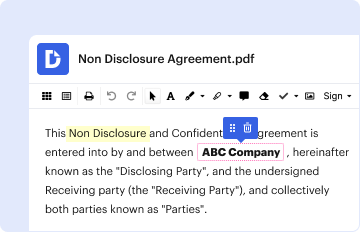
Type text, add images, blackout confidential details, add comments, highlights and more.

Type text, add images, blackout confidential details, add comments, highlights and more.
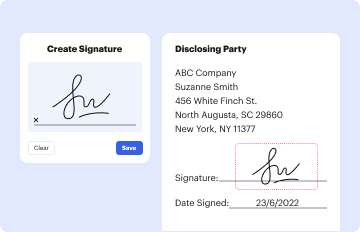
Draw your signature, type it, upload its image, or use your mobile device as a signature pad.
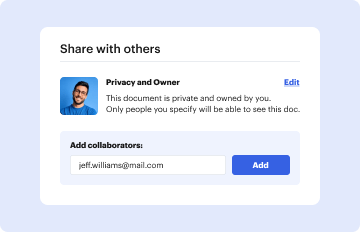
Send it via email, link, or fax. You can also download it, export it or print it out.
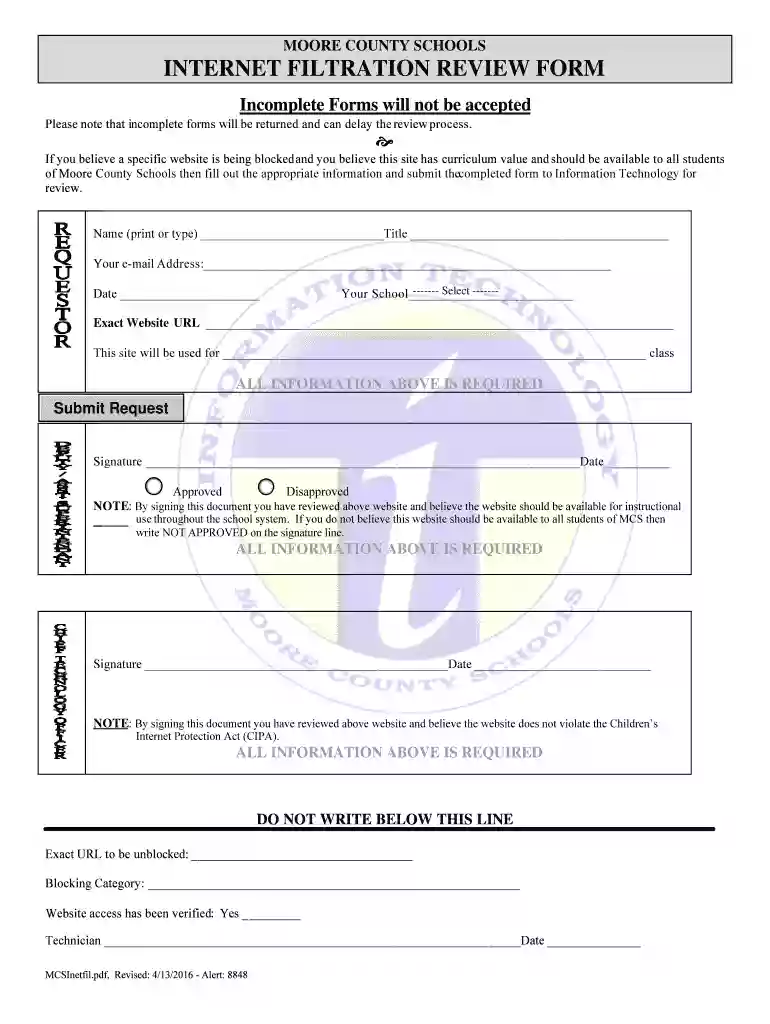
The Internet Filtration Review Form, especially for Moore County Schools (MCS), serves to assess and potentially lift restrictions on certain websites for educational use. This form is crucial in balancing the need for internet safety while allowing access to valuable educational resources. Staff members can request the unblocking of specific websites, providing the necessary details such as the URL and the educational context in which the site will be used. This mechanism ensures compliance with the Children's Internet Protection Act (CIPA) and addresses the dynamic needs of the educational environment, adapting to technological advancements and curriculum changes.
To effectively use the MCS Internet Review Form, staff must thoroughly complete the required sections to justify the educational necessity of unblocking a website. Start by entering personal and professional details, including name and department. Proceed to include the requested website's URL and a comprehensive explanation of its intended educational purpose. It is essential to articulate how the website supports curricular goals or enhances learning experiences. Once completed, the form should be submitted for administrative review. This submission may require coordination with IT departments or internet safety officers to assess the request's validity against school board policies and CIPA regulations.
The Internet Filtration Review Form can typically be obtained through the Moore County Schools' internal resources, often available on the school district's intranet or through direct request from IT services or school administration. Additionally, staff may receive guidance and access to the form during professional development sessions regarding internet safety and technological tools in the classroom. Ensuring accessibility of the form is crucial, as prompt and efficient requests allow educators to adapt instructional materials to better meet student needs.
Predominantly, the form is utilized by educators, librarians, and school administrators who frequently integrate internet resources into lesson plans. These users often require access to broader internet resources to create engaging and comprehensive educational content. Additionally, IT staff and administrators are beneficiaries in terms of managing internet safety while being flexible to educational demands. This ensures a cohesive approach to digital learning resources and internet safety compliance.


This form plays a pivotal role in legal compliance with CIPA by documenting the rationale and approval process for unblocking websites. Ensuring that internet access aligns with legal standards helps protect students and the institution while providing flexibility in educational resources. Legal usage also involves maintaining a record for audit trails and accountability, safeguarding against potential misuse or policy breaches.
A middle school science teacher may use this form to request access to a reputable scientific database previously blocked due to general internet filtering policies. By detailing the academic benefit and curriculum alignment, the teacher aims to enhance students' research capabilities. Similarly, a high school history department might petition to unblock a digital archive vital for a World History project, emphasizing the educational significance and contextual value.
In the digital age, the preference often leans towards electronic submission of the form for efficiency and environmental considerations. A digital version allows seamless completion and swift submission without physical constraints, enhancing tracking capabilities. Paper versions may still be used in scenarios with limited digital access or preference for traditional record-keeping processes.
We've got more versions of the mcs internet review form doc form. Select the right mcs internet review form doc version from the list and start editing it straight away!
Microsoft Word doesn’t have signing tools to generate valid eSignatures and enforceable documents. Luckily, DocHub is an online eSignature-compliant editor that supports different document formats, such as .doc files. Log in to your account and import the Word edition of your mcs internet review form doc from your device and cloud, or URL - our editor will automatically turn it into an editable PDF. Make all essential adjustments in your document and click Sign to generate your own legally-binding electronic signature. You will find four signing methods from which to choose.
You can easily edit fill out your mcs internet review form doc on any iOS device. Open an internet browser of your liking, go to the DocHub website, authorize or create a new account, add your file for editing, and make your required alterations. Our service is mobile-friendly, so utilizing its functions on your smartphone will be a no-brainer, even on the first try.
At DocHub, your data security is our priority. We follow HIPAA, SOC2, GDPR, and other standards, so you can work on your documents with confidence.
This page includes MSA 699 resources, forms, and templates for the Research Review Application process as well as the Student Guide to the MSA Capstone Project
This document is supplied as a guide for Avid iNEWS Command. Reasonable care has been taken in preparing the information it contains. However, this document mayRead more


