Enteral feeding and medication administration 2026

Get Form
Enteral feeding and medication administration Preview on Page 1

Here's how it works

01. Edit your form online
Type text, add images, blackout confidential details, add comments, highlights and more.

02. Sign it in a few clicks
Draw your signature, type it, upload its image, or use your mobile device as a signature pad.

03. Share your form with others
Send it via email, link, or fax. You can also download it, export it or print it out.

How to use or fill out Enteral feeding and medication administration with our platform

Form edit decoration
9.5
Ease of Setup
DocHub User Ratings on G2
9.0
Ease of Use
DocHub User Ratings on G2
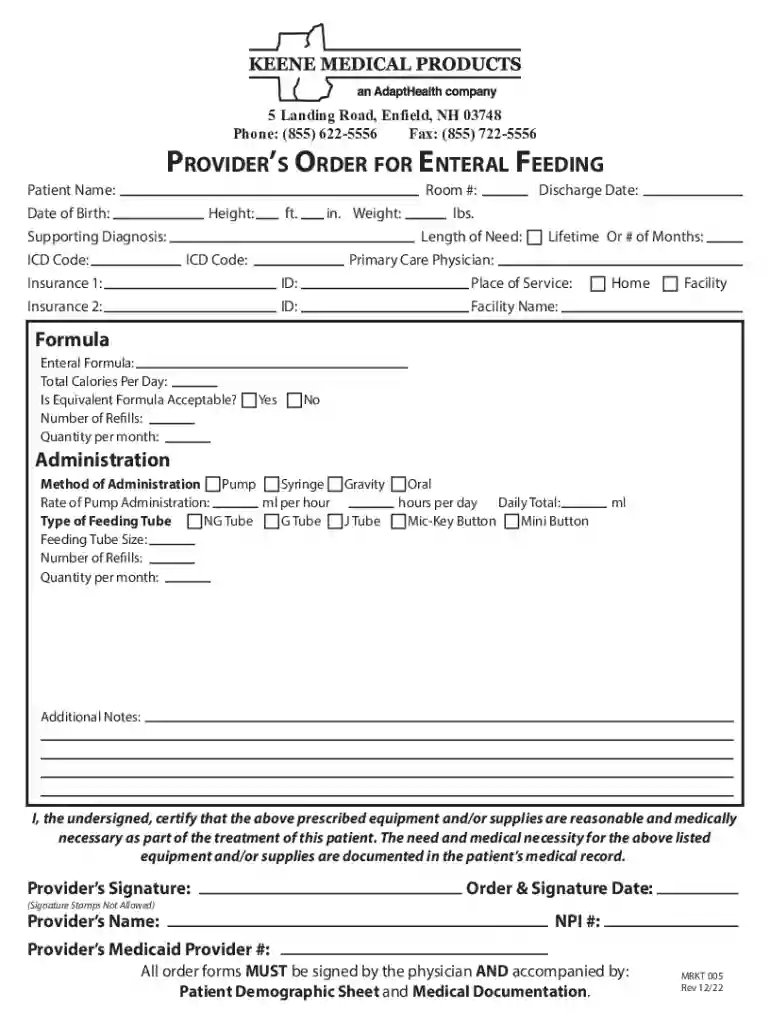
  1. Click ‘Get Form’ to open the Enteral feeding and medication administration document in the editor.
  2. Begin by entering the patient's name and date of birth in the designated fields. This information is crucial for identifying the patient.
  3. Fill in the supporting diagnosis and ICD code, ensuring accuracy as this will impact insurance coverage.
  4. Provide details such as height, weight, room number, discharge date, and length of need. These metrics are essential for proper assessment.
  5. In the formula section, specify the enteral formula type and total calories per day. Indicate if an equivalent formula is acceptable and list the number of refills required.
  6. For administration methods, select between pump or syringe, then input the rate of pump administration and feeding tube type along with size.
  7. Complete any additional notes that may be relevant to the patient's care before signing off on the document.

Start using our platform today to streamline your Enteral feeding and medication administration process for free!

See more Enteral feeding and medication administration versions

We've got more versions of the Enteral feeding and medication administration form. Select the right Enteral feeding and medication administration version from the list and start editing it straight away!
Versions Form popularity Fillable & printable
2022 4.5 Satisfied (35 Votes)
2014 4 Satisfied (56 Votes)
be ready to get more

Complete this form in 5 minutes or less

Get form

Got questions?

We have answers to the most popular questions from our customers. If you can't find an answer to your question, please contact us.
Contact us
Flush the enteral tube with water before, in between and after medication administration. Using the syringe with the prepared medication, attach the tip syringe to the enteral tube. Administer the medication in a slow and steady manner.
List of interactions for Enteral feeds Acenocoumarol. Enteral feeds (vitamin-K containing) potentially decrease the anticoagulant effect of Acenocoumarol. Aluminium hydroxide. . Phenindione. Phenytoin. Sucralfate. Theophylline. Warfarin.
The addition of drugs into enteral nutrition bags may result in occlusion of the tube, change in bioavailability of the nutrient or the drug, or alteration of gastrointestinal function by interactions of drug-enteral product.
Tablets or capsules that are enteric-coated, extended-release (XR), or slow-release (SR) cannot be taken through your feeding tube. Ask your healthcare provider if you can get the medication in a different form. Do not mix different medications together unless your healthcare provider tells you to.
After the drug is delivered, the feeding should be stopped and the tube should be flushed with at least 15 mL of purified water before and after each medication is given. Administer each drug separately. Each medication should be given separately through the feeding tube.

Security and compliance

At DocHub, your data security is our priority. We follow HIPAA, SOC2, GDPR, and other standards, so you can work on your documents with confidence.

Learn more
ccpa2
pci-dss
gdpr-compliance
hipaa
soc-compliance

People also ask

Contraindications Absolute Contraindications. Acute Kidney Injury. Acute Liver Failure and Liver Transplantation. Acute Lung Injury (ALI), Acute Respiratory Distress Syndrome (ARDS) Multiple Trauma. Abdominal Surgery. Acute Pancreatitis.
Drugs that should not be given by the endotracheal route include , , calcium salts, , norepinephrine, and sodium bicarbonate.
If you are giving more than 1 medicine, give each medicine by itself. Flush the feeding tube with a small amount of water after each medicine. After you give all the medicine, flush the tube with the recommended amount of water. Clamp the tube or start the feedings again if your child is getting continuous feedings.

Related links