




01. Edit your wisconsin wkc 16 form online
Type text, add images, blackout confidential details, add comments, highlights and more.

Type text, add images, blackout confidential details, add comments, highlights and more.

Draw your signature, type it, upload its image, or use your mobile device as a signature pad.

Send wkc 16 form via email, link, or fax. You can also download it, export it or print it out.
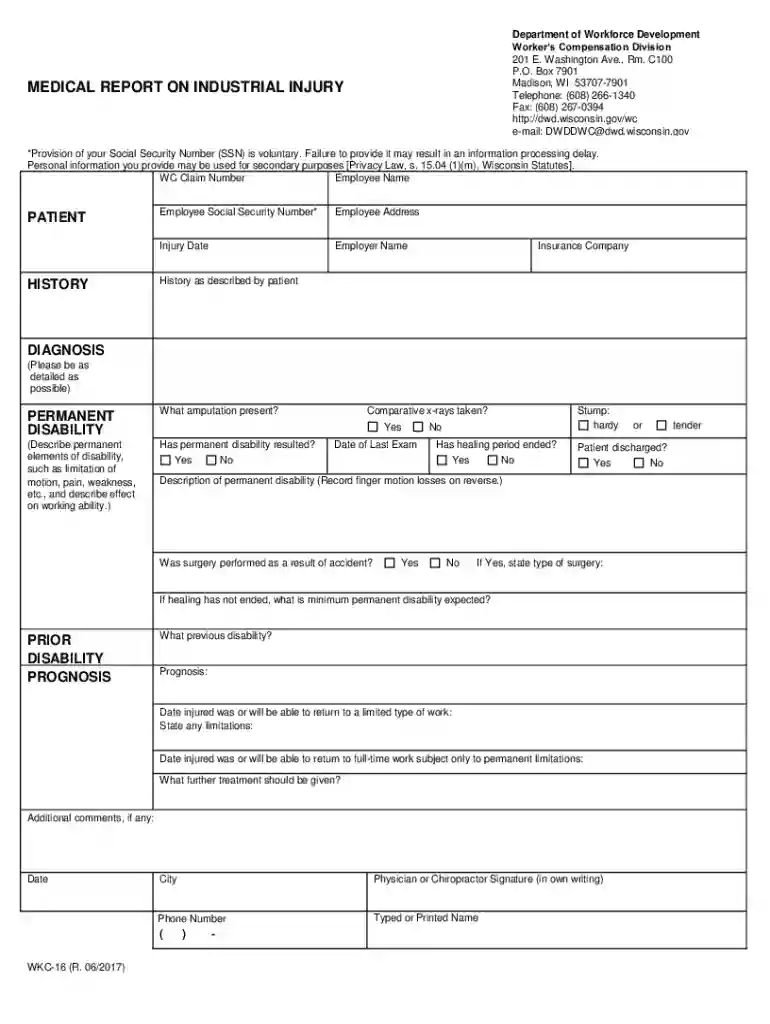
The WKC-16, Medical Report on Industrial Injury, is a critical document used primarily in worker's compensation cases in the United States. It is designed for healthcare professionals such as physicians and chiropractors to provide a detailed assessment of an employee's injury sustained during their employment. This form captures comprehensive information related to the injury, including the patient's medical history, specific diagnoses, the extent of permanent disability, and treatment recommendations. By supplying necessary details about the nature and impact of the injury, the WKC-16 ensures accurate processing of worker's compensation claims and facilitates fair compensation and rehabilitation decisions.
Completing the WKC-16 form requires meticulous attention to detail. The process is structured to ensure all relevant information is captured comprehensively:
Patient Information: Enter the injured employee's personal details, including name, contact information, and employment details.
Injury Details: Provide a chronological account of the incident leading to the injury, including time, place, and activity undertaken during the injury.
Diagnosis: Offer medical diagnoses related to the injury, illustrating both primary and secondary health impacts.
Treatment Summary: Describe the medical treatments administered or planned for the patient, covering both immediate and long-term care strategies.
Disability Assessment: Evaluate the injury's impact on the patient's ability to perform their work duties, including any permanent limitations or disabilities recognized.
Physician's Certification: Conclude with the healthcare provider's attestation, affirming the accuracy of the data supplied, and providing contact details for further correspondence.
The WKC-16 form is pivotal not only for documenting industrial accidents but also for corroborating the legitimacy of worker's compensation claims. Its accuracy and thoroughness ensure that injured workers receive appropriate care and compensation in line with their injuries. Moreover, the form serves as a legal document to protect the rights of both employees and employers, offering verified medical insights to guide the compensation process.
The primary users of the WKC-16 are healthcare providers tasked with evaluating industrial injuries, but its application extends beyond these professionals. Employers and insurance companies rely on the form to assess and verify compensation claims, while legal practitioners may use it as evidence in disputes or claims processing. Regulatory agencies might also review the WKC-16 submissions to ensure compliance with labor laws.
Several critical components make the WKC-16 indispensable in industrial injury reporting:
The legal validity of the WKC-16 form underscores its role within worker's compensation frameworks. Adherence to state-specific regulations ensures that the form meets legal standards across different jurisdictions. The document not only supports claims filing but also upholds the fair treatment of injured workers, and complying with state-specific legal requirements minimizes litigation risks.
Practical scenarios for using the WKC-16 include:
In each case, physicians thoroughly leverage the form to encapsulate medical findings that are vital for determining the appropriate compensation.
There may be state-specific iterations of the WKC-16 that incorporate additional requirements or specify other guidelines pertinent to different jurisdictions. Knowledge of these variations ensures accurate compliance and optimal applicability in different scenarios.
The WKC-16 form allows for flexible submission, adapting to the needs of both healthcare providers and employers:
Ensuring the correct submission procedure according to employer or insurance protocols enhances the form's efficacy in facilitating timely worker's compensation claims.
By understanding the form's comprehensive utility, precise completion methods, and legal implications, users ensure that the WKC-16 effectively supports the fair and accurate treatment of industrial injury cases.
We've got more versions of the wisconsin wkc 16 form form. Select the right wisconsin wkc 16 form version from the list and start editing it straight away!
Approving paperwork on a mobile device is quick, easy, and doesn’t require software installation when you have an account with DocHub. Log in from any browser, fill in your blank fields with your information, and click on Sign → Create your signature. You can draw your eSignature just as you usually do on paper, add its picture to your wisconsin wkc 16, or type in your name and stylize its look. No matter what option you select, your document will be valid.
If you choose analog methods of completing your WKC-16, Medical Report on Industrial Injury, it is simple to download your file for printing. Search DocHub’s Forms & Templates catalog to get the exact document template you need and open it for editing or download it on your gadget in the format of your liking. It is possible to complete your form electronically and put your handwritten signature on it right after printing or eSign your document with DocHub.
At DocHub, your data security is our priority. We follow HIPAA, SOC2, GDPR, and other standards, so you can work on your documents with confidence.
A first report of injury with the information required by a completed form WKC-12 on or before the 14th day after an accident or the beginning of aRead more
This form is to be filed by the insurer or self-insured employer when temporary disability exceeds 3 weeks or permanent disability results.Read more


