Workers Compensation Claim State Environmental Guide 2026

Get Form
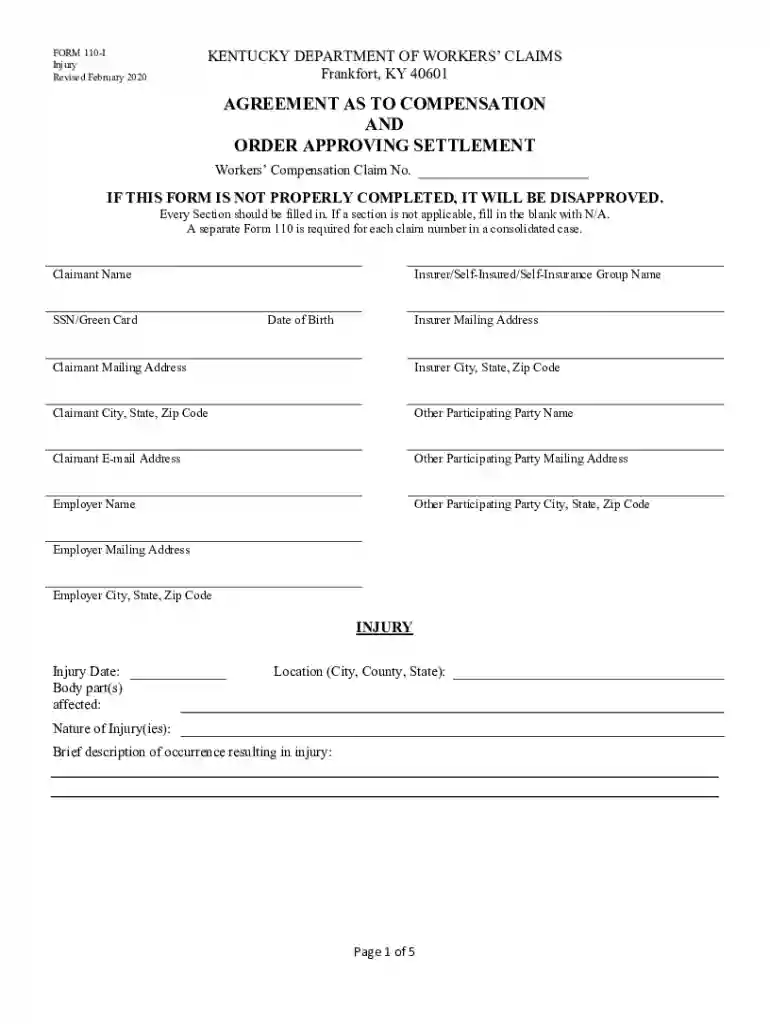
Workers Compensation Claim State Environmental Guide Preview on Page 1

Here's how it works

01. Edit your form online
Type text, add images, blackout confidential details, add comments, highlights and more.

02. Sign it in a few clicks
Draw your signature, type it, upload its image, or use your mobile device as a signature pad.

03. Share your form with others
Send it via email, link, or fax. You can also download it, export it or print it out.

Definition and Meaning

The Workers Compensation Claim State Environmental Guide serves as a comprehensive reference for navigating workers' compensation claims, including understanding specific state requirements and regulations. It acts as a central resource, ensuring compliance with varying legal parameters across states. The guide aims to provide clarity on the processes involved in filing, reviewing, and settling workers' compensation claims, emphasizing the importance of meeting state-specific criteria to avoid potential legal issues.

How to Use the Workers Compensation Claim State Environmental Guide

Using the Workers Compensation Claim State Environmental Guide involves several steps to ensure that the relevant information is extracted and applied effectively. First, users should identify the state where the compensation claim is being filed, as each state may have unique guidelines. Next, the guide should be used to understand specific procedural requirements such as documentation, filing deadlines, and legal stipulations. By following these steps, users can ensure that all actions taken are in alignment with state laws, thereby facilitating smoother claim processing.

Steps to Complete the Workers Compensation Claim State Environmental Guide

  1. Identify State Regulations: Begin by determining the specific state regulations applicable to your compensation claim.
  2. Gather Necessary Information: Collect all relevant details concerning the claimant, employer, and circumstances of the injury or illness.
  3. Follow Procedural Guidelines: Adhere to the outlined steps for submitting the claim, including filling out requisite forms and securing all needed signatures.
  4. Submit the Claim: Forward the completed forms either online, by mail, or in person, depending on state-specific methods.
  5. Retain Copies for Records: Maintain copies of all submitted documents for future reference and to assist in potential disputes or clarifications.

Key Elements of the Workers Compensation Claim State Environmental Guide

  • State Regulations: Detailed instructions on compliance with state-specific laws and mandates.
  • Filing Procedures: Step-by-step process of how to correctly file a claim.
  • Documentation Requirements: Comprehensive list of necessary documents, including medical reports and employment information.
  • Deadline Adherence: Importance of understanding and meeting filing deadlines.
  • Dispute Resolution Guidelines: Procedures to follow in the instance of disputes or claim denials.

State-specific Rules for the Workers Compensation Claim State Environmental Guide

Each state within the U.S. sets its own rules and requirements regarding worker compensation claims. It is crucial for claimants to be familiar with these unique conditions to ensure compliance. State-specific rules often dictate the types of injuries covered, the extent of benefits available, and the processes required for filing and appeals. Understanding these variations is essential for accurately navigating the workers' compensation landscape.

Required Documents for Workers Compensation Claim State Environmental Guide

  • Claimant Identification: Proof of identity and employment status.
  • Medical Reports: Documentation supporting the injury or illness related to the claim.
  • Employer Information: Details about the employer’s insurance coverage and employment contract.
  • Accident Reports: Formal reports detailing the circumstances and cause of the injury.
  • Declaration Statements: Signed declarations confirming the accuracy of submitted information.

Penalties for Non-Compliance with the Workers Compensation Claim State Environmental Guide

Non-compliance with the guide can result in significant penalties, including the rejection of claims, fines, and legal action. Ignoring state-specific requirements or failing to submit necessary documentation within deadlines can delay compensation benefits and potentially lead to litigation. Thus, adherence to the outlined procedures and rules is critical to avoid these consequences.

Digital vs. Paper Version of the Workers Compensation Claim State Environmental Guide

The Workers Compensation Claim State Environmental Guide is available in both digital and paper formats to accommodate different user preferences. The digital version offers the convenience of easy searching and updating, while the paper version provides a tangible reference. Each format has its unique advantages, with digital being more accessible and eco-friendly, and paper offering a traditional method that some users may find more reliable in regions with limited digital access.

Software Compatibility with Workers Compensation Claim State Environmental Guide

For efficient handling of workers' compensation claims, the guide can be integrated with various software tools such as TurboTax and QuickBooks. These platforms can streamline the documentation and filing process, ensuring accuracy and completeness. Users benefit from the ease of managing claims digitally, reducing errors, and improving record-keeping efficiency. Compatibility with popular software helps simplify the administrative aspects of workers' compensation claims.

See more Workers Compensation Claim State Environmental Guide versions

We've got more versions of the Workers Compensation Claim State Environmental Guide form. Select the right Workers Compensation Claim State Environmental Guide version from the list and start editing it straight away!
Versions Form popularity Fillable & printable
2020 4.5 Satisfied (65 Votes)
2006 4.4 Satisfied (28 Votes)
be ready to get more

Complete this form in 5 minutes or less

Get form

Got questions?

We have answers to the most popular questions from our customers. If you can't find an answer to your question, please contact us.
Contact us
For workers compensation law to apply, an on-the-job injury must be caused by the employment. This requires the employee to prove both that the injury 1) arose out of the employment, and 2) occurred within the course of the employment.
Some key phrases to avoid saying to an insurance adjuster include: Im sorry. It was all/partly my fault. I did not see the other person/driver.
What You Shouldnt Tell Your Workers Comp Doctor Never lie about prior injuries, pre-existing conditions, or medical history. Never lie about the extent of your workplace injury or how it happened. Do not exaggerate your symptoms, including pain or functionality.
Here is a quick list of things that you should never say to your workers comp doctor, even if you are getting a second opinion: Never lie about prior injuries, pre-existing conditions, or medical history. Never lie about the extent of your workplace injury or how it happened.
There is a fine line between thoroughness and exaggeration. Talking to a workers comp adjuster is tricky because you want to thread the line carefully without omitting anything. You want to let them know about your pain and symptoms in detail, without saying something untrue that may be used against you down the line.

Security and compliance

At DocHub, your data security is our priority. We follow HIPAA, SOC2, GDPR, and other standards, so you can work on your documents with confidence.

Learn more
ccpa2
pci-dss
gdpr-compliance
hipaa
soc-compliance
be ready to get more

Complete this form in 5 minutes or less

Get form

People also ask

5 Things Not to Say to Your Workers Comp Adjuster #1: Dont Give Any Inaccurate Details on How the Accident Happened. #3: Avoid Giving Personal Information That Has Nothing to Do with Your Claim. #4: Dont Say Anything That Limits the Extent of Your Injuries. #5: Dont Agree to Anything Without Discussing with Your Lawyer.
In that case, you may qualify for time-loss compensation due to the fact that youre temporarily unable to return to work. Typically, the workers comp system in most states offers 66% of your wages. Depending on the state, you may receive your salary benefits weekly, bi-weekly, or once a month.
Workers comp lawyers might not always tell you that you can file a claim on your own without them. They also might not mention that they get paid even if you lose your case. It could take a long time to get compensation, and they might only take cases they think they can win easily.

Related links