




01. Edit your form online
Type text, add images, blackout confidential details, add comments, highlights and more.

Type text, add images, blackout confidential details, add comments, highlights and more.

Draw your signature, type it, upload its image, or use your mobile device as a signature pad.

Send it via email, link, or fax. You can also download it, export it or print it out.
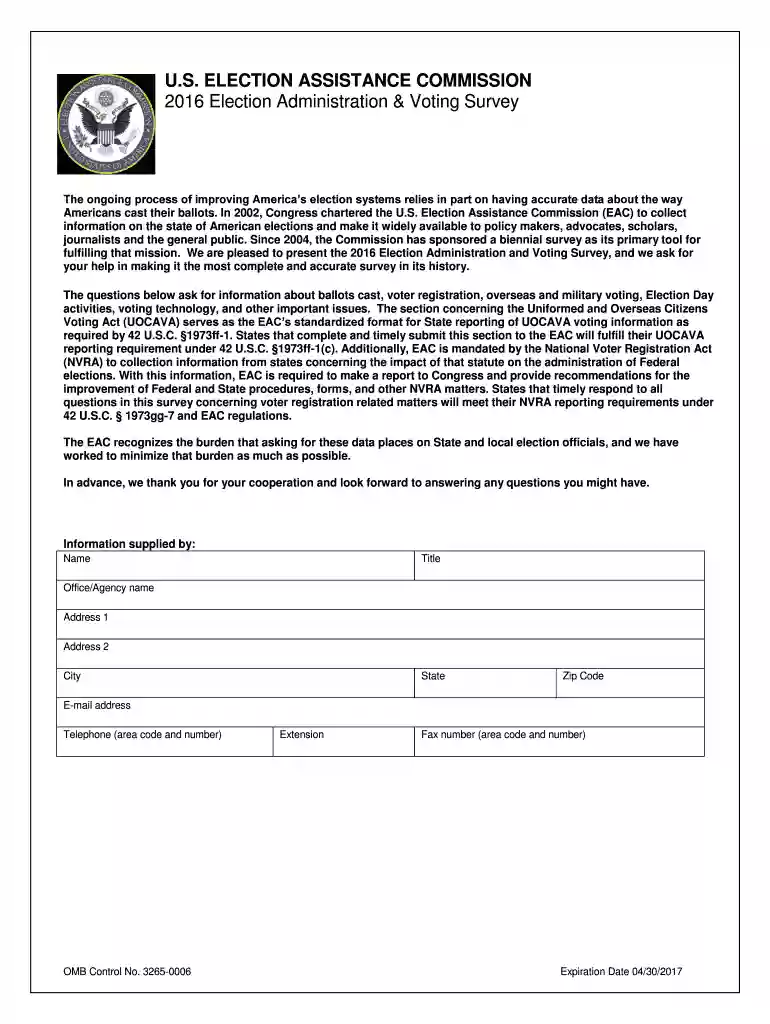
The U.S. Election Assistance Commission (EAC) 2016 Election form primarily revolves around the collection of comprehensive data concerning election administration in the United States. This survey encompasses various elements, including voter registration, absentee voting, polling places, and provisional ballots. The EAC uses this data to evaluate and improve election systems nationwide.
Collect Necessary Information:
Follow Federal Guidelines:
Data Accuracy:
Submitting this form is aligned with federal legal requirements, ensuring states report data for assessment and compliance checking. Accurate reporting through this form helps maintain lawful election practices.
This form holds critical importance as it aids in measuring and enhancing the transparency and effectiveness of the election process. By standardizing data collection, it assists in ensuring uniform compliance across states.
States may have unique regulations that influence how they report data. It’s essential to account for state-level differences in voter registration procedures and provisional ballot handling to avoid discrepancies in the data submitted.
Obtain the Form:
Submission Channels:
Failure to submit the EAC 2016 Election form can result in oversight issues and inaccuracies in federal data, potentially affecting election funding and planning. It is crucial for election officials to understand these ramifications and comply accordingly.
Choosing between digital and paper submission involves understanding various advantages:
Understanding the nuances of the EAC's data collection efforts and aligning them with federal and state regulations ensures that election administrators contribute effectively to a transparent and robust electoral process.
We've got more versions of the U S ELECTION ASSISTANCE COMMISSION 2016 Election form. Select the right U S ELECTION ASSISTANCE COMMISSION 2016 Election version from the list and start editing it straight away!
Sure, you’ll find numerous apps for this on the web. Nevertheless, if you need to eSign your U S ELECTION ASSISTANCE COMMISSION 2016 Election without installing extra software, DocHub is the best choice you can make. This powerful editor works on mobile devices just as on desktops. Open our editor in any internet browser, register or log in to your account, and start processing your documents.
If you store your papers in Google Drive, there is no need to download your U S ELECTION ASSISTANCE COMMISSION 2016 Election on your computer and upload it back to our editor. A significantly easier way is to install a browser extension developed by DocHub to simplify this flow. The extension allows editing PDFs in your web browser. Alternatively, you may integrate your DocHub and Gmail accounts for more efficient modifying.
At DocHub, your data security is our priority. We follow HIPAA, SOC2, GDPR, and other standards, so you can work on your documents with confidence.
Jul 16, 2018 Good morning Chairman Gowdy, Ranking Member Cummings, and members of the committee. I am pleased to appear before you today to offerRead more
On June 30, 2025, the EAC published the biennial Election Administration and Voting Survey (EAVS) Comprehensive Report, an analysis of state-by-state dataRead more


