




01. Edit your form online
Type text, add images, blackout confidential details, add comments, highlights and more.

Type text, add images, blackout confidential details, add comments, highlights and more.

Draw your signature, type it, upload its image, or use your mobile device as a signature pad.

Send it via email, link, or fax. You can also download it, export it or print it out.
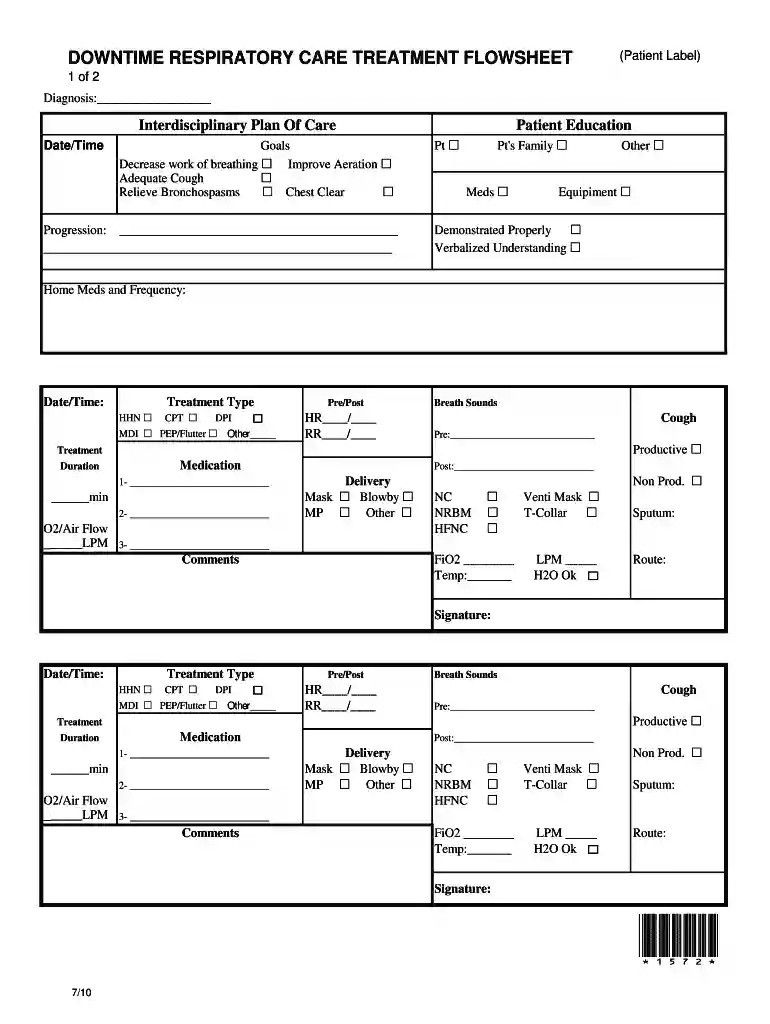
The "Downtime Respiratory Care Treatment Flowsheet" is a structured document used primarily in healthcare settings to record and manage respiratory treatments for patients. This form plays a crucial role when electronic systems are unavailable, ensuring continuity in patient care by documenting critical information. It serves several functions, such as tracking patient diagnosis, treatment plans, medication administration, and other essential components related to respiratory therapy. By safeguarding essential patient and treatment data, the flowsheet helps healthcare providers maintain accuracy and efficiency, even during system downtimes.
To ensure accurate documentation, it is essential to follow a systematic approach when completing the flowsheet.
Patient Identification: Begin by clearly writing down the patient's full name, date of birth, and medical identification number to avoid any misidentification.
Diagnosis Entry: Document the specific respiratory diagnosis and any relevant patient history that may impact treatment.
Interdisciplinary Care Plan: Note any care plans discussed and agreed upon by the healthcare team, including goals and expected outcomes.
Treatment Documentation: Specify the types of treatments administered, including details about frequency, duration, and any equipment used.
Medication Details: Record all medications provided during the treatment, inclusive of dosages and time administered.
Vital Signs Monitoring: Regularly update the form with vital signs such as respiratory rate, pulse, and blood pressure at specified intervals.
Assessment and Observations: Include findings from breath sounds and cough assessments, ensuring all details are comprehensively captured.
Patient Education Section: Fill out this section to note any instructions or education given to the patient regarding their condition and treatment protocol.
Sign-off and Review: Upon completion, ensure all sections are accurately filled and sign the document before it is reviewed by a supervisory clinician if necessary.
Recognizing the core elements of the flowsheet can enhance its utility and ensure detailed record-keeping.
Patient Diagnosis
Interdisciplinary Care Plans
Treatment Types and Protocols
Medication Information
Monitoring and Observations
Consider a patient with COPD; clinicians need to monitor their response to various medications and therapies, with all this data documented on the flowsheet for comprehensive oversight.
Discussing real-world applications ensures clarity on the practical usage of this form across healthcare settings.
Hospital Setting: In situations where the electronic health record (EHR) system crashes, staff can rely on the flowsheet to continue documentation without disruption.
Clinical Research: Researchers may utilize such forms to gather and analyze respiratory treatment patterns and outcomes during system downtimes.
Understanding effective utilization maximizes the benefits gained from this documentation tool.
System Integration: Regularly update electronic systems with information from the flowsheet once systems are restored.
Training and Familiarization: Ongoing staff training ensures that everyone is adept at completing the flowsheet accurately under pressure.
In conclusion, the Downtime Respiratory Care Treatment Flowsheet functions as a critical document in maintaining thorough and accurate respiratory care records amidst system downtime situations. Its comprehensive design supports diverse healthcare needs, ensuring patient care is neither compromised nor delayed.
We've got more versions of the DOWNTIME RESPIRATORY CARE TREATMENT FLOWSHEET form. Select the right DOWNTIME RESPIRATORY CARE TREATMENT FLOWSHEET version from the list and start editing it straight away!
| Versions | Form popularity | Fillable & printable |
|---|---|---|
| 2010 | 4.8 Satisfied (59 Votes) |
At DocHub, your data security is our priority. We follow HIPAA, SOC2, GDPR, and other standards, so you can work on your documents with confidence.
Oct 3, 2017 The purpose of this document is to provide clinical end users with procedures to use in documenting inpatient/outpatient care during thoseRead more
The papers abstracted in this book were presented at the Symposium on Natural Attenuation of. Chlorinated Organics in Ground Water, held September 11-13,Read more
During downtime procedures, nurses will document pertinent information on the Critical. Care Paper Flow Sheet. 2. Each patient will have a complete physicalRead more


