




01. Edit your form online
Type text, add images, blackout confidential details, add comments, highlights and more.

Type text, add images, blackout confidential details, add comments, highlights and more.

Draw your signature, type it, upload its image, or use your mobile device as a signature pad.

Send it via email, link, or fax. You can also download it, export it or print it out.
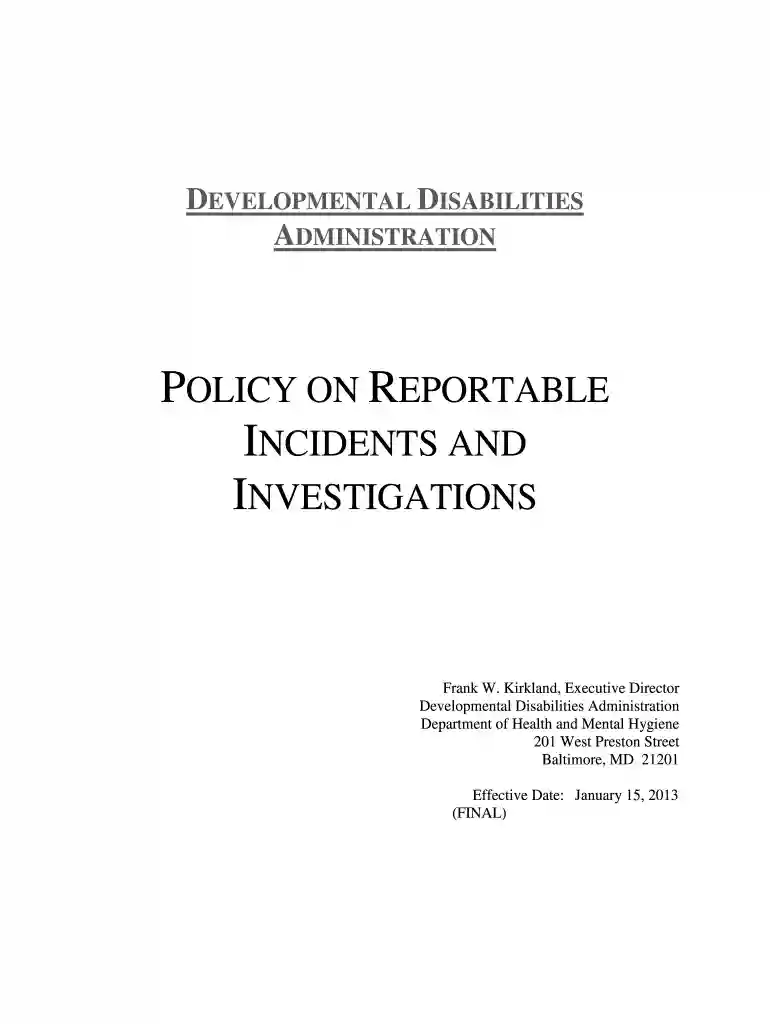
The "Maryland Reportable Incidents" form is a structured protocol used to document and address incidents that could affect the health and safety of individuals with developmental disabilities. This includes two categories of incidents: Type I, which involves severe injuries or allegations of abuse, and Type II, which covers less severe issues but still requires attention for safety reasons. The protocol ensures that any incident threatening the well-being of individuals is systematically reported, investigated, and resolved in compliance with legal and ethical guidelines.
Failing to adhere to the reporting guidelines can compromise individual safety and lead to legal consequences for the responsible agencies. Thus, understanding and utilizing the form correctly is crucial for all parties involved.
Using the Maryland Reportable Incidents form involves several steps designed to ensure thorough documentation and handling of incidents. Each step is crucial to maintaining the integrity of the process and upholding the safety standards for individuals with developmental disabilities.
Identify the Incident Type: Assess whether the incident falls under Type I or Type II. This determines the level of urgency and the response required.
Accurate Documentation: Record all relevant details, such as the time, date, persons involved, and nature of the incident. Objectivity is key to ensure factual reporting.
Notify Appropriate Authorities: Depending on the severity, notifications may need to go to specific state agencies or oversight bodies within a defined timeframe.
Conduct Investigations: Initiate a thorough investigation to discern the cause of the incident and steps taken to address it. Documentation should include findings and any corrective actions initiated.
Implement Corrective Measures: Based on the investigation outcomes, apply necessary changes to prevent future occurrences. This might involve policy updates, training, or environmental adjustments.
Agencies are responsible for ensuring staff understand how to utilize the form and adhere to protocols. Training sessions and comprehensive guidelines should be made available to all personnel involved in the process.
Understanding specific terminology is essential for accurately navigating and utilizing the Maryland Reportable Incidents form. These terms help clarify expectations and procedures.
Familiarity with abbreviations like DDA (Developmental Disabilities Administration) is essential to ensure clear communication across agencies and during documentation.
The form includes various fields that must be thoroughly completed to ensure a comprehensive understanding of the incident and facilitate appropriate responses.
Some forms necessitate the inclusion of follow-up actions taken and recommendations for further preventive measures. This helps ensure that all aspects of the incident are addressed.
Understanding state-specific regulations surrounding reportable incidents is crucial for compliance and ensuring optimal care for individuals with developmental disabilities.
Agencies must adhere to Maryland's state laws governing the reporting protocol, which includes specific timelines, documentation requirements, and penalties for non-compliance. These laws are designed to protect affected individuals and maintain high standards of care.
Utilizing case studies can shed light on how the Maryland Reportable Incidents form is applied in real-world scenarios. These examples can guide users in filling out the form accurately and efficiently.
An individual experienced a fall resulting in a fracture while under supervised care. This Type I incident required immediate reporting to the relevant state authorities and a swift investigation to improve safety protocols and prevent similar incidents.
A staff member was accused of verbal abuse, categorized as a Type II incident. This prompted an internal investigation, staff retraining, and monitoring improvements within the facility to enhance resident safety and staff conduct.
The form serves as a critical legal document that ensures incidents affecting developmental disability services are accurately reported and addressed.
By using this form, agencies can safeguard vulnerable populations’ rights and well-being, helping to maintain ethical standards and trust within care environments.
Non-compliance with the Maryland Reportable Incidents reporting protocol can lead to severe consequences for involved agencies and individuals.
Adhering to the Maryland Reportable Incidents form's guidelines ensures protection for individuals with developmental disabilities and prevents legal or regulatory penalties for caregivers and institutions.
We've got more versions of the maryland reportable incidents form. Select the right maryland reportable incidents version from the list and start editing it straight away!
| Versions | Form popularity | Fillable & printable |
|---|---|---|
| 2013 | 4.8 Satisfied (176 Votes) |
Of course, electronically drawing your signature is acceptable, but only if you use a tool that complies with industry laws and regulations. Consider DocHub, which guarantees eSignature validity under ESIGN and UETA requirements. All you need to approve your maryland reportable incidents electronically is an account with DocHub and an internet connection. After you open your file in our editor, click Sign and choose the Draw tool.
Having a swift editing platform like DocHub, you do not need anything but a web browser and internet connection to edit your maryland reportable incidents online swiftly. Upload your document or find the relevant form in DocHub’s catalog, open our editor with a single click, and finish it electronically. To edit your forms anytime, sign up a free profile with DocHub.
At DocHub, your data security is our priority. We follow HIPAA, SOC2, GDPR, and other standards, so you can work on your documents with confidence.
Md. Code Regs. 10.07.22.14 - Incident Reports (1) Time, date, place, and individuals present; (2) Complete description of the incident; (3) Response ofRead more
Reportable Diseases, About Reporting, What to Report, Counts and Rates, Case Report Forms, Site Logo, Maryland Department of HealthRead more
by M Souppaya 2017 Cited by 198 If and when security incidents occur within a containerized environment, organizations should be prepared to respond with processes and tools that are optimizedRead more


