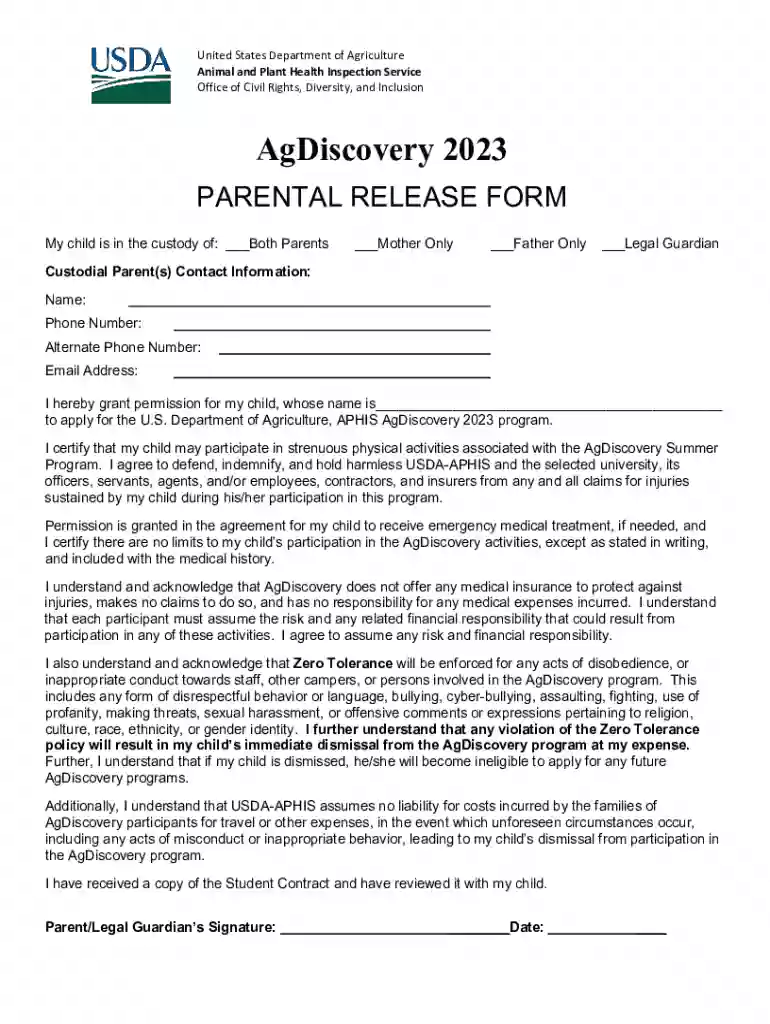
Definition and Meaning of Parental Release Form
A parental release form is a legal document used to grant permission for a minor to participate in specific activities or programs. This form typically includes the parent's or guardian's consent and information about potential risks involved. For the AgDiscovery 2023 program organized by the U.S. Department of Agriculture, this form permits a child to participate while acknowledging medical treatment responsibilities and behavior expectations. Additionally, a Picture and Video Release Statement is often included, allowing the use of the child’s image in promotional materials.
Key Components of the Form
- Parental Consent: A statement that signifies the parent's or guardian's approval for the minor's participation.
- Acknowledgment of Risk: Details the potential risks associated with the program or activity.
- Medical Treatment Responsibility: Outlines who is responsible for medical decisions and care, in case of emergencies.
- Behavioral Expectations: Describes the expected conduct of the child during participation.
- Media Release: Provides consent for capturing and using the child’s image in promotional content.
How to Use the Parental Release Form
To use the parental release form effectively, one must understand its purpose and complete it accurately. This form ensures that all legal and logistical elements are addressed before participation.
- Review the Form: Carefully read all sections, especially those concerning the permissions and responsibilities involved.
- Fill Out Required Fields: Ensure all mandatory fields, such as personal information, emergency contacts, and medical consents, are fully completed.
- Sign the Document: Obtain signatures from the parent or guardian and, if required, the participant.
Common Usage Scenarios
- School Activities: Such as field trips and extracurricular programs.
- Camps and Workshops: Including those focusing on specific skills or academic interests.
- Media and Production: When minors are involved in video or photo shoots.
How to Obtain the Parental Release Form
The parental release form is typically provided by the organization conducting the event or program. For AgDiscovery 2023, the form can be obtained through the U.S. Department of Agriculture’s Animal and Plant Health Inspection Service.
- Visit Official Websites: Access the organization’s official site to download the form, or request it via email or phone.
- Contact Organizers Directly: Reach out to program coordinators for a physical or electronic copy.
- Check Event Documentation: The form might be included in event registration packets.
Steps to Complete the Parental Release Form
Completing the form correctly is crucial to ensuring all permissions and agreements are legally binding. Follow these steps for accurate completion.
- Read All Instructions: Begin by carefully reading the guidelines provided with the form.
- Fill in Personal Details: Include the participant's full name, date of birth, and contact information.
- Provide Emergency Contacts: List reliable contacts who can be reached in case of an emergency.
- Medical Information: Document any medical conditions, allergies, and the preferred physician.
- Sign and Date: Both the parent or guardian and participant must provide their signatures and the date.
Ensuring Accuracy
- Double-Check All Entries: Verify that all information is accurate and complete.
- Confirm Consents: Make sure all consents are properly marked and initialed where necessary.
Importance of the Parental Release Form
The parental release form plays a crucial role in legally authorizing a minor’s participation in diverse activities, ensuring that both the guardians and the organizing body are clear on terms regarding liability and responsibility.
Benefits
- Legal Protection: Minimizes legal risks for organizers and provides a clear outline of guardian consent.
- Safety Assurance: Ensures that all emergency and medical protocols are pre-determined.
- Clarity of Expectations: Defines behavior standards and consent for use of images, reducing potential misunderstandings.
Legal Use and Compliance
Using a parental release form entails adherence to legal standards and compliance requirements, particularly concerning consent and liability.
- Jurisdictional Laws: Forms must comply with federal and state laws governing consent and minor protection.
- Documentation: Ensure that the form is properly filed and accessible for reference in case of disputes or emergencies.
Legal Considerations
- Understand the extent of liability protection offered.
- Ensure the form is up-to-date with current legal standards, particularly regarding electronic signatures and digital documentation.
Key Elements of the Parental Release Form
Several essential sections must be present to make the parental release form complete and valid.
- Detailed Participant Information: Including the child's identification and emergency contacts.
- Clear Consent Clauses: With explicit parental permission for all intended activities.
- Risk Acknowledgment: A statement recognizing potential risks involved.
- Media Consent Section: Agreement regarding photos or videos of the child.
Recommended Features
- Editable Formats: Forms should be easily accessible and fillable online or via common applications.
- Comprehensive Instructions: Detailed guidance for completing and submitting the form.
Digital vs. Paper Version
Given the rise of digital platforms, the choice between using a digital or paper version of the parental release form can impact efficiency and accessibility.
- Digital Version: Offers easy distribution and storage, supports electronic signatures, and allows real-time updates.
- Paper Version: May be required in scenarios lacking digital access or where traditional documentation is preferred.
Pros and Cons
- Digital Form Advantages: Faster processing, reduced paper waste, and easy updates.
- Paper Form Benefits: Tangible records and potentially more trust for certain stakeholders.
For optimal utility, consider the context and audience when choosing the appropriate format for the parental release form.