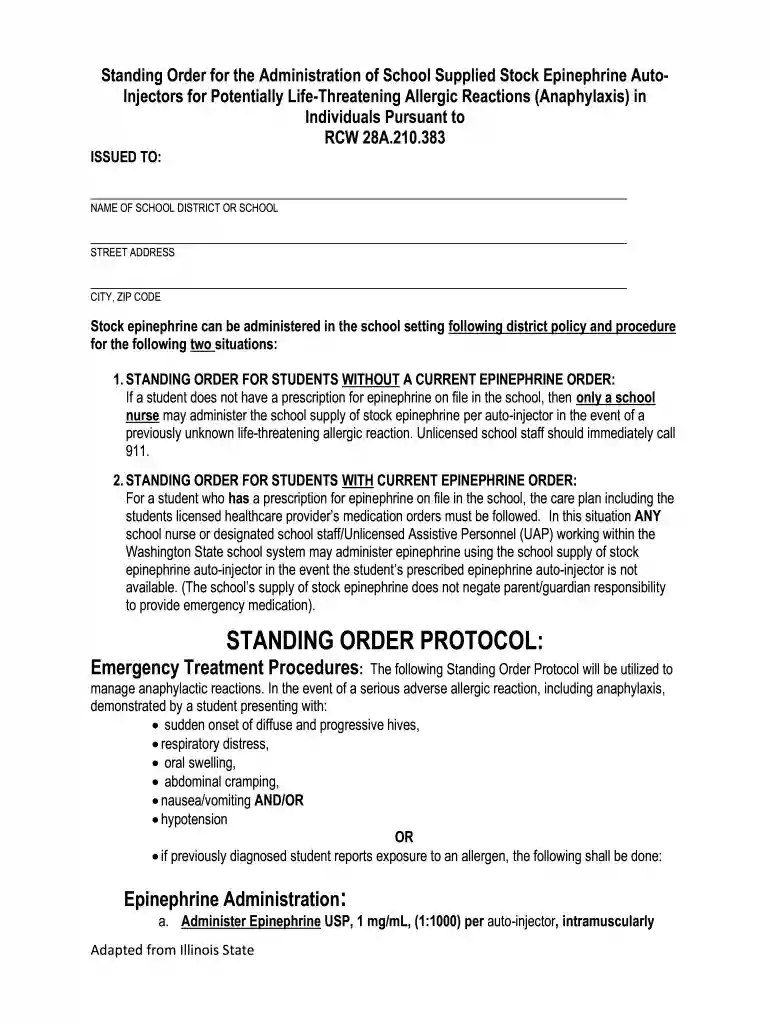
Standing Order for the Administration of School Supplied Stock Epinephrine Auto-Injectors for Potent 2026

Get Form
Standing Order for the Administration of School Supplied Stock Epinephrine Auto-Injectors for Potent Preview on Page 1

Here's how it works

01. Edit your form online
Type text, add images, blackout confidential details, add comments, highlights and more.

02. Sign it in a few clicks
Draw your signature, type it, upload its image, or use your mobile device as a signature pad.

03. Share your form with others
Send it via email, link, or fax. You can also download it, export it or print it out.

Definition & Meaning

The "Standing Order for the Administration of School Supplied Stock Epinephrine Auto-Injectors for Potent" is a protocol used to ensure that students experiencing anaphylaxis receive prompt medical intervention with epinephrine auto-injectors. Anaphylaxis is a severe, potentially life-threatening allergic reaction, and having a standing order facilitates the quick administration of this life-saving medication in school settings. This order allows trained personnel to use school-supplied auto-injectors on any student showing signs of anaphylaxis, regardless of whether the student has a personal prescription.

Key Terms

  • Anaphylaxis: A severe allergic reaction that can involve the whole body and may become life-threatening quickly.
  • Epinephrine Auto-Injector: A device pre-filled with the drug epinephrine, used to treat allergic reactions.
  • Standing Order: A pre-authorized protocol allowing specific medicines or treatments to be administered under certain conditions.

How to Use the Standing Order

Administering an epinephrine auto-injector under a standing order involves several critical steps to ensure the safety of the student and the correct execution of the procedure.

  1. Identify Symptoms: Recognize the symptoms of anaphylaxis, which may include hives, swelling, difficulty breathing, and a drop in blood pressure.
  2. Access the Auto-Injector: Retrieve the epinephrine auto-injector from the designated storage area within the school.
  3. Administer Epinephrine: Follow the manufacturer's instructions to administer the auto-injector to the outer thigh of the student.
  4. Activate Emergency Services: Immediately call emergency medical services (EMS) after administering the medication to ensure further medical evaluation and care.
  5. Monitor and Document: Observe the student for any changes and document the incident, including the time of administration and the symptoms noted.

Steps to Complete the Standing Order

Completing the standing order involves preparing the necessary documentation and ensuring all parties involved understand their responsibilities.

  1. Gather Required Documents: Obtain parental consent forms and any previous medical records related to allergies of known students.
  2. Training Staff: Ensure that school nurses and other designated staff members are trained in recognizing anaphylaxis symptoms and administering epinephrine.
  3. Confirm Authorization: Verify that the standing order is signed by a licensed healthcare provider, authorizing the use of epinephrine auto-injectors in the school.
  4. Review Regularly: Schedule regular reviews of the standing order with healthcare professionals to update protocols as necessary.

Why Use the Standing Order

The standing order provides several advantages to schools, primarily focusing on student safety and preparedness.

  • Rapid Response: Enables schools to respond quickly to allergic reactions, reducing the time to treatment and potential complications.
  • Legal Protection: Provides a legal framework that protects school staff from liability when administering medications under the order.
  • Inclusive Safety: Protects students without prior diagnoses by allowing the use of stock epinephrine for first-time reactions.

Who Typically Uses the Standing Order

The standing order is primarily used by school personnel responsible for student health and safety.


  • School Nurses: The primary users, trained to recognize anaphylaxis and administer epinephrine.
  • Trained Staff: Teachers and administrators who have received training can also use the order when a nurse is unavailable.
  • Volunteers and Aides: May be included in the protocol if trained, ensuring broad coverage across school premises.
decoration image ratings of Dochub

Legal Use of the Standing Order

Legal compliance is crucial in the administration of stock epinephrine within schools.

Regulatory Requirements

  • State Laws: Each state may have different regulations and requirements regarding the use of stock epinephrine in schools.
  • Documentation Protocols: Schools must follow specific protocols for documenting use, including recording the student's response and any side effects.
  • Consent and Notifications: Parental consent and proper notification following administration are essential to comply with legal requirements.

Key Elements of the Standing Order

Understanding the critical components of the standing order is essential for effective implementation.

  • Healthcare Provider Authorization: A licensed healthcare provider must authorize the standing order, detailing specific conditions for usage.
  • Training Programs: Schools must develop comprehensive training programs to ensure staff readiness.
  • Incident Documentation: Detailed records of each use of the epinephrine auto-injector, including timing, dosage, and symptoms, must be maintained.

State-Specific Rules for Implementation

Implementation can vary significantly based on specific state rules and guidelines.

  • State Health Departments: May provide additional guidelines or requirements beyond federal mandates.
  • Variance in Training Standards: States might have different standards regarding training duration and certification for staff handling epinephrine.
  • Liability Protections: Varying levels of legal protection for staff using epinephrine as per state laws, affecting implementation decisions.

By utilizing these structured instructions and insights, schools ensure the safety and well-being of students prone to allergic reactions, consistent with legal and medical guidelines in the U.S.

be ready to get more

Complete this form in 5 minutes or less

Get form

Got questions?

We have answers to the most popular questions from our customers. If you can't find an answer to your question, please contact us.
Contact us

You should use only reliable software solutions with strong security compliance to approve your paperwork electronically. DocHub is just the type of software you need! It stores data on Amazon Web Servers and complies with all essential security requirements and eSignature regulations, so it’s a trusted way to eSign your Standing Order for the Administration of School Supplied Stock Epinephrine Auto-Injectors for Potent or other paperwork with this tool.

As a comprehensive document modifying service, DocHub is accessible on mobile phones. Open DocHub in your choice of mobile browser and use our intelligent mobile-friendly toolset to complete your Standing Order for the Administration of School Supplied Stock Epinephrine Auto-Injectors for Potent.

Once epinephrine is administered, you should call 911 immediately and advise dispatchers that you have just used epinephrine for a suspected anaphylactic reaction. Make arrangements to be transported to an emergency room for additional treatment and for observation.
Administer Place the orange tip on your thigh. Next, aim for the middle of the outer thigh, holding it at a right angle to the thigh. Swing the pen back about 6 inches and firmly push it against your thigh. Hold firmly in place for 3 seconds. Remove the from your thigh. Massage the injection site.
GRAPHICS Take the autoinjector out of its case. Hold it in your hand. Take off the safety cap (or caps). If youre giving the injection to a child or someone who might have trouble staying still, hold their leg so they cant move. Press the tip firmly into the outer thigh. Hold it in place for at least 2 to 3 seconds.

Security and compliance

At DocHub, your data security is our priority. We follow HIPAA, SOC2, GDPR, and other standards, so you can work on your documents with confidence.

Learn more
ccpa2
pci-dss
gdpr-compliance
hipaa
soc-compliance
be ready to get more

Complete this form in 5 minutes or less

Get form

People also ask

An injection of epinephrine should be given in the outer thigh. Injecting the medication intravenously or into the buttocks is not recommended. Auto-injectors can usually be used through clothing. Be sure to check the manufacturers instructions for details.
Place the orange tip against the middle of the outer thigh (upper leg) at a right angle (perpendicular) to the thigh. Swing and push the auto-injector firmly until it clicks. The click signals that the injection has started.
Place the tip of the auto-injector against the patients thigh (preferably bare), halfway between their waist, and knee. With a rapid motion, push the auto- injector firmly against the thigh until the spring loaded needle is activated. Hold the auto-injector in place for ten (10) seconds.
This medicine is injected under the skin or into the muscle of your outer thigh only. Do not inject this medicine into a vein, into the muscle of your buttocks, or into your fingers, toes, hands, or feet. To do so, may increase the chance of having serious side effects.
Always call for first aid or medical assistance. Symptoms can return or get worse after giving the injection. It may be necessary to administer a second injection, especially if the person does not respond to the first dose within 5 minutes, and if medical emergency responders have not arrived to the location.

Related links