
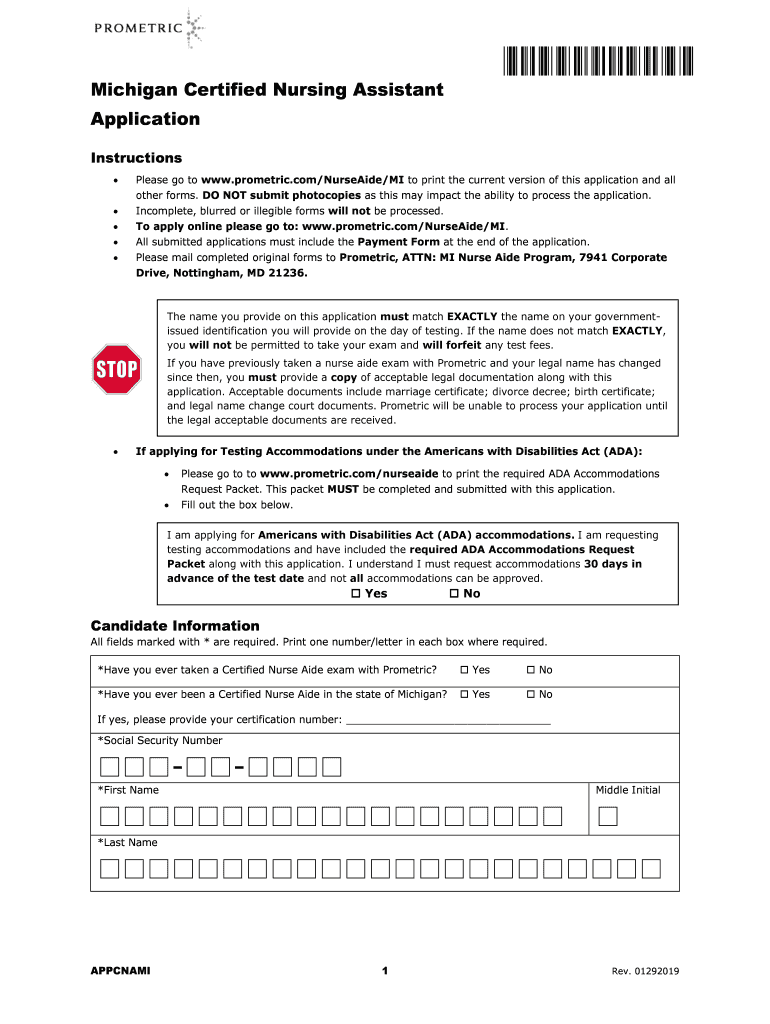







Definition and Importance of Michigan CNA Reciprocity Form
The Michigan CNA Reciprocity Form is an essential document for certified nursing assistants (CNAs) moving to Michigan who wish to transfer their certification from another state. This form facilitates the recognition of qualifications gained elsewhere, allowing CNAs to continue their professional practice without retaking the entire certification process. By maintaining uniformity in the qualifications required for CNAs, the form ensures that individuals meet Michigan's standards for patient care and safety across diverse settings.
Steps to Complete the Michigan CNA Reciprocity Form
-
Gather Necessary Documentation:
- Original certification details from the previous state.
- Proof of employment, verifying experience as a CNA.
- Government-issued identification for identity verification.
-
Fill Out Personal Information:
- Name, address, contact details, and social security number.
- Employment history relevant to CNA positions.
-
Provide Certification Details:
- State and expiration date of original certification.
- Verification of active certification status without any restrictions.
-
Submit Additional Requirements:
- Criminal background check documents as mandated by Michigan.
- Evidence of continuing education or training hours if applicable.
-
Review and Send the Completed Form:
- Double-check all filled information for accuracy.
- Submit the form via mail or approved online platforms as instructed.
How to Obtain the Michigan CNA Reciprocity Form
To obtain the Michigan CNA Reciprocity Form, applicants can visit the Michigan Department of Licensing and Regulatory Affairs (LARA) website, where they can download the form. Alternatively, individuals may request the form via mail by contacting the Nurse Aide and Nurse Aide Trainer section of LARA. Some CNA programs or employers may also provide the form to their employees who are transitioning to Michigan.
Key Elements of the Michigan CNA Reciprocity Form
- Applicant Information: Crucial for identifying the individual and ensuring records are correctly associated.
- Certification History: Details of the applicant's CNA certification credentials from the previous state, including any disciplinary actions.
- Employment Verification: Helps affirm the active status and practical experience of the applicant.
- Background Check Consent: Essential for maintaining safety and integrity in healthcare environments.
Who Typically Uses the Michigan CNA Reciprocity Form
The form is predominantly used by CNAs who have obtained their certification in a state other than Michigan and are seeking to transfer their credentials for employment purposes in Michigan. Employers may require their new hires from out-of-state to complete this form to verify certification validity and compliance with local regulations.


Legal Use of the Michigan CNA Reciprocity Form
The Michigan CNA Reciprocity Form is legally used to assess and authorize the transfer of CNA certification across state lines. It ensures that CNAs meet the regulatory standards set by Michigan, providing a structured pathway for skilled professionals to integrate into the local healthcare workforce legally and seamlessly. The form respects privacy mandates and complies with relevant data protection regulations.
State-Specific Rules for the Michigan CNA Reciprocity Form
Michigan may have unique requirements compared to other states, notably in areas like mandatory training hours, specific competencies, and ongoing education conditions. The state mandates a clear criminal history report and verification of an unblemished certification in the former state to prevent unqualified or disqualified individuals from obtaining a Michigan CNA license.
Required Documents for the Michigan CNA Reciprocity Form
- Certified copy of CNA certificate or license from the original state.
- Official letter from the state nursing board confirming the certificate's active status.
- Certified transcripts or training records proving completed training programs.
- Recent pay stubs or a work verification form, if required by Michigan.
State-by-State Differences
While all states have processes for certifying CNAs, requirements for reciprocity can vary significantly. Some states may have agreements facilitating smoother transfers, while others require additional assessments or training. Michigan's attention to verified credentials and potential need for extra documentation distinguishes it in processing reciprocity requests.
Form Submission Methods
Applicants may choose between several submission methods for convenience:
- Online Submission: Via an official portal, ensuring quick transmission.
- Mail Submission: For those preferring physical copies or lacking internet access.
- In-Person Submission: At designated state offices for direct verification and assistance.
Eligibility Criteria for the Michigan CNA Reciprocity Form
- An active, unrestricted CNA license from another state.
- Minimum requirement satisfaction of Michigan nursing aide training hours.
- No pending disciplinary actions or sanctions in the original licensure state.

Examples of Using the Michigan CNA Reciprocity Form
A CNA, certified in Ohio, plans to relocate to Michigan for job opportunities and needs to transfer certification to meet local employment standards. They gather all necessary documents, fill out the form, and submit it for processing, ensuring no employment gaps due to licensure issues. This illustrates real-world use and reinforces the importance of accuracy in submissions.




