
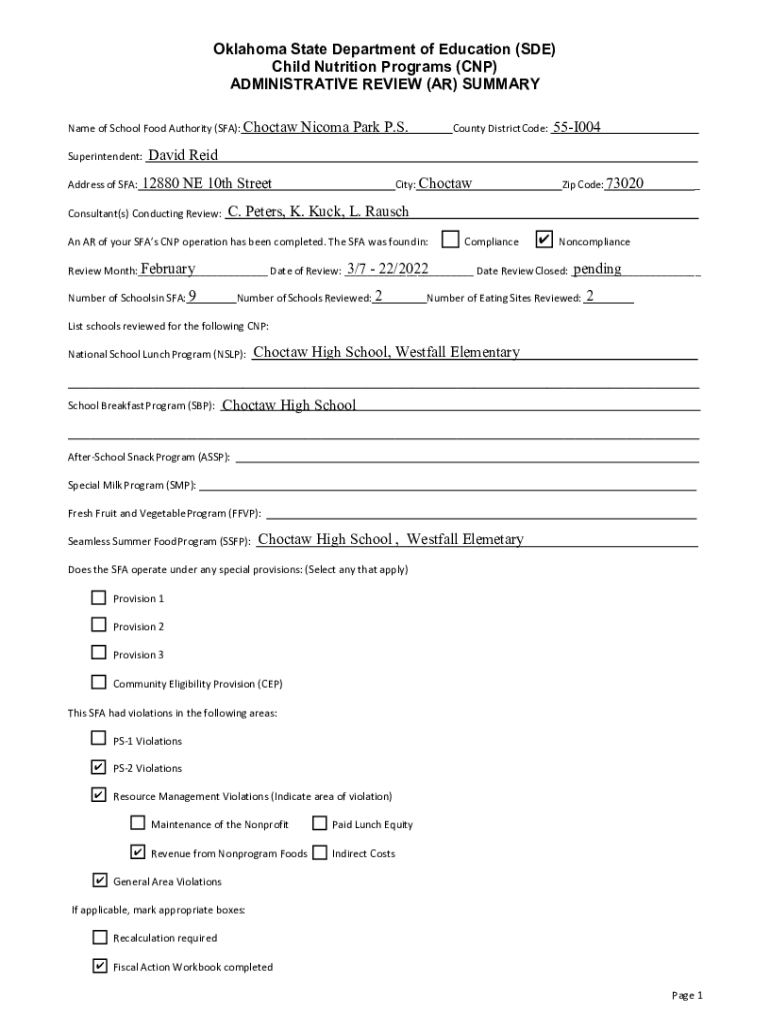





Sde ok child-nutrition-programsChild NutritionOklahoma State Department of Education 2026

Get Form
sde ok child-nutrition-programsChild NutritionOklahoma State Department of Education Preview on Page 1

Here's how it works

01. Edit your form online
Type text, add images, blackout confidential details, add comments, highlights and more.
02. Sign it in a few clicks
Draw your signature, type it, upload its image, or use your mobile device as a signature pad.
03. Share your form with others
Send it via email, link, or fax. You can also download it, export it or print it out.

Definition & Meaning

The "sde ok child-nutrition-programsChild NutritionOklahoma State Department of Education" form pertains to the administrative oversight of child nutrition initiatives governed by the Oklahoma State Department of Education. These programs are designed to ensure compliance with federal and state guidelines for child nutrition, providing oversight on meal patterns, resource management, and competitive food standards within schools in Oklahoma.

Key Elements of the sde ok child-nutrition-programs

  • Compliance Findings: This section details the specific areas where schools meet or fail to meet nutrition standards.
  • Corrective Actions: Outlines necessary steps schools must take to address non-compliance, including potential deadlines.
  • Training Requirements: Specifies areas where staff training is required to maintain compliance and improve program efficacy.
  • Public Reporting: Mandates transparency by requiring schools to report findings to the public.

Steps to Complete the Form

  1. Review Current Procedures: Assess existing meal patterns, resource management, and compliance with nutritional standards.
  2. Compile Necessary Data: Gather relevant documents and data required for form submission.
  3. Draft Response to Findings: Address each compliance finding with detailed plans for corrective actions and training.
  4. Submit the Form: Use the appropriate submission method, whether digital or physical, adhering to deadlines.

Legal Use of the Form

The form serves as a legal document ensuring that child nutrition programs operate under the required state and federal regulations. Compliance with these guidelines is legally binding and ensures schools provide nutritious meals to students.

State-Specific Rules

Oklahoma's regulations require public reporting of compliance findings, unique to its mandate under state law. These rules aim to foster transparency and ensure the public is informed about school nutrition standards.

Important Terms Related to the Form

  • Compliance Audit: Evaluation of a school's adherence to prescribed nutrition guidelines.
  • Corrective Actions: Steps outlined to remedy deficiencies in compliance.
  • Nutritional Standards: Guidelines regulating the content and quality of meals served in schools.

Who Typically Uses the Form

  • School Administrators: Responsible for overseeing nutrition programs and ensuring compliance.
  • Nutrition Coordinators: Facilitate the implementation of wellness policies and corrective actions.
  • Oklahoma State Department of Education Officials: Conduct reviews and provide support for compliance measures.

decoration image ratings of Dochub

Examples of Using the Form

  • Addressing Meal Pattern Violations: Schools use the form to outline how they will adjust meal services to meet required standards.
  • Implementing Staff Training: Documentation of planned training sessions for cafeteria staff to improve food service quality.

Required Documents

Schools must provide evidence of meal services, training logs, and corrective action plans. Documentation supporting compliance or outlining deviations and plans for correction is essential.

Form Submission Methods

Schools can submit the form via the state's online portal or through traditional mailing methods, ensuring adherence to deadlines.

Penalties for Non-Compliance

Schools failing to comply with the form requirements may face funding penalties or increased scrutiny from the state education agency. Compliance ensures continued eligibility for federal funding under child nutrition programs.

See more sde ok child-nutrition-programsChild NutritionOklahoma State Department of Education versions

We've got more versions of the sde ok child-nutrition-programsChild NutritionOklahoma State Department of Education form. Select the right sde ok child-nutrition-programsChild NutritionOklahoma State Department of Education version from the list and start editing it straight away!
Versions Form popularity Fillable & printable
2018 4.8 Satisfied (90 Votes)
2016 4.1 Satisfied (20 Votes)
be ready to get more

Complete this form in 5 minutes or less

Get form

Got questions?

We have answers to the most popular questions from our customers. If you can't find an answer to your question, please contact us.
Contact us
The child nutrition programs are administered by USDAs Food and Nutrition Service (FNS). Additional information about program eligibility requirements, benefits, and application processes can be obtained from FNS for meals in schools and childcare and meals in summer programs.
Length of Time to Become a Nutritionist You must have at least a bachelors degree, which takes an average of four years to complete. If you desire a masters degree, to become registered by the CDR or certified by the BCNS, that usually takes about two more years to earn, bring total education time to six years.
According to the Academy of Nutrition and Dietetics, the difference in salary between RDNs and nutritionists is between $25,000 and $35,000 annually. This type of difference in pay, for most nutritionists, makes the advanced education and training and the RDN credential well worth the time and money.
To become a pediatric nutritionist, individuals must earn a Bachelors Degree in Nutrition or Dietetics. This education is also expected to incorporate coursework that is specific to the guidelines set by the Accreditation Council for Education in Nutrition and Dietetics (ACEND).
To earn board certification, dietitians must first become registered through the Commission on Dietetic Registration. They must maintain their registration for at least two years and complete 2,000 practice hours within the pediatric specialty.

Security and compliance

At DocHub, your data security is our priority. We follow HIPAA, SOC2, GDPR, and other standards, so you can work on your documents with confidence.

Learn more
ccpa2
pci-dss
gdpr-compliance
hipaa
soc-compliance
be ready to get more

Complete this form in 5 minutes or less

Get form

People also ask

The CN labeling program is a voluntary federal labeling program for the CNP. CN labels provide a way for a manufacturer to demonstrate how a processed food product contributes to the meal pattern requirements in CNP and are approved by USDA.
Federal child nutrition programs are funded mostly out of mandatory spending, with a small discretionary component. Annual appropriations for child nutrition programs generally cover the cost of providing benefits to all eligible applicants.

Related links


