







Definition & Meaning
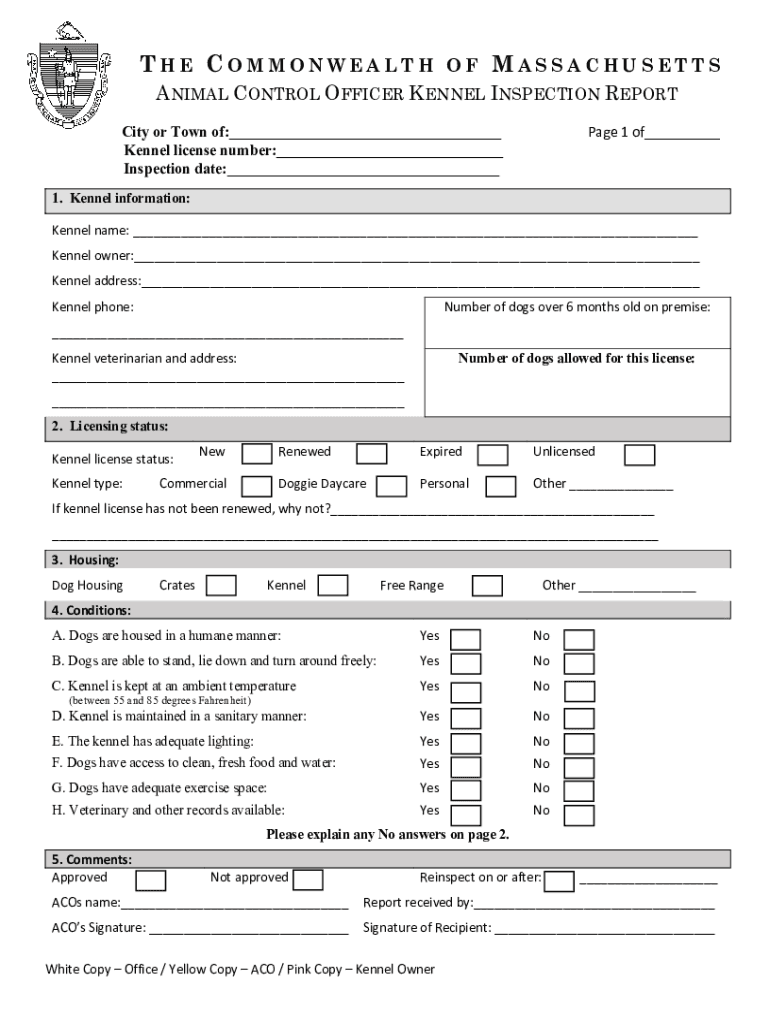
The "City or Town of: Kennel license number: Inspection date:" form is a crucial document used in animal control and kennel management within the United States. It serves as an official record detailing the specific locale of the kennel, a unique identification number linked to the kennel's license, and the precise date when the latest inspection was conducted. This form is essential for regulatory compliance, ensuring that all kennels operate within established guidelines for animal welfare and public health standards.
Examples
For instance, a kennel located in Boston may have its details logged as "City or Town of: Boston, Kennel license number: 12345, Inspection date: 03/15/2023." This format aids in maintaining an organized system for authorities to monitor compliance and uphold the integrity of kennel operations within their jurisdiction.
Importance
Maintaining accurate records via this form is critical for tracking the frequency and results of inspections. It helps ensure that kennels adhere to sanitary conditions, provide humane treatment to animals, and comply with all requisite regulations.
Key Elements of the Form
City or Town Information
Each form requires the specific name of the city or town where the kennel operates. This information is vital for regional oversight and dictates which local regulations apply to the kennel's operation.
- Example: Listing as "City or Town of: Springfield" provides clarity on the jurisdictional reach.
Kennel License Number
This unique identifier links the kennel to its official licensure, ensuring traceability and accountability in the event of audits or inspections.
- Example: "Kennel license number: 98765" can help identify the kennel and track its compliance history.
Inspection Date
Recording the inspection date is essential to document the latest compliance check. This timestamp serves as a reference for future inspections and helps track the chronological order of compliance events.
- Example: "Inspection date: 08/12/2023" confirms the most recent evaluation effort.
How to Use the Form
Steps to Complete the Form
- Gather Required Information: Collect the necessary data, including your city or town, kennel license number, and the date of the latest inspection.
- Enter the Details: Accurately fill in each section on the form with the gathered information.
- Verify Accuracy: Double-check for any errors or omissions to ensure the information is precise.
- Submit to Authorities: Once completed, submit the form to the appropriate local animal control department or regulatory agency.
Practical Scenario
Assume you manage a kennel in New Haven. You received your latest inspection on 05/10/2023, and your kennel is registered with the license number 11223. Filling out this form would involve logging these exact details in the appropriate sections to ensure official records reflect your compliance status.
Legal and Compliance Considerations
State-Specific Rules
The regulatory requirements linked to kennel operations and inspection forms can vary significantly from state to state. Some U.S. states may have additional inspection criteria, mandatory compliance workshops, or more frequent inspection cycles.
Compliance Consequences
Failure to accurately complete or submit this form in a timely manner may result in penalties, fines, or even suspension of the kennel's operating license. Therefore, understanding and adhering to state-specific rules is paramount.
Typical Users
Primarily, kennel owners, animal control officers, and local government authorities utilize this form to maintain transparency and regulatory compliance in kennel operations.
Examples of Using the Form
Case Study
Consider the scenario of a new kennel opening in Austin. An initial inspection post-license acquisition is conducted, and details are recorded as "City or Town of: Austin, Kennel license number: 56820, Inspection date: 01/22/2023." This form becomes part of the kennel's permanent compliance record, providing a point of reference for annual evaluations by regulatory bodies.
Potential Variations
Some variations might involve extended forms including sections for reporting specific kennel conditions, such as space adequacy or cleanliness — enhancing oversight capabilities.
Conclusion
Accurately documenting kennel inspections through the "City or Town of: Kennel license number: Inspection date:" form is essential for ensuring compliant and ethical operations in the animal care sector. Its structured approach not only facilitates precise record-keeping but also supports regulatory frameworks designed to protect animal welfare and uphold public health standards.




