



01. Edit your form online
Type text, add images, blackout confidential details, add comments, highlights and more.

Type text, add images, blackout confidential details, add comments, highlights and more.

Draw your signature, type it, upload its image, or use your mobile device as a signature pad.

Send it via email, link, or fax. You can also download it, export it or print it out.
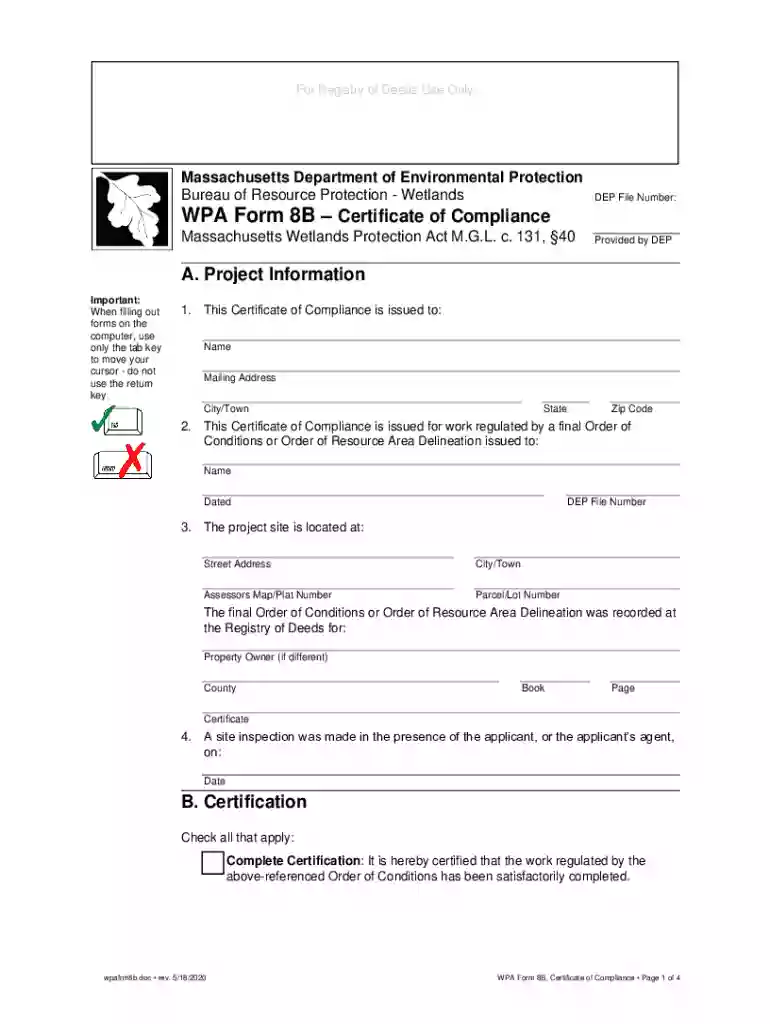
WPA Form 8B, also known as the Certificate of Compliance, is issued by the Massachusetts Department of Environmental Protection. It certifies that the work conducted on a project complies with the Massachusetts Wetlands Protection Act. This document confirms that construction or renovation activities have adhered to environmental standards, ensuring that wetland areas are preserved and not adversely affected by human activities. The Certificate of Compliance includes information about the project, work completion certification, authorization from the Conservation Commission, and confirms recording at the Registry of Deeds. It plays an important role in the regulatory framework by offering a formal acknowledgment of environmental compliance.
Using the Certificate of Compliance involves several steps and understanding its importance in regulatory compliance:
Understanding Compliance Requirements: Ensure all construction or development activities align with the environmental standards outlined in the Massachusetts Wetlands Protection Act.
Verification: On completing a project, verify that all conditions specified in the project orders have been met. This includes checking that any restoration of the wetland area is completed as specified.
Filing for Compliance: Submit the WPA Form 8B to the Massachusetts Department of Environmental Protection for review. Attach any necessary documentation that supports compliance, like project plans or photographs of completed work.
Review by Authorities: The Conservation Commission reviews the submission for thoroughness and accuracy. If all requirements are satisfied, they issue the Certificate of Compliance.
Document Recording: Record the issued certificate at the local Registry of Deeds to finalize the process.
Completing the Certificate of Compliance requires detailed attention to each section of the form:
Project Information: Enter comprehensive details about the project, including the primary contact person, project address, and a brief description of the work performed.
Completion Certification: Certify that the work specified in the order of conditions has been accomplished satisfactorily. This step often requires input from project managers or lead engineers to ensure all tasks are complete.
Authorization by the Conservation Commission: Obtain the necessary authorizations and signatures from the local Conservation Commission. This step is critical as it provides the official confirmation of compliance.
Ongoing Conditions: Identify any ongoing conditions that need to be maintained post-project completion, ensuring long-term environmental protection of the wetland resources.
Registry of Deeds: Once the form is complete and authorized, submit it to the Registry of Deeds for recording, which provides a public record of compliance.
Obtaining a Certificate of Compliance is crucial for several reasons:
Understanding certain terms associated with WPA Form 8B is essential for proper completion and application:
The WPA Form 8B encompasses several core components:
Regulations related to the Certificate of Compliance can vary slightly state-wide based on:
Practical applications of the Certificate of Compliance include:
These examples reflect diverse scenarios in which the Certificate of Compliance operates as a crucial regulatory tool, showcasing its essential role in sustainable property development across Massachusetts.
We've got more versions of the granby-ma fileswpa-form-8bWPA Form 8BCertificate of Compliance - Granby MA form. Select the right granby-ma fileswpa-form-8bWPA Form 8BCertificate of Compliance - Granby MA version from the list and start editing it straight away!
At DocHub, your data security is our priority. We follow HIPAA, SOC2, GDPR, and other standards, so you can work on your documents with confidence.


