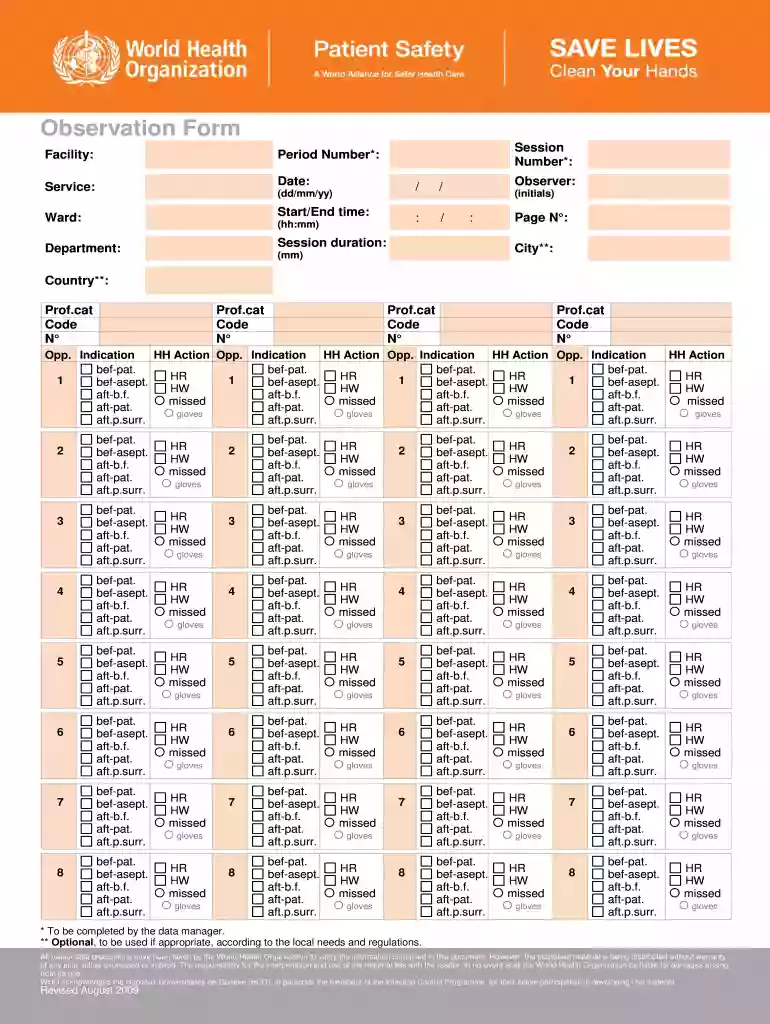
Definition and Meaning of the WHO Hand Hygiene Observation Form
The WHO Hand Hygiene Observation Form serves as a structured tool used to monitor and evaluate hand hygiene practices within healthcare settings. This form is a critical component in promoting compliance with hand hygiene protocols, which are essential for preventing healthcare-associated infections. It facilitates systematic data collection regarding the adherence of healthcare workers and establishes a foundation for continuous quality improvement.
The primary objective of this observation form is to assess various hand hygiene behaviors during patient care interactions. Key metrics recorded include the timing of hand hygiene actions, the specific situations that necessitate hand washing or use of sanitizers, and the compliance rates of healthcare personnel. By identifying trends and gaps in compliance, organizations can tailor educational interventions and policy adjustments to enhance overall hand hygiene standards.
How to Use the WHO Hand Hygiene Observation Form
Using the WHO Hand Hygiene Observation Form requires careful attention to detail and adherence to specific guidelines to ensure accurate data collection. The process typically includes the following steps:
- Preparation: Familiarize yourself with the form before observation. Understand each section and the meaning behind the form fields, which may include observer details, facility information, and specific time points for observation.
- Conduct Observations: Observe healthcare workers during patient interactions, focusing on hand hygiene opportunities where washing or sanitizing is recommended. Document each observation immediately on the form to maintain accuracy.
- Record Data: Fill out the form comprehensively. This includes marking whether hand hygiene was performed, noting the type of hand hygiene (soap and water versus hand sanitizer), and the circumstances leading to hand hygiene actions.
- Data Analysis: Once completed, analyze the collected data to assess compliance rates and identify patterns or areas needing improvement.
- Feedback and Improvement: Share insights with healthcare teams and leadership to create action plans for enhancing hand hygiene practices based on observed behaviors.
Steps to Complete the WHO Hand Hygiene Observation Form
Completing the WHO Hand Hygiene Observation Form involves multiple steps that ensure thorough and accurate documentation. Here are the necessary steps:
- Identify Key Information: At the top of the form, input critical details such as the facility name, date of observation, and observer’s identity.
- Select Observation Categories: Specify the categories for observation, such as 'before patient contact,' 'after patient contact,' and 'after body fluid exposure,' to align with the WHO's Five Moments for Hand Hygiene.
- Document Observational Data:
- Record each instance of hand hygiene opportunity with details, including the time and type of hygiene action taken.
- Mark compliance or non-compliance clearly to facilitate easy tracking.
- Calculate Compliance Rates: After observation, use the recorded data to calculate the compliance rates. This can involve simple arithmetic to compare the number of observed compliant actions against total opportunities.
- Summarize Findings: Provide a summary of the observations, highlighting any patterns found in compliance or non-compliance among different healthcare workers or departments.
Why Use the WHO Hand Hygiene Observation Form?
Employing the WHO Hand Hygiene Observation Form is vital for several reasons:
- Enhances Patient Safety: By monitoring hand hygiene practices, healthcare settings can significantly reduce the incidence of healthcare-associated infections, thereby enhancing patient safety.
- Equip Healthcare Professionals: The form serves as a tool for educating and training healthcare workers about the importance of proper hand hygiene.
- Supports Accreditations: Documentation of compliance with hand hygiene protocols can support healthcare facilities in meeting accreditation standards and guidelines.
- Facilitates Continuous Improvement: Regular use of the form allows for ongoing assessment and provides a mechanism to address compliance shortcomings through targeted interventions and feedback.
- Data-Driven Decisions: The insights gained from completed forms enable healthcare leaders to make informed decisions about resource allocation, training programs, and procedural adjustments.
Key Elements of the WHO Hand Hygiene Observation Form
The WHO Hand Hygiene Observation Form comprises several key elements that are crucial for its effectiveness:
- Facility Information: Includes the name and type of healthcare facility where observations are taking place, providing context for the data collected.
- Observer Details: Allows recording of the observer’s name and position, which adds credibility and accountability to the observations.
- Observation Timing: Specific timeframes for observing hand hygiene opportunities, which helps to ensure a comprehensive assessment throughout different shifts and care scenarios.
- Compliance Indicators: Sections to mark whether hand hygiene was performed (or not performed) during designated opportunities, with additional notes for any special circumstances.
- Comments Section: Provides space for qualitative observations or additional insights that may not be captured in structured data points.
Examples of Using the WHO Hand Hygiene Observation Form
Practical applications of the WHO Hand Hygiene Observation Form can be seen in various healthcare scenarios:
- Routine Ward Observations: Nurses conducting hourly rounds use the observation form to document the hand hygiene practices of all staff members during patient checks.
- Surgical Departments: In operating rooms, the form can be utilized to ensure strict adherence to hand hygiene protocols before and after procedures.
- Training Programs: During hand hygiene training sessions, trainers can observe healthcare workers in practice and fill out the form to provide feedback on their compliance in real-time.
- Quality Improvement Initiatives: Hospitals may conduct facility-wide audits using the form to establish Baseline compliance rates, setting a foundation for quality improvement strategies targeting hand hygiene practices.
Important Terms Related to the WHO Hand Hygiene Observation Form
Understanding key terminology associated with the WHO Hand Hygiene Observation Form is essential for accurate usage. Some important terms include:
- Compliance Rate: The percentage of observed hand hygiene opportunities where workers performed the correct action, crucial for evaluating adherence.
- Observation Period: The specific timeframe during which observations are conducted, often predetermined to ensure consistency.
- Five Moments for Hand Hygiene: A foundational concept by WHO outlining critical times when healthcare workers must perform hand hygiene, guiding the structure of observations.
- Healthcare-Associated Infections (HAIs): Infections patients may acquire while receiving treatment for medical or surgical conditions, underscoring the importance of hand hygiene practices.
- Quality Improvement: Processes aimed at enhancing patient care quality, which can be significantly influenced by hand hygiene compliance data gathered from the observation form.