How to claim for damages 2026

Get Form
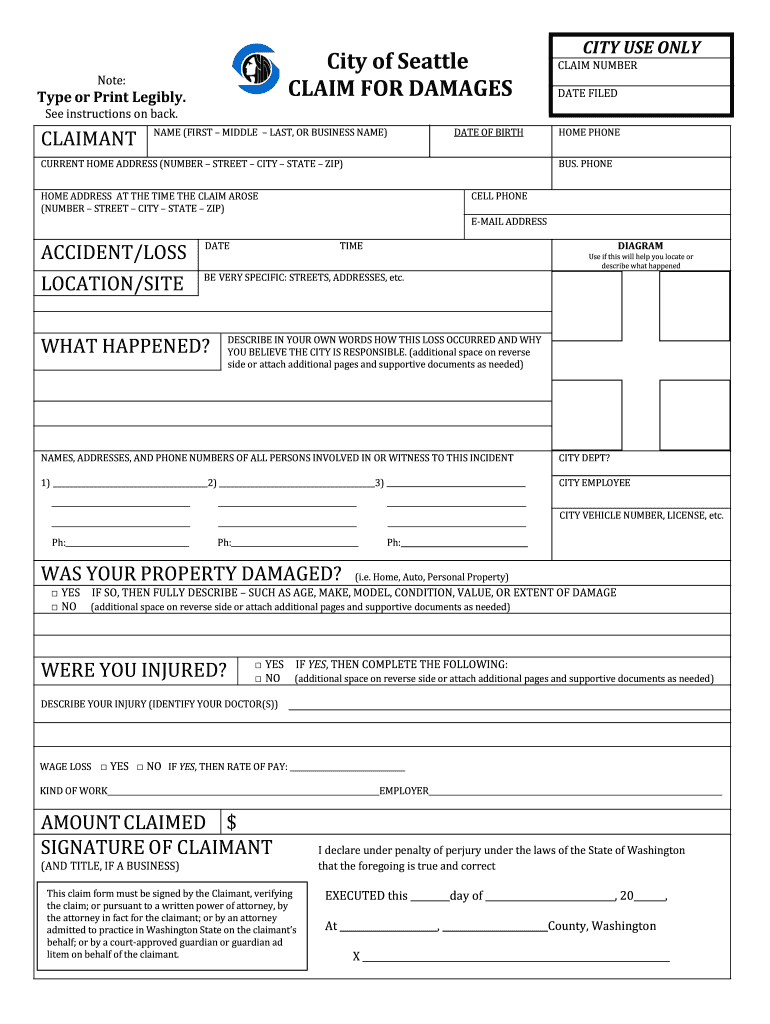
city of seattle claim for damages Preview on Page 1

Here's how it works

01. Edit your city of seattle claim for damages online
Type text, add images, blackout confidential details, add comments, highlights and more.
02. Sign it in a few clicks
Draw your signature, type it, upload its image, or use your mobile device as a signature pad.
03. Share your form with others
Send it via email, link, or fax. You can also download it, export it or print it out.

How to use or fill out the Claim for Damages form

Form edit decoration
9.5
Ease of Setup
DocHub User Ratings on G2
9.0
Ease of Use
DocHub User Ratings on G2
  1. Click ‘Get Form’ to open it in the editor.
  2. Begin by entering your personal information in the 'CLAIMANT' section. This includes your full name, date of birth, and current home address. Ensure all details are typed or printed legibly.
  3. In the 'ACCIDENT/LOSS' section, provide specific details about the incident, including location, date, time, and a clear description of what happened. Be as detailed as possible to support your claim.
  4. List all individuals involved or who witnessed the incident along with their contact information. This will help substantiate your claim.
  5. Indicate whether your property was damaged and provide a thorough description if applicable. If you were injured, complete that section with details about your injury and any medical professionals involved.
  6. Finally, review all entries for accuracy before signing the form. Your signature verifies that the information is true and correct.

Start using our platform today to easily fill out and submit your Claim for Damages form online for free!

See more how to claim for damages versions

We've got more versions of the how to claim for damages form. Select the right how to claim for damages version from the list and start editing it straight away!
Versions Form popularity Fillable & printable
2013 4.8 Satisfied (195 Votes)
be ready to get more

Complete this form in 5 minutes or less

Get form

Got questions?

We have answers to the most popular questions from our customers. If you can't find an answer to your question, please contact us.
Contact us
First, make sure your claim is specific and debatable. Avoid vague statements that cant be argued for or against. Then, back up your claim with credible evidence facts, data, and expert opinions. Each paragraph should contribute to defending your thesis.
Proof: What evidence do you have to prove your side Collect evidence proving your position. If you are the plaintiff, this could be evidence showing the damage, cost of repairing the damage, and whos responsible for the damage. This might include a police report, photographs, repair bills, proof of payment.
The Right to Claim Damages clause establishes a partys entitlement to seek financial compensation if the other party bdocHubes the contract. In practice, this clause allows the injured party to recover losses that directly result from the bdocHub, such as lost profits or costs incurred due to non-performance.
Actual Loss. The loss must be actual and real, not hypothetical or speculative. Causation. The loss must be the proximate result of the defendants wrongful act or omission. Proof of Loss. The claimant must present sufficient and competent evidence to prove the damages claimed.
How Do I Write Compensation for Damages? Define the Event: Clearly state what constitutes a bdocHub or a harmful act. Specify the Damages: Detail what types of losses are eligible for compensation. Determine the Calculation: Explain how the compensation amount will be calculated.

Security and compliance

At DocHub, your data security is our priority. We follow HIPAA, SOC2, GDPR, and other standards, so you can work on your documents with confidence.

Learn more
ccpa2
pci-dss
gdpr-compliance
hipaa
soc-compliance

People also ask

What Should be Included in a Property Damage Incident Report? Date and Time of the Damage. Reporters Contact Information. Property and Property Owner Information. Description of Damage. Cause of Damage. Injury/Accident Report. Visual Documentation/Evidence. Witness Information.
Begin the letter with a professional salutation and a clear, concise statement of the purpose of the letter. Explain the details of the claim in a clear and organized manner. Summarize the main points of the letter and provide a call to action. Close the letter with a professional closing and your signature.

Related links