
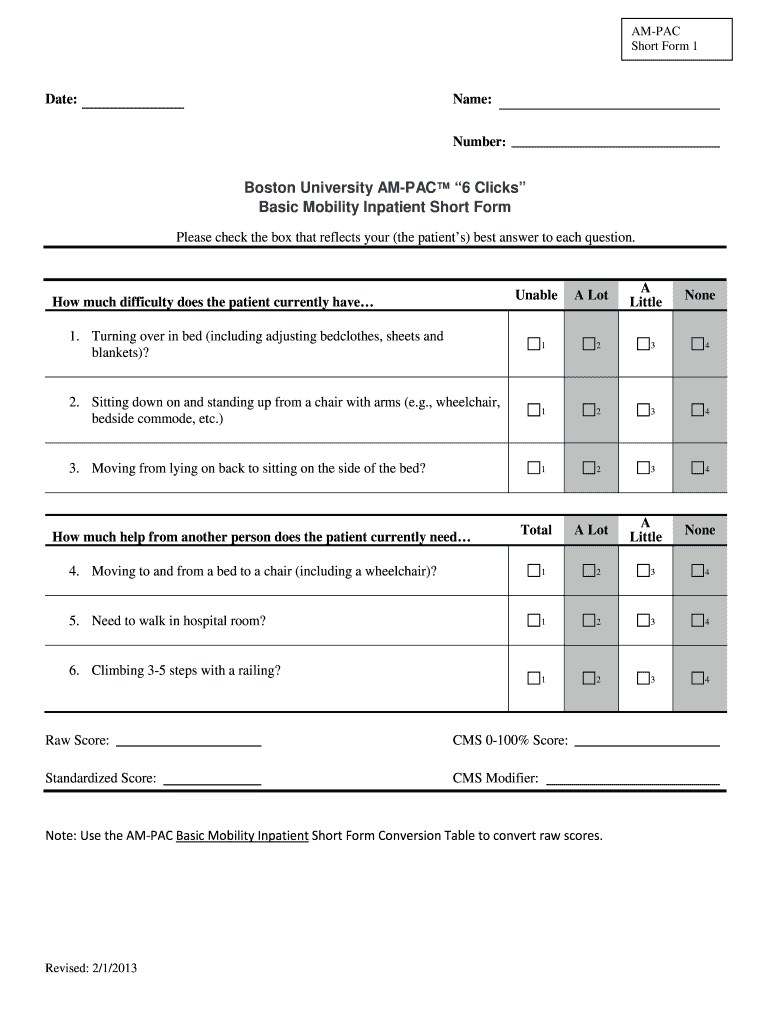







Overview of the AM-PAC 6 Clicks Form
The AM-PAC 6 Clicks form is a standardized tool designed for assessing a patient's mobility and daily activity limitations in a clinical setting. This short form helps healthcare professionals evaluate a patient’s ability to perform fundamental mobility tasks, which informs treatment plans and necessary interventions. The questions focus on the patient’s capacity to carry out basic movements, making it a crucial instrument in rehabilitation and physical therapy.
Purpose of the AM-PAC 6 Clicks Form
The main objective of the AM-PAC 6 Clicks form is to provide a quick yet comprehensive assessment of a patient's mobility. This tool aims to:
- Evaluate a patient’s functional abilities.
- Identify areas where patients may require support or rehabilitation.
- Track progress over time, allowing for assessment of treatment efficacy.
Key Features of the AM-PAC 6 Clicks Form
- Interactive Structure: The form includes specific movements such as “getting in and out of bed” or “walking across the room,” with options for scoring difficulty levels.
- Simplicity and Clarity: The layout is designed for easy comprehension, making it accessible for both patients and clinicians.
- Short Assessment Time: Completing the form typically takes just a few minutes, streamlining the assessment process.
How to Use the AM-PAC 6 Clicks Form
To effectively utilize the AM-PAC 6 Clicks form, follow these steps:
- Distribute the Form: Provide the patient with the form in a quiet environment for optimal concentration.
- Explain the Process: Ensure the patient understands how to score each item based on their level of difficulty, using the provided scale.
- Collect the Responses: After the patient completes the form, review their scores together to clarify their needs and concerns.
- Interpret the Results: Analyze the scores with reference to the AM-PAC guidelines to determine the patient's mobility level and care requirements.
Scoring Methodology
Responses are typically measured on a scale that categorizes mobility levels:
- No Difficulty: Patient scores this for tasks they can perform without assistance.
- Some Difficulty: Indicates mild challenges that may require alternative strategies or minimal assistance.
- Extreme Difficulty: Signifies significant mobility issues; these patients may require extensive support.
Steps to Complete the AM-PAC 6 Clicks Form
Completing the AM-PAC 6 Clicks form involves a systematic approach:
- Access the Form: Obtain the AM-PAC 6 Clicks PDF, either in print or digital format.
- Begin Assessment: Start with the first mobility task and proceed in order. The tasks typically involve basic movements such as:
- Walking short distances.
- Transferring from one surface to another (e.g., chair to bed).
- Record Responses: Document the patient's difficulties, using the provided options to indicate their level of ease or hardship with each task.
- Review All Sections: Ensure all items are completed before concluding the assessment.
Common Challenges
Some patients may find certain questions tricky due to misunderstanding the movements involved. Clinicians should be prepared to clarify and demonstrate movements as necessary.
Who Typically Uses the AM-PAC 6 Clicks Form
The AM-PAC 6 Clicks form is widely utilized by various professionals in healthcare settings, including:
- Physical Therapists: To assess patient mobility and guide rehabilitation.
- Occupational Therapists: To determine support needs in daily activities.
- Nurses: To monitor patient recovery in hospital environments.
- Rehabilitation Specialists: To create tailored therapeutic plans based on mobility assessments.


Clinical Importance
The use of the AM-PAC 6 Clicks form is crucial in settings where understanding mobility affects treatment outcomes, such as post-surgery recovery, older adult care, or chronic illness management.
Key Elements of the AM-PAC 6 Clicks Form
Focus on the following key components to ensure effective completion and interpretation:
- Patient-Centric Questions: Each question targets everyday activities, reflecting real-world mobility challenges.
- Scoring Criteria: Clearly defined scoring options facilitate objective assessment.
- Time-Efficiency: The brevity of the form respects both patient time and clinical workflow efficiency.
Usability Enhancements
For ease of use, healthcare facilities often employ training sessions to familiarize staff with the assessment methodology and proper scoring interpretations. This training is essential to optimize the form's application in clinical settings.




