
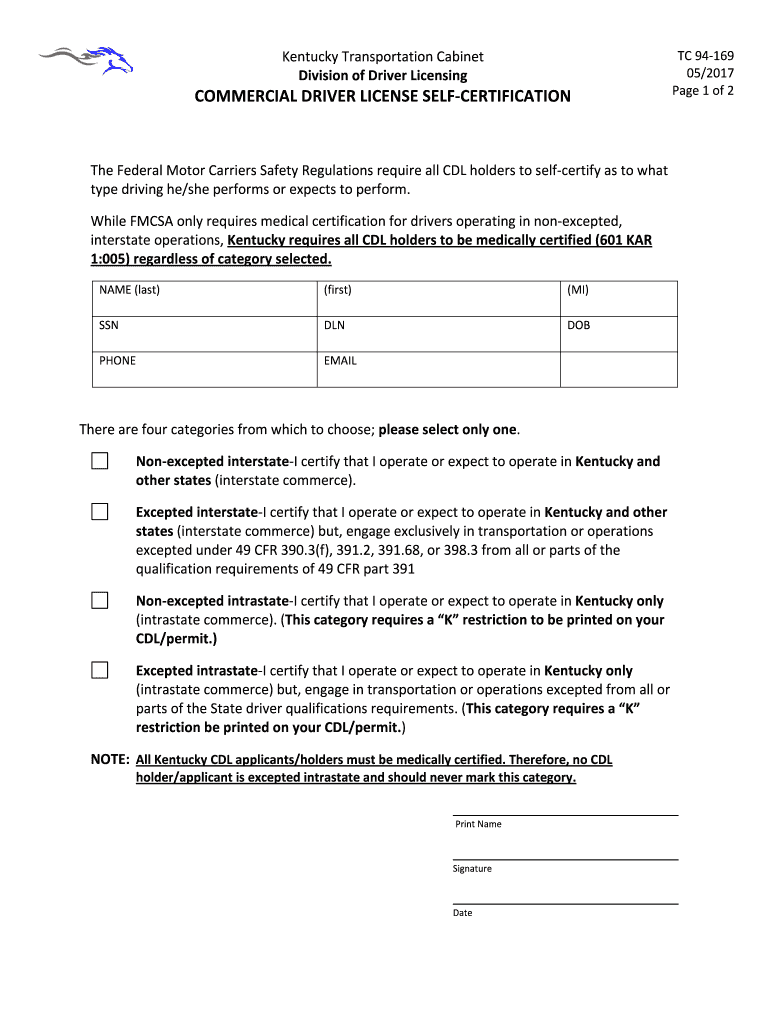







Definition and Meaning of Kentucky CDL Medical Self Certification
The Kentucky CDL medical self-certification is an essential process that mandates commercial drivers to affirm that they meet the medical standards required by federal and state regulations. This self-certification is a component of maintaining a valid Commercial Driver's License (CDL) in Kentucky, ensuring that drivers are physically fit to operate commercial vehicles.
In essence, the self-certification serves to categorize CDL holders based on the type of driving they perform, which may be interstate or intrastate. This categorization also determines the subsequent requirements for medical certification and compliance with relevant safety regulations.
Categories of Self-Certification
- Interstate Commerce: Drivers engaging in interstate commerce must meet federal standards and obtain a valid medical examination certificate from a licensed medical examiner.
- Intrastate Commerce: Those who drive solely within Kentucky may have different requirements, though they must still assert their medical fitness.
- Excepted Intrastate: Unique to some states, this category often includes drivers who operate vehicles that do not require a CDL. However, in Kentucky, CDL holders cannot select this category due to stricter state requirements.
Understanding these classifications is crucial for CDL holders, as it dictates the necessary medical compliance and certification processes they must follow.
Steps to Complete the Kentucky CDL Medical Self Certification
The process of completing the Kentucky CDL medical self-certification is straightforward but requires careful attention to detail to ensure compliance.
-
Review Medical Qualifications: Begin by familiarizing yourself with the medical qualifications required for CDL holders. This includes understanding the federal and state requirements.
-
Obtain a Medical Examination: Schedule an appointment with an authorized medical examiner who is listed on the National Registry of Certified Medical Examiners. They will conduct a comprehensive medical examination.
-
Receive Medical Examination Certificate: After evaluation, if you meet the necessary health guidelines, you'll obtain a Medical Examination Certificate. This document must be kept updated in accordance with the expiration dates specified.
-
Complete the Self-Certification Form: Access the Kentucky CDL portal (mycdl.ky.gov) to complete the online self-certification form. Ensure you select the correct category that reflects your driving activity.
-
Submit Documentation: If you are required to submit your Medical Examination Certificate, upload the document through the portal or send it using the specified methods provided on the website.
-
Review Submission Status: After submission, it is advisable to check the status of your certification to ensure that it has been processed correctly. Use the Kentucky CDL portal to verify your certification.
Following these steps accurately helps ensure that your self-certification remains valid and compliant with state and federal regulations.
Important Terms Related to Kentucky CDL Medical Self Certification
Familiarity with key terminology surrounding the Kentucky CDL medical self-certification process is essential for successful navigation through the requirements.
- Medical Examination Certificate: A document issued by a certified medical examiner confirming that the driver meets the medical standards to hold a CDL.
- Self-Certification: The process by which CDL holders declare their compliance with medical requirements based on the type of commerce they engage in.
- National Registry of Certified Medical Examiners: A registry maintained by the Federal Motor Carrier Safety Administration (FMCSA) listing medical examiners authorized to perform evaluations for commercial drivers.
- Intrastate vs. Interstate Commerce: Distinctions that refer to whether a driver operates solely within Kentucky or across state lines, influencing the regulatory requirements they must meet.
- Kentucky CDL Portal: The online platform (mycdl.ky.gov) for Kentucky CDL holders to manage their medical certifications and related documents.
Understanding these terms assists drivers in navigating the process effectively and ensuring compliance with all relevant regulations.
State-Specific Rules for Kentucky CDL Medical Self Certification
Kentucky has specific regulations that govern the CDL medical self-certification process, which enhance the rigor of compliance and safety for commercial drivers.
- Mandatory Medical Exams: All CDL holders must undergo a medical examination conducted by a certified medical examiner and cannot operate a commercial vehicle without a valid Medical Examination Certificate.
- Self-Certification Categories: Unlike some states, Kentucky prohibits the excepted intrastate category for CDL holders, which means that all drivers must meet federal and state medical standards for their certification.
- Upload Requirements: CDL holders in Kentucky must upload their Medical Examination Certificate to the Kentucky CDL portal, ensuring that there is a digital record of their medical fitness.
- Regular Updates: There is a requirement for drivers to renew their medical certificates at specified intervals—every two years for most drivers, though some may require annual evaluations based on their medical condition.
Comprehending these state-specific rules aids CDL holders in maintaining their licenses in a lawful manner.
Legal Use of the Kentucky CDL Medical Self Certification
The legal framework surrounding the Kentucky CDL medical self-certification ensures driver safety and compliance with both state and federal regulations.
- Federal Compliance: The Kentucky CDL medical self-certification must adhere to the requirements set forth by the FMCSA, which governs the medical qualifications of commercial drivers nationwide.
- State Enforcement: Kentucky's Division of Motor Vehicle Licensing enforces state-specific laws regarding medical self-certification. Non-compliance can result in penalties or revocation of driving privileges.
- Legal Accountability: By signing the self-certification form, CDL holders attest to the truthfulness of their medical condition, potentially facing legal consequences for falsification or misleading information.
Understanding the legal implications helps drivers appreciate the seriousness of the self-certification process and their responsibilities therein.
How to Use the Kentucky CDL Medical Self Certification Template
The Kentucky CDL medical self-certification template serves as a formal declaration for drivers to affirm their medical readiness.
-
Accessing the Template: Drivers can access the certification form through the mycdl.ky.gov portal. It is essential to ensure you are using the latest version of the template to remain compliant with current requirements.
-
Filling Out the Form: When completing the self-certification, ensure all sections are filled out accurately, including personal information and selected driving category.
-
Review Before Submission: Before finalizing the submission, review all entries for accuracy. Errors or omissions can lead to delays in processing your certification.
-
Receive Confirmation: After submitting the form, wait for email confirmation or an update on the Kentucky CDL portal, acknowledging the successful completion of your self-certification.
Using the template effectively streamlines the certification process and helps maintain compliance.
Examples of Using the Kentucky CDL Medical Self Certification in Real-World Scenarios
Utilizing the Kentucky CDL medical self-certification in practical scenarios highlights its importance within the commercial driving landscape.
-
Scenario 1: New CDL Applicants: A truck driver applying for their CDL for the first time must undergo a medical exam, receive a Medical Examination Certificate, and complete self-certification as a prerequisite to obtaining their license.
-
Scenario 2: Recertification for Medical Conditions: A driver diagnosed with a condition that affects their ability to drive may need to submit additional medical documentation upon renewal of their Medical Examination Certificate to demonstrate compliance with safety standards.
-
Scenario 3: Potential Disqualification: A driver who fails to submit their self-certification form or Medical Examination Certificate within the required timeframe may face disqualification from driving commercially until compliance is achieved.
These scenarios illustrate the practical application of the self-certification process across various aspects of commercial driving in Kentucky.




