




01. Edit your nh marriage license application form online
Type text, add images, blackout confidential details, add comments, highlights and more.

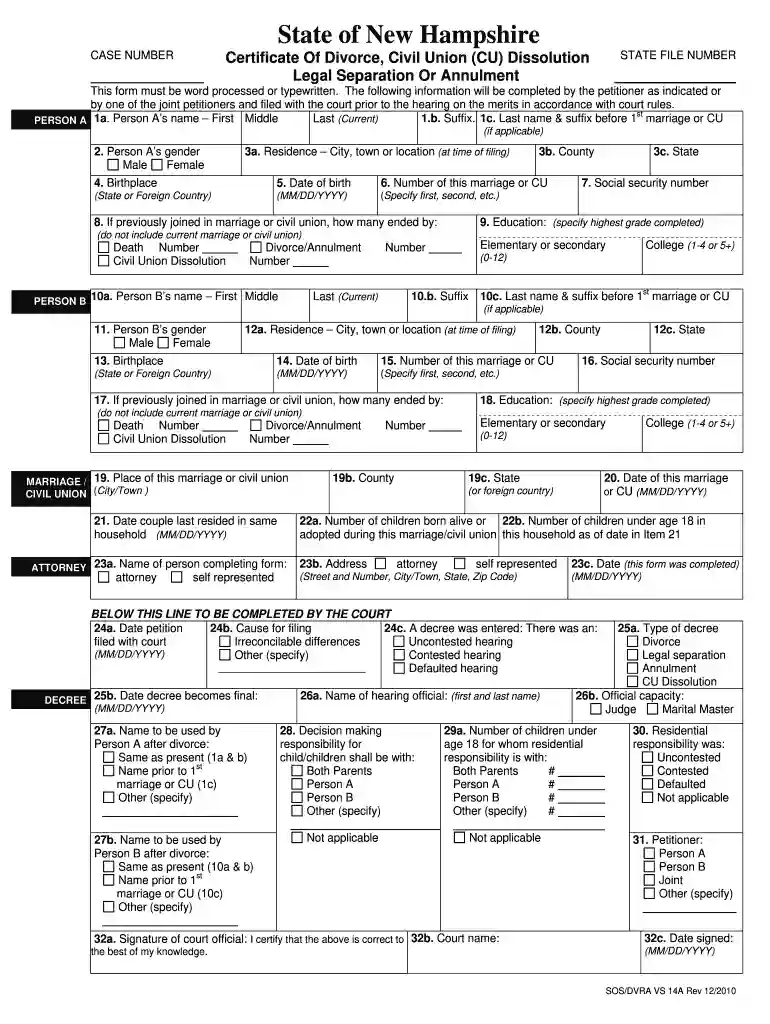
Type text, add images, blackout confidential details, add comments, highlights and more.

Draw your signature, type it, upload its image, or use your mobile device as a signature pad.

Send nh marriage certificate via email, link, or fax. You can also download it, export it or print it out.
A New Hampshire marriage license serves as the official legal document that authorizes two individuals to marry. This license is essential for the legal recognition of the marriage, ensuring that the union adheres to state laws and regulations. The NH marriage license outlines the identities of the parties involved, including their names, dates of birth, and other pertinent details. It's crucial for couples to understand that obtaining this license is the first step in formalizing their commitment, and it must be filed with the appropriate state authority to be valid.
Understanding these elements is foundational for couples planning their nuptials in New Hampshire.
Completing the NH marriage license involves several specific steps that couples must follow to ensure a smooth application process.
Gather Required Information: Prior to applying, both individuals should collect necessary information including:
Complete the Application Form: Couples can obtain the NH marriage license application form from their local town or city clerk’s office or through their official website. It’s essential to fill out the form accurately, as errors can delay processing.
Submit the Application: Couples must submit the form in person at the appropriate local authority, usually the town or city clerk’s office. Both parties must be present for verification.
Pay the Fee: A fee is required to process the application. This amount varies by locality but generally ranges from $45 to $50. Payment methods may vary, so couples should check in advance.
Receive the License: Upon approval, couples will receive their marriage license immediately, allowing them to schedule their wedding ceremony. They should ensure that they understand how long the license remains valid.
By following these steps, couples can streamline the process of obtaining their marriage license.
When applying for a marriage license in New Hampshire, specific documents are necessary to verify the identities and eligibility of the applicants. Couples should be prepared to provide the following:
Fulfilling these document requirements is essential for a successful application.
Understanding specific terminology related to the NH marriage license can help couples navigate the process effectively. Key terms include:
Familiarity with these terms can reduce confusion during the application and ceremony.
The NH marriage license legally binds the two individuals to one another in the eyes of the state. It is important to recognize its implications:
Understanding the legal ramifications of the marriage license can guide couples before and after their marriage ceremony.
When applying for a marriage license in New Hampshire, couples should be aware of specific rules that apply within the state. Notable regulations include:
Familiarity with these state-specific rules is important for couples navigating the marriage licensing process in New Hampshire.
We've got more versions of the nh marriage license application form form. Select the right nh marriage license application form version from the list and start editing it straight away!
| Versions | Form popularity | Fillable & printable |
|---|---|---|
| 2010 | 4.8 Satisfied (125 Votes) |
At DocHub, your data security is our priority. We follow HIPAA, SOC2, GDPR, and other standards, so you can work on your documents with confidence.
In most circumstances you may apply for a marriage license at any NH county clerk office where you plan to be married. These offices are usually located inRead more
This article gives information on recognition of nonbinary gender identities in law, government, services, and businesses in the USA.Read more
If all requirements are met, a marriage license may be issued the same day. Marriage licenses are valid for 90 days from the date of issuance and may be usedRead more


