




01. Edit your k1 speed waiver online
Type text, add images, blackout confidential details, add comments, highlights and more.

Type text, add images, blackout confidential details, add comments, highlights and more.

Draw your signature, type it, upload its image, or use your mobile device as a signature pad.

Send k1 speed waiver pdf via email, link, or fax. You can also download it, export it or print it out.
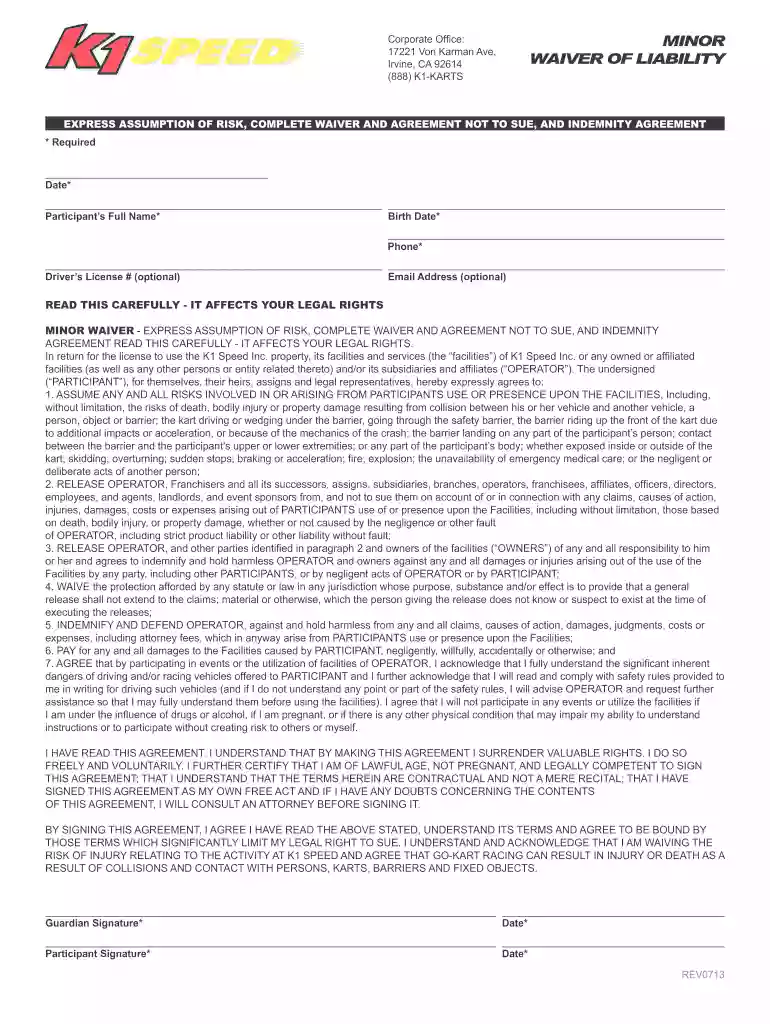
The K1 Speed waiver is a legal document designed to outline the risks associated with participating in activities at K1 Speed facilities. Participants must sign this document to acknowledge their understanding of the inherent dangers of racing and karting. By signing the waiver, individuals agree to assume all risks associated with their participation and release K1 Speed Inc. from liability for any injuries or damages incurred while using their facilities. This waiver is critical in protecting the organization from legal claims related to accidents, injuries, or other issues that may arise during the racing experience.
The K1 Speed waiver typically includes language that emphasizes the necessity of assuming personal responsibility for safety. It includes stipulations that participants understand the operational rules, acknowledge the unpredictability of racing, and agree not to hold K1 Speed liable for any mishaps, providing essential legal protection for both the company and the participants.
Understanding the key elements of the K1 Speed waiver is essential for both participants and the facility. The waiver usually includes the following components:
These elements are crucial as they provide clarity regarding the responsibilities and liabilities of all parties involved during the racing experience.
Completing the K1 Speed waiver involves several important steps that participants should follow to ensure proper documentation. Here’s a straightforward process:
Accessing the Waiver: Visit the K1 Speed website to find the waiver. For convenience, you might be able to access it as a K1 Speed waiver PDF or through an online form.
Reading the Document: It's crucial to read the waiver thoroughly. Understand all terms and conditions before proceeding with the signing.
Filling Out Required Information: Enter necessary personal information such as name, date of birth, and contact details on the form. If you are a minor, a guardian or parent typically needs to provide their information as well.
Acknowledgment of Risks: The waiver will likely include a section where you must acknowledge your understanding of the risks involved in the activity.
Signing the Waiver: After completing the necessary fields, provide your signature. Ensure that you date the waiver, as it may be invalid without this information.
Submitting the Waiver: Depending on the facility's process, you may need to submit the form online or present it in person upon arrival.
Following these steps helps ensure that all legal requirements are met, and that participants can enjoy their experience with minimal risk of legal complications.
The K1 Speed waiver is legally binding if it adheres to local, state, and federal laws regarding liability waivers. In the United States, liability waivers must typically contain explicit language that communicates the risks involved and ensures that the signer understands what they are relinquishing by signing. Here are key considerations regarding the legal use of such waivers:
Clear Language: The waiver must be written in clear and understandable language without legal jargon, ensuring that participants fully comprehend their rights and responsibilities.
Voluntary Signing: Participants must voluntarily sign the waiver without coercion. This establishes that they agree to the terms of the waiver willingly.
Compliance with Local Laws: Different states and jurisdictions may have specific rules regarding waivers. It's important for K1 Speed to ensure that their waiver complies with state laws, which might influence its enforceability.
Costs and Legal Fees: In some cases, the waiver may address potential legal costs incurred should disputes arise. This can further protect K1 Speed from future liability.
Understanding these legal dimensions helps both K1 Speed and participants navigate the potential risks associated with racing safely and legally.
Utilizing the K1 Speed waiver occurs often during visits to K1 facilities. Here are practical scenarios where the waiver plays a crucial role:
Minor Participants: When minors participate, their parents or guardians must read and sign the K1 Speed minor waiver form, ensuring they comprehend the risks involved. This protects the business by ensuring that legal permission is granted for young participants.
Group Events: During corporate outings or birthday parties, all participants may need to fill out individual waivers. This process simplifies liability management for K1 Speed by confirming that everyone involved has acknowledged and accepted the risks.
Accident Reports: If an accident occurs at the facility, the signed waiver serves as critical documentation for the investigation. It often stands as evidence that the participant was informed about the risks, which could potentially protect K1 Speed from liability claims.
These examples illustrate how the K1 Speed waiver functions in real-world settings, emphasizing its importance in ensuring safety and legal protection throughout the karting experience.
We've got more versions of the k1 speed waiver form. Select the right k1 speed waiver version from the list and start editing it straight away!
At DocHub, your data security is our priority. We follow HIPAA, SOC2, GDPR, and other standards, so you can work on your documents with confidence.


