




01. Edit your imm1344 online
Type text, add images, blackout confidential details, add comments, highlights and more.

Type text, add images, blackout confidential details, add comments, highlights and more.

Draw your signature, type it, upload its image, or use your mobile device as a signature pad.

Send imm1344 pdf via email, link, or fax. You can also download it, export it or print it out.
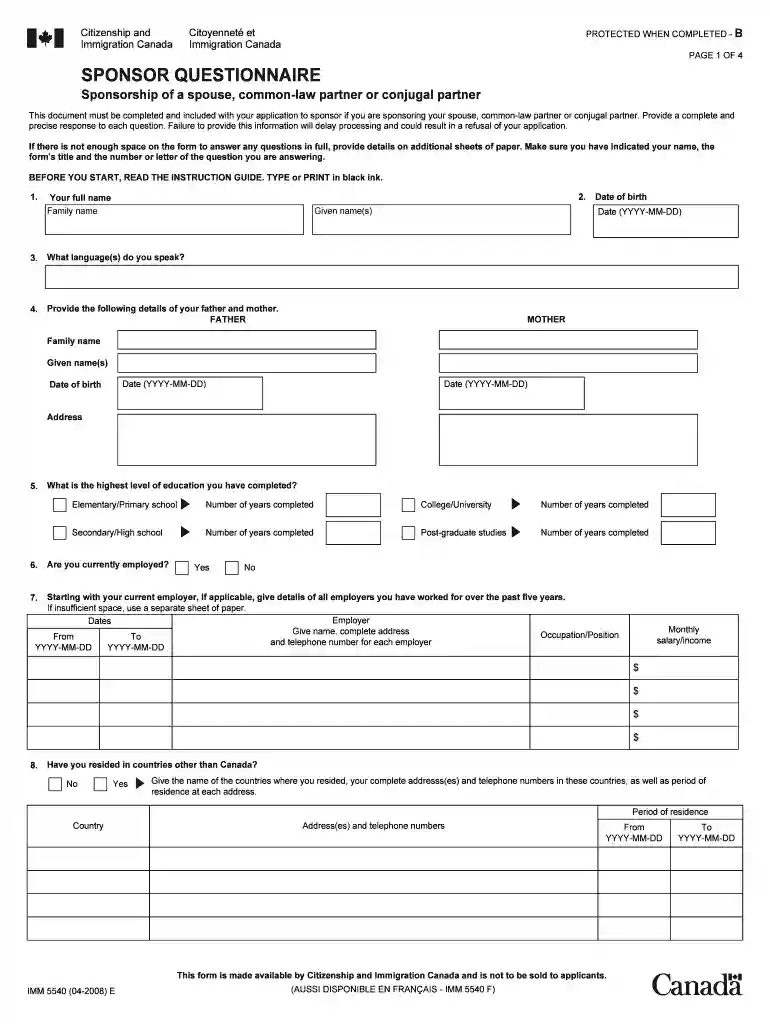
Canadian immigration forms for spousal sponsorship are official documents required by the Immigration, Refugees and Citizenship Canada (IRCC) to facilitate the immigration of a spouse, common-law partner, or conjugal partner to Canada. These forms serve as a preliminary step in the process that allows a Canadian citizen or permanent resident to sponsor their partner for permanent residency. The primary form for this process is the IMM 1344, which must be filled out accurately and completely to avoid delays or complications in the application process.
The forms include personal details about the sponsor and the applicant, including their backgrounds, current living situations, and previous relationships. Providing accurate information is crucial, as this affects both the application approval timeline and the allocation of resources during processing. Forms must also adhere to specific legal requirements, including signatures and supporting documents, ensuring compliance with Canadian immigration laws.
In summary, understanding the definition and purpose of these forms is vital for individuals seeking to bring their spouses or partners to Canada, as they set the foundation for a successful application.
Completing the Canadian immigration forms for spousal sponsorship involves a systematic approach to ensure all required information is provided accurately. The following steps outline this process:
Obtain the forms: Start by downloading the IMM 1344 form. Ensure you are using the latest version available on the IRCC website or through authorized sources.
Gather required documents: Collect all necessary supporting documents, including proof of identity such as passports, documents proving the relationship (e.g., marriage certificates), and evidence of the sponsor’s Canadian citizenship or residency status.
Complete the forms: Fill out the IMM 1344 and any additional forms. Take your time to provide detailed information about your background, employment history, and residence status. Accuracy is critical to prevent any delays in processing.
Review the information: Once completed, double-check all entries for accuracy. Make sure there are no missing fields, and validate that the information matches the supporting documents to avoid inconsistencies.
Sign and date the forms: Ensure that all necessary signatures are included. Notably, the IMM 1344 requires the signature of the sponsor, which is crucial for the application’s validity.
Submit the forms: After reviewing, submit the completed forms along with all required supporting documents. Depending on the specific application guidelines, you may submit these forms either online through the IRCC portal or via mail.
Track the application: Once submitted, keep track of your application status through the IRCC online application tracker. This will allow you to monitor any updates or additional information requests.
Completing these steps thoroughly enhances the chances of obtaining first stage approval for spousal sponsorship and facilitates a smoother application process.
When applying for spousal sponsorship in Canada, certain documents are essential to support the application and verify the relationship comprehensively. These documents typically include:
Proof of identity: This can include copies of valid passports for both the sponsor and the applicant. Every passport page should be included, especially those showing entry stamps or visas.
Proof of relationship: Relevant documentation might include a marriage certificate, joint bank account statements, lease agreements showing shared residence, or photographs that demonstrate a history together.
Sponsorship application form: The completed IMM 1344 form must be submitted, detailing the sponsor's information and their commitment to supporting their partner financially.
Police clearance certificates: Both the sponsor and the applicant may need to provide these certificates from their respective countries, confirming that they do not have a criminal record.
Financial documents: Evidence of the sponsor's financial stability, such as recent pay stubs, tax returns, and bank statements, may be necessary to prove the ability to support the applicant.
Medical examinations: Depending on the applicant's country of origin, a medical examination report may be required, confirming the applicant's health and compliance with Canada’s healthcare regulations.
Providing thorough and accurate documentation is critical for the successful review of your spousal sponsorship application and can impact overall processing times.
Understanding the key elements of the Canadian immigration forms for spousal sponsorship is essential for a complete application. The significant components include:
Sponsor Information: This section requires detailed personal data about the sponsor, such as their full name, address, date of birth, and residency status in Canada. It's vital to ensure all data matches official documents.
Applicant Information: Similar to the sponsor section, this part captures the necessary details about the sponsored spouse or partner. This includes travel history, marital status, and any previous applications for immigration to Canada.
Relationship History: This area allows the sponsor to provide a detailed description of the relationship, including how the couple met, the timeline of their relationship, and any plans for living together in Canada.
Financial Commitment: The sponsor must affirm their understanding of the financial obligations involved in supporting their partner. This includes covering living expenses and ensuring the applicant does not rely on social assistance.
Declarations and Signatures: The completed form must include the necessary signatures, which confirm that all information provided is accurate and that the sponsor accepts the legal responsibilities of the sponsorship.
Awareness of these key elements ensures a better-prepared application, minimizing the likelihood of processing delays or denials.
To be eligible for spousal sponsorship in Canada, certain criteria need to be met by both the sponsor and the applicant. This ensures that the application is valid and likely to result in successful immigration approval:
Sponsor's Qualifications: The sponsor must be a Canadian citizen or a permanent resident. They should be at least eighteen years old, capable of financially supporting the applicant, and not currently in default on any previous sponsorship obligations.
Relationship Validity: The couple must demonstrate a genuine relationship. This means that if they are married, the marriage must be legally recognized, and if they are in a common-law or conjugal relationship, they must have lived together for a minimum of twelve consecutive months.
Legal Status: The applicant must have a legal immigration status, meaning they should not be inadmissible to Canada on criminal or medical grounds. Prior immigration refusals should also be addressed.
Documentation: Both parties need to provide correct and complete forms, as missing or incorrect documentation can impact eligibility and approval.
Understanding these eligibility criteria is fundamental for potential sponsors to navigate the spousal sponsorship application process effectively. Meeting all requirements significantly increases the chance of obtaining a positive outcome.


We've got more versions of the imm1344 form. Select the right imm1344 version from the list and start editing it straight away!
| Versions | Form popularity | Fillable & printable |
|---|---|---|
| 2008 | 4.8 Satisfied (178 Votes) |
At DocHub, your data security is our priority. We follow HIPAA, SOC2, GDPR, and other standards, so you can work on your documents with confidence.
Form I-485, Application to Register Permanent Residence or Adjust Status, is for a person in the United States to apply for lawful permanent resident statusRead more
Feb 18, 2021 You are categorized as qualified for spousal sponsorship if you are a Canadian citizen, or your residence is officially permanent in Canada.Read more


