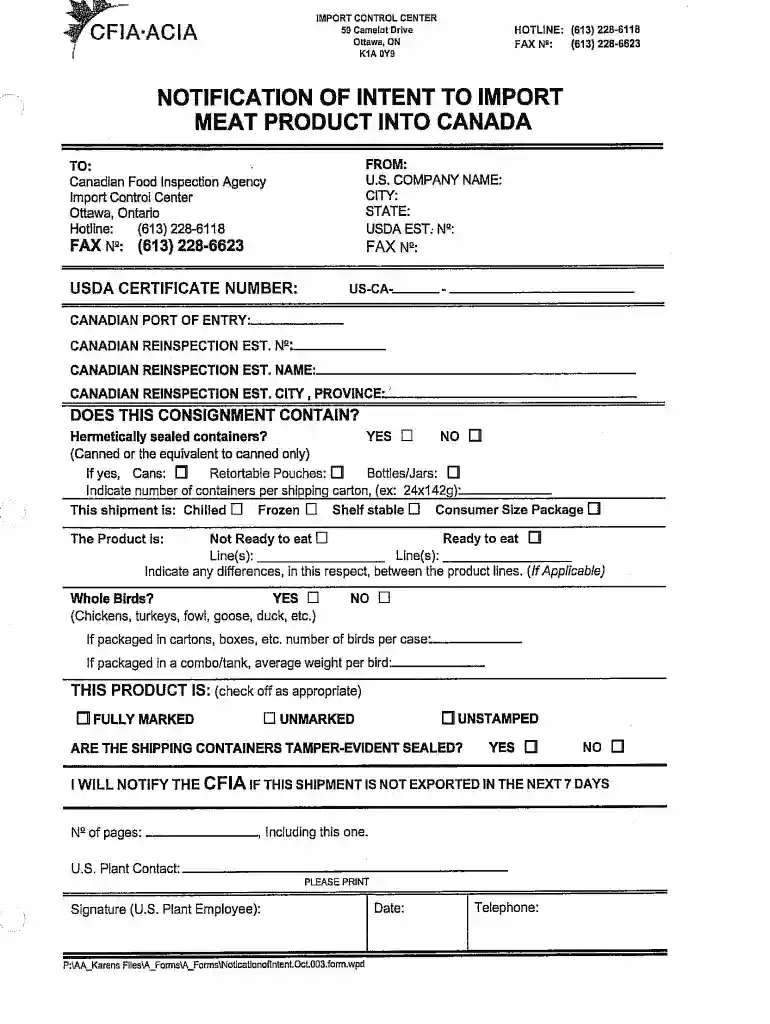
Notification of intent to import meat product into canada 2025

Get Form
can you import meat into canada Preview on Page 1

Here's how it works

01. Edit your can you import meat into canada online
Type text, add images, blackout confidential details, add comments, highlights and more.

02. Sign it in a few clicks
Draw your signature, type it, upload its image, or use your mobile device as a signature pad.

03. Share your form with others
Send it via email, link, or fax. You can also download it, export it or print it out.

How to use or fill out notification of intent to import meat product into Canada with our platform

Form edit decoration
9.5
Ease of Setup
DocHub User Ratings on G2
9.0
Ease of Use
DocHub User Ratings on G2
  1. Click ‘Get Form’ to open the notification of intent to import meat product into Canada in the editor.
  2. Begin by filling in your company details in the 'FROM' section, including your U.S. company name, USDA establishment number, and contact information.
  3. In the 'TO' section, ensure that the Canadian Food Inspection Agency's details are correctly entered as specified.
  4. Indicate the Canadian port of entry and provide information about any reinspection establishments if applicable.
  5. Answer the questions regarding the consignment's packaging and contents, such as whether it contains hermetically sealed containers and if it is ready-to-eat.
  6. Complete any additional fields related to whole birds or specific product lines, ensuring accuracy in quantities and descriptions.
  7. Finally, review all entries for completeness before signing and dating the form at the bottom.

Start using our platform today to streamline your document editing and submission process for free!

See more notification of intent to import meat product into canada versions

We've got more versions of the notification of intent to import meat product into canada form. Select the right notification of intent to import meat product into canada version from the list and start editing it straight away!
Versions Form popularity Fillable & printable
2003 4.8 Satisfied (108 Votes)
be ready to get more

Complete this form in 5 minutes or less

Get form

Got questions?

We have answers to the most popular questions from our customers. If you can't find an answer to your question, please contact us.
Contact us
Comments Section Its to stop certain diseases/parasites/insects/etc from being carried into regions where they typically arent found. Different countries have different requirements for proving the food is safe, and its simplest for them to just ban the transport across borders.
There are no standard fees or costs related to import licenses as most agencies have different requirements. However, other agencies may have different requirements or fees, so its always best to check with them individually before starting the import process.
Use APHIS eFile to apply for a CIP (this method is faster but requires eAuthentication). If youre unable to apply online, you may download PPQ Form 588 (162.01 KB) and fax a paper copy of the application to 301-734-5786.
FSIS Import Application Process To import to the U.S., countries must first complete the FSIS eligibility application package. To ensure that this process goes smoothly, FSIS provides as much advice and guidance as needed to other governments concerning any portion of the process.
Types of import permits There are two kinds of import permits, general and specific. The type you need depends on the nature of the goods being shipped, their classification on the ICL, and their entry conditions.

People also ask

Do I need a license to import food to USA? No, theres no specific license required for most food items when importing to the US. However, you will need to adhere to the necessary guidelines and regulations set by agencies like the FDA and USDA to ensure the foods safety and compliance.
GENERAL REQUIREMENTS 2 Breeding cattle imported into Canada must be born after January 1, 1999 and the animals must be identified with a permanent identification recognized by the United States Department of Agriculture (USDA) and are not under restriction for movement, slaughter or destruction control.

Related links