Definition & Meaning
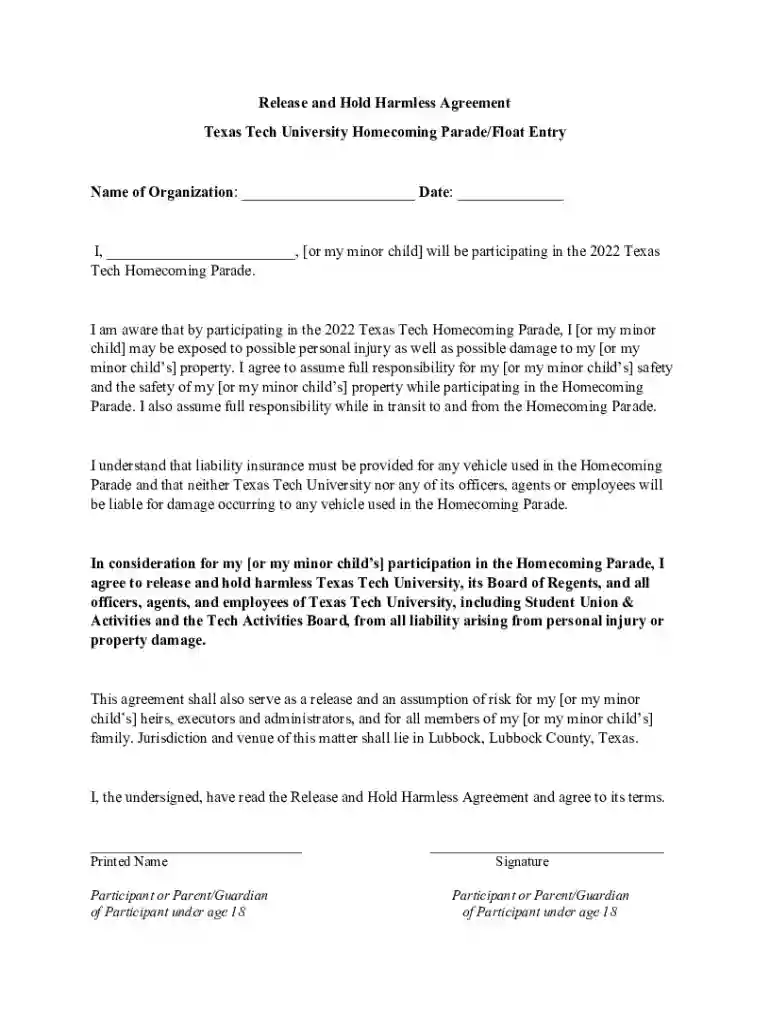
The "Release and Hold Harmless Agreement" for Texas Tech University's Homecoming Parade is a legal document designed to protect the university and its affiliates from liability claims. It stipulates that participants acknowledge the inherent risks involved in the parade, such as personal injury or property damage. By signing this agreement, participants agree not to hold Texas Tech University or related parties responsible for any incidents that might occur during the event. This type of agreement is essential for limiting legal exposure and ensuring that all parties are aware of their responsibilities and the potential risks.
Key Components
- Assumption of Risk: Participants recognize that engaging in the parade carries certain risks and assume responsibility for any potential injury or damage.
- Liability Release: The agreement releases Texas Tech University and its affiliates from liability for any incidents that occur during the event.
- Scope of Agreement: The release extends to heirs and family members of the participant, ensuring they are also bound by the terms.
- Requirement for Insurance: For certain participants, especially those with vehicles, liability insurance is a prerequisite to participation.
Practical Examples
- Parade Participant: A student who wishes to join the parade must sign the agreement to acknowledge their understanding of the risks and to release the university from any liability related to their participation.
- Vehicle Owner: A participant planning to drive a float must provide proof of liability insurance, as specified in the agreement, to ensure coverage for any accidents or damage.
How to Obtain the Release and Hold Harmless Agreement
The agreement can typically be obtained directly from Texas Tech University's official website or through the event's administrative office. Participants are advised to carefully read and complete the form well in advance of the parade to ensure compliance with all requirements.
Steps to Access the Form
- Visit the Texas Tech University Website: Navigate to the section dedicated to the Homecoming Parade or events.
- Contact the Event Office: For direct assistance, reach out to the homecoming event office via email or phone to request a copy of the agreement.
- Check Your Email or Mail: If you are registered for the event, the event organizers may send the form directly to you.
Steps to Complete the Release and Hold Harmless Agreement
Completing the form accurately is crucial to ensure that you are legally covered. Here is a detailed step-by-step guide on how to fill out this agreement:
- Provide Personal Information: Enter your full name, address, and contact details.
- Acknowledge the Risks: Read through the section on risks and initial where required to confirm your understanding.
- Sign the Release: Place your signature in the designated area to confirm your agreement to release Texas Tech University from liability.
- Provide Vehicle Insurance Details: If applicable, fill in the details of your vehicle’s liability insurance, including policy number and insurer information.
- Submit the Form: Once completed, submit the form according to instructions provided, either by mail, in-person, or electronically.
Common Mistakes to Avoid
- Incomplete Information: Ensure all fields are completed accurately to avoid delays.
- Missing Signatures: Double-check that you have signed all required sections.
Why Use the Release and Hold Harmless Agreement
Utilizing this agreement is a strategic way for participants and the university to manage risk effectively. It provides clarity on legal and safety responsibilities, ultimately enhancing the safety of the event and protecting all parties involved.
Benefits to Participants
- Clarity on Risk: Participants gain a clear understanding of the risks involved and the extent of their liability.
- Legal Protection: By signing, participants protect themselves and the university from potential legal disputes.
Benefits to Texas Tech University
- Risk Management: The agreement aids in managing liability risks associated with organizing large public events.
- Safeguard Reputation: Ensures that the university maintains its reputation by minimizing preventable incidents.
Key Elements of the Release and Hold Harmless Agreement
Understanding the crucial elements of this agreement can help participants prepare properly and reduce the likelihood of misunderstandings.
Core Components
- Assumption of Risk Language: Explicit terms that detail the potential risks the participant assumes.
- Disclaimer of Liability: Statements that negate the university’s responsibility for incidents outside their control.
- Insurance Requirements: Specifics about necessary insurance coverage for participants with vehicles or certain roles in the parade.
Real-World Applications
- Student Organization Participation: A fraternity planning to have a float must understand its insurance obligations and ensure compliance with the agreement.
- Alumni Involvement: Alumni returning to participate should recognize the scope of the agreement, especially if they are traveling with family.
State-Specific Rules for the Release and Hold Harmless Agreement
While the agreement is particular to Texas Tech University’s Homecoming, it must align with broader Texas state laws regarding liability waivers. Understanding these laws ensures that the agreement is enforceable.
Considerations for Compliance
- Adherence to Texas Law: The agreement should be crafted in compliance with Texas statute to ensure its legal validity.
- Specific Provisions: Some clauses may be unique to Texas, considering local legal standards on liability and insurance.
Implications for Participants
Participants should be aware that while the form is specific to the event, state regulations shape its parameters, offering a layer of legal protection granted by state law.
Legal Use of the Release and Hold Harmless Agreement
The agreement serves as a contractual promise not to sue Texas Tech University and related entities for specific claims.
Enforceability
- Legal Framework: As long as the agreement is signed voluntarily and with full understanding, it is a legally binding contract.
- Court Precedents: Legal precedents in Texas often uphold such agreements if they meet statutory requirements and participants sign willingly.
Limitations
- Scope Restrictions: The agreement cannot exempt Texas Tech University from liability due to gross negligence or willful misconduct, which must be clearly understood by both parties.