




01. Edit your reg 227 online
Type text, add images, blackout confidential details, add comments, highlights and more.

Type text, add images, blackout confidential details, add comments, highlights and more.

Draw your signature, type it, upload its image, or use your mobile device as a signature pad.

Send duplicate title form ca dmv via email, link, or fax. You can also download it, export it or print it out.
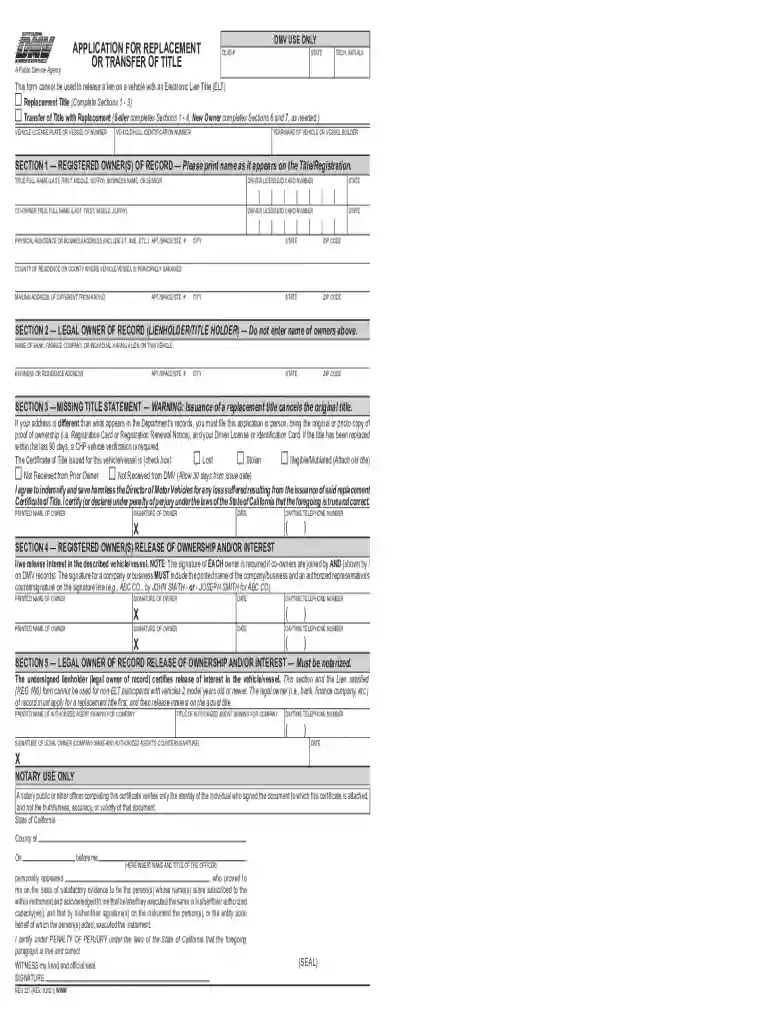
The REG 227, known as the Application for Replacement or Transfer of Title, is utilized by the Department of Motor Vehicles (DMV) for vehicle or vessel title modifications. This form primarily facilitates the issuance of a replacement title when the original is lost, stolen, or damaged, and is also used for transferring ownership from one party to another. It is a critical document in maintaining the legal record of vehicle ownership and ensuring all pertinent parties are accurately documented.
Securing a copy of the REG 227 form is straightforward. It can be acquired directly from a DMV office in your state or downloaded as a PDF from the official DMV website. Some third-party services may also offer downloadable versions of this form, but it is crucial to verify the authenticity before use. When you visit a DMV office, customer service representatives can provide additional guidance on completing and submitting the form correctly.
Owner Information: Begin by filling in the registered owner’s details, including name, address, and contact information. Ensure accuracy to avoid processing delays.
Vehicle/Vessel Details: Enter specifics such as the Vehicle Identification Number (VIN) or Hull Identification Number (HIN), make, model, and year.
Title Description: Specify whether the title is lost, stolen, or damaged. If transferring ownership, include the new owner’s information.
Signatures: All parties involved must provide their signatures to validate the application. This includes owners, legal representatives, and the new owner in cases of transfer.
Notarization: Certain scenarios require notarization, especially when the title is declared as lost or when transferring ownership without the seller present.
Submission: Once completed, submit the form via mail or at a local DMV office. Be sure to include any applicable fees and additional documentation as required.
Identification Requirements: Proof of identity and ownership may be required. This can include driver’s licenses, previous titles, or registration documents.
Fee Structure: Fees for processing are state-specific and may vary depending on the action requested (replacement vs. transfer).
Certified Copies: If demanded, a certified copy of the original title should be attached to the application when transferring ownership.
Having a complete and accurate REG 227 form is essential for both private and commercial vehicle transactions. It prevents legal complications related to vehicle ownership and ensures a clear transfer of title. Proper completion protects all parties from future disputes over ownership or title validity.
The form is regularly used by car dealerships, private sellers, and buyers in transferring vehicle ownership. It is also applicable for fleet management companies requiring accurate record-keeping. Additionally, it serves as a legal means for asserting ownership when original documentation is compromised.
Scenario One: John loses the title to his car in a flood. Using the REG 227 form, he applies for a replacement title to ensure he remains the documented owner.
Scenario Two: Maria sells her boat and completes the REG 227 form to transfer ownership to the new buyer, Peter, who will become the legal owner when the application is processed.
Title transfer and replacement regulations can vary by state. Some states may require emissions testing or insurance verification before processing the REG 227 form. It is vital to consult your local DMV’s guidelines to ensure compliance with state-specific regulations.
Submitting an incomplete or inaccurate REG 227 form can lead to processing delays or penalties. Double-check all information, ensure the inclusion of necessary documents, and adhere to state-mandated timelines to avoid potential fines.
We've got more versions of the reg 227 form. Select the right reg 227 version from the list and start editing it straight away!
At DocHub, your data security is our priority. We follow HIPAA, SOC2, GDPR, and other standards, so you can work on your documents with confidence.
A grade and/or transfer credit will . elective course is intended for Landscape Development and General Horticulture students
DMV USE ONLY. DL/ID #. STATE. TECH. INITIALS. APPLICATION FOR REPLACEMENT. OR TRANSFER OF TITLE. This form cannot be used to release a lien on a vehicle with anRead more


