National Board Inspection Code, Part 1, Installation - CT 2026

Get Form
nbic part 1 pdf Preview on Page 1

Here's how it works

01. Edit your nbic part 1 pdf online
Type text, add images, blackout confidential details, add comments, highlights and more.

02. Sign it in a few clicks
Draw your signature, type it, upload its image, or use your mobile device as a signature pad.

03. Share your form with others
Send national board inspection code via email, link, or fax. You can also download it, export it or print it out.

Definition & Meaning

The National Board Inspection Code (NBIC), Part 1, Installation - CT, serves as a comprehensive guideline for the installation of boilers and pressure vessels. It is an essential document for ensuring that the installation process adheres to the highest safety standards. This code outlines the necessary procedures and requirements to guarantee that installations are safe and compliant with industry regulations. Adherence to the NBIC helps mitigate risks associated with improper installations, thus protecting personnel and property.

Who Typically Uses the National Board Inspection Code, Part 1, Installation - CT

The primary users of the NBIC, Part 1, Installation - CT, include boiler and pressure vessel installers, safety inspectors, and engineers. These professionals are responsible for overseeing installation projects, ensuring compliance with the code, and maintaining safety standards. Additionally, facility managers and compliance officers in various industries utilize this code to verify that installations within their facilities are up to standard. By following these guidelines, they help ensure the safety and efficiency of the operational environment.


decoration image ratings of Dochub

Key Elements of the National Board Inspection Code, Part 1, Installation - CT

  • Installation Type and Requirements: This section details the various types of installations permissible under the code and the specific criteria they must meet.
  • Safety Features: The inclusion of safety mechanisms, such as pressure relief valves and emergency shut-off systems, is crucial for compliance.
  • Material Specifications: Guidance on the materials that can be used during installation is provided to ensure durability and safety.
  • Testing Protocols: Procedures for testing installations to verify their integrity and safety are outlined, ensuring they meet designated standards.
  • Documentation and Records: A detailed overview of the record-keeping requirements for installations, including completion certificates and compliance documentation.

Steps to Complete the National Board Inspection Code, Part 1, Installation - CT

  1. Review the Code Requirements: Familiarize yourself with the installation types covered and the relevant safety and compliance standards.
  2. Plan the Installation: Develop a comprehensive plan that incorporates all necessary elements such as safety features and material specifications.
  3. Conduct the Installation: Execute the installation according to the plan, ensuring each step aligns with the code's standards.
  4. Perform Testing and Inspections: Carry out required testing protocols to confirm the installation is secure and compliant.
  5. Document the Process: Complete the necessary documentation, including an installation report and compliance certificates.

Important Terms Related to the National Board Inspection Code, Part 1, Installation - CT

  • Boiler: A closed vessel in which water or other liquid is heated for steam generation.
  • Pressure Vessel: A container designed to hold liquids or gases at a pressure significantly different from the ambient pressure.
  • Safety Valve: A valve mechanism that automatically releases substances from a boiler or pressure vessel to prevent pressure from exceeding preset limits.
  • Compliance Certificate: An official document confirming that the installation meets all applicable safety and regulatory standards.

State-Specific Rules for the National Board Inspection Code, Part 1, Installation - CT

Each state may have specific adaptations or additional requirements related to the NBIC. For example, Connecticut may impose additional safety checks or documentation requirements specific to the state's regulatory environment. It is crucial for installers and inspectors to be aware of these state-specific rules to ensure full compliance. Consulting with local regulatory bodies can provide clarity and prevent potential non-compliance scenarios.

Legal Use of the National Board Inspection Code, Part 1, Installation - CT

The NBIC, Part 1, Installation - CT, is not only a guideline but a legal requirement in many jurisdictions. Compliance with this code is often mandated by state or federal law, meaning that failure to adhere can result in legal penalties, including fines or operational shutdowns. Legal adherence ensures that installations meet safety benchmarks necessary to protect workers and facilities.

Form Variants Related to the National Board Inspection Code, Part 1, Installation - CT

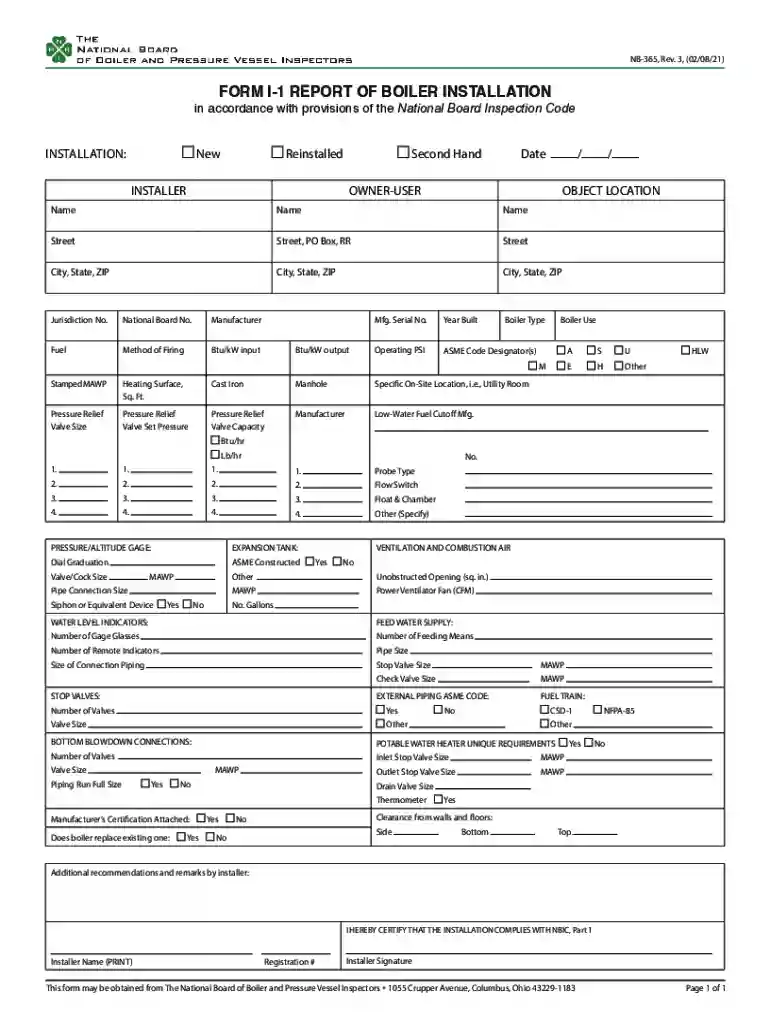
The primary form related to this code is the boiler installation report (FORM I-1). This form captures essential details regarding the installation, such as installer and owner information, specifications, and compliance certifications. In certain cases, additional forms related to state-specific requirements or alternative installation practices may be necessary to ensure comprehensive documentation.

Penalties for Non-Compliance

Violating the NBIC, Part 1, or failing to meet its requirements can lead to significant legal repercussions. These might include monetary fines, operational restrictions, or suspensions of licenses. Recurrent non-compliance can damage reputations and result in long-term operational limitations. Preventative measures, such as regular training and updates on the latest code amendments, can mitigate these risks.

Examples of Using the National Board Inspection Code, Part 1, Installation - CT

Consider a manufacturing plant that installs a new boiler to enhance production capacity. By adhering to the NBIC standards, the plant ensures the installation is safe, minimizing risks of accidents. Similarly, a hospital installing a pressure vessel for an oxygen supply system must comply with the NBIC to ensure patient safety. These examples underscore the importance of the code in diverse operational settings.

See more National Board Inspection Code, Part 1, Installation - CT versions

We've got more versions of the National Board Inspection Code, Part 1, Installation - CT form. Select the right National Board Inspection Code, Part 1, Installation - CT version from the list and start editing it straight away!
Versions Form popularity Fillable & printable
2021 4.4 Satisfied (45 Votes)
2015 4.5 Satisfied (57 Votes)
2010 4 Satisfied (34 Votes)
be ready to get more

Complete this form in 5 minutes or less

Get form

Got questions?

We have answers to the most popular questions from our customers. If you can't find an answer to your question, please contact us.
Contact us
It is the purpose of the National Board Inspection Code (NBIC) to maintain the integrity of pressure-retaining items by providing rules for post-construction activities including installation, and by providing rules for post-installation activities including inspections, repairs, and alterations, thereby ensuring the
NBBI training is accredited by the International Association for Continuing Education and Training (IACET). The NBIC is an internationally recognized standard that governs and maintains rules for the installation, inspection, repair, and alteration of inservice pressure equipment.
National Board (NB) Registration: The NB Registration is a certification mark issued by the National Board of Boiler and Pressure Vessel Inspectors. It indicates that a company has been authorized to use the R stamp and has undergone inspection and audit by the National Board.
Part 1, Installation This Part provides requirements and guidance to ensure all types of pressure-retaining items are installed and function properly. Installation includes meeting specific safety criteria for construction, materials, design, supports, safety devices, operation, testing, and maintenance.
The NBIC is intended to provide rules, information, and guidance to manufacturers, Jurisdictions, inspectors, owner-users, installers, contractors, and other individuals and organizations performing or involved in post-construction activities, thereby encouraging the uniform administration of rules pertaining to

Security and compliance

At DocHub, your data security is our priority. We follow HIPAA, SOC2, GDPR, and other standards, so you can work on your documents with confidence.

Learn more
ccpa2
pci-dss
gdpr-compliance
hipaa
soc-compliance
be ready to get more

Complete this form in 5 minutes or less

Get form