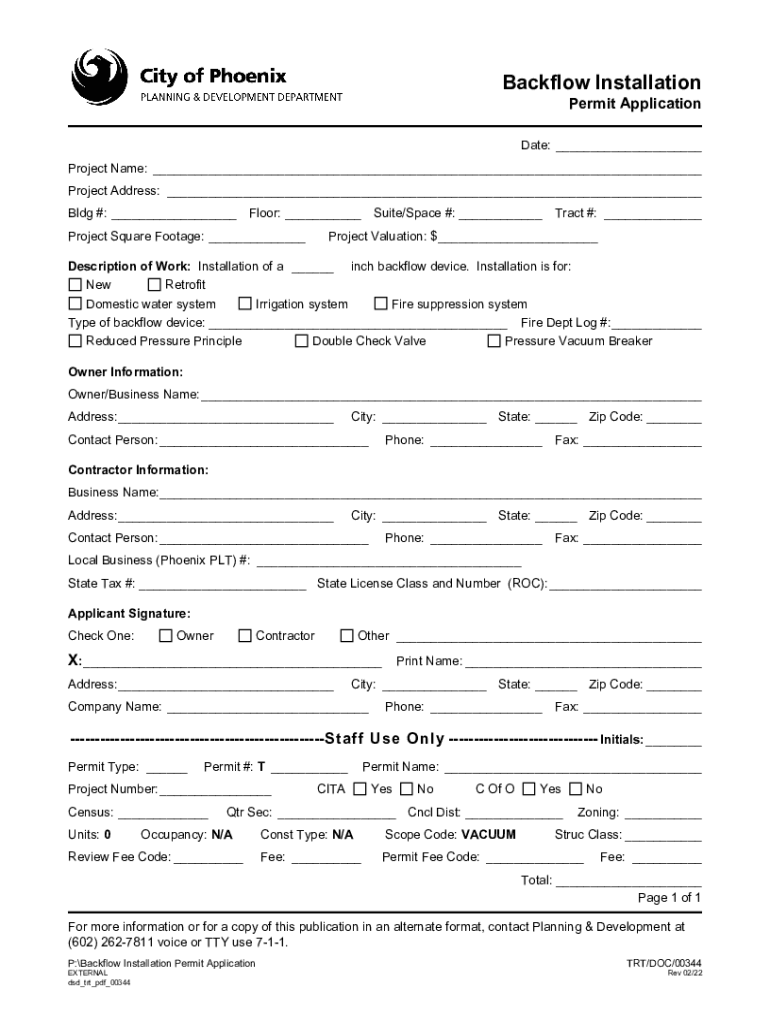
Backflow Installation OTC Application doc 2026

Get Form
Backflow Installation OTC Application doc Preview on Page 1

Here's how it works

01. Edit your form online
Type text, add images, blackout confidential details, add comments, highlights and more.
02. Sign it in a few clicks
Draw your signature, type it, upload its image, or use your mobile device as a signature pad.
03. Share your form with others
Send it via email, link, or fax. You can also download it, export it or print it out.

How to use or fill out Backflow Installation OTC Application doc with our platform

Form edit decoration
9.5
Ease of Setup
DocHub User Ratings on G2
9.0
Ease of Use
DocHub User Ratings on G2
  1. Click ‘Get Form’ to open the Backflow Installation OTC Application in the editor.
  2. Begin by entering the date at the top of the form. This is essential for tracking your application.
  3. Fill in the Project Name and Project Address fields accurately, ensuring all details are correct for processing.
  4. Complete the Building Number, Floor, Suite/Space Number, Tract Number, and Project Square Footage sections as applicable.
  5. In the Project Valuation field, enter the estimated cost of your project. Provide a brief Description of Work detailing the installation specifics.
  6. Select whether this installation is for a New or Retrofit system and specify if it’s for Domestic water, Irrigation, or Fire suppression systems.
  7. Indicate the type of backflow device being installed and provide any necessary Fire Department Log numbers.
  8. Fill out Owner Information including name, address, contact person, and phone number. Repeat this process for Contractor Information.
  9. Choose your role (Owner, Contractor, Other) and provide your signature along with printed name and contact details.

Start filling out your Backflow Installation OTC Application today using our platform for free!

See more Backflow Installation OTC Application doc versions

We've got more versions of the Backflow Installation OTC Application doc form. Select the right Backflow Installation OTC Application doc version from the list and start editing it straight away!
Versions Form popularity Fillable & printable
2022 4.1 Satisfied (22 Votes)
2013 4.2 Satisfied (29 Votes)
be ready to get more

Complete this form in 5 minutes or less

Get form

Got questions?

We have answers to the most popular questions from our customers. If you can't find an answer to your question, please contact us.
Contact us
The required records for backflow prevention devices are visual inspection records and inspection and service records, which help ensure compliance with health regulations. Other records like correspondence with the manufacturer and employee lists are generally not necessary.
RPs installed outside must be protected from freezing, must be installed a minimum distance of twelve (12) inches above the ground, and no higher than four (4) foot above ground. Landscaping is allowed around the backflow preventer, but must not interfere with the required testing, and/or repair.
An RP is a mechanical backflow preventer that consists of two independently acting, spring-loaded check valves with a hydraulically operating, mechanically independent, spring-loaded pressure differential relief valve between the check valves and below the first check valve.
Test Results: The relief valve must read 2 psid or greater. If the reading is 2 psid or higher, make certain the buffer between #1 check valve and relief valve is 3 psid or greater for backflow to pass.
The cost to a backflow preventer typically ranges from $130 to $1,200, with many homeowners averaging around $300. This investment ensures that your water system complies with local regulations and prevents potential health hazards.

Security and compliance

At DocHub, your data security is our priority. We follow HIPAA, SOC2, GDPR, and other standards, so you can work on your documents with confidence.

Learn more
ccpa2
pci-dss
gdpr-compliance
hipaa
soc-compliance
be ready to get more

Complete this form in 5 minutes or less

Get form

People also ask

Backflow assemblies most commonly installed on residential irrigation systems are the double check valve assembly (DCVA) and the pressure vacuum breaker assembly (PVBA). The DCVA may be installed in a vault below finished grade. The PVBA must be installed at least 12 inches above finished grade.
Installation Guidelines: A reduced pressure assembly must be installed so that the relief valve port is at least twelve inches above finished grade. The critical level (C/L) of the valve shall be the bottom of the valve body unless otherwise indicated and must allow test equipment clearance.
A minimum of 12 inches of clear space shall be maintained above the assembly to allow for servicing check valves and for operation of shut-off valves. A minimum of 30 inches of clear space shall be maintained between the front side of the device and the nearest wall or obstruction.

Related links